A Critical Review of Current Heavy Haul Safety Standards
Freedom Heavy Haul can offer expedited Pickup and Delivery for any size shipment anywhere in the USA. Contact us today for No Hassle, No Pressure Pricing.
Heavy haul safety standards are the real-world rules and operating habits that keep oversize/overweight freight, the public, and the crew safe from the moment a load is planned to the moment it’s delivered. They’re not “just paperwork.” They’re a chain of decisions, route selection, permits, equipment choice, securement, inspections, driving limits, and communication, that must stay solid under pressure. In this review, you’ll see what today’s standards get right, where they fail in the real world, and how a professional carrier can turn “compliance” into predictable, incident-free moves.
What “Safety Standards” actually include (and why people misunderstand them)
Most people imagine safety standards as a checklist. In practice, standards are a system:
- Federal operating rules (driver conduct, maintenance expectations, hours-of-service, cargo securement principles).
- State permit and routing controls (escorts, curfews, bridge limits, lane restrictions, temporary closures).
- Enforcement expectations (roadside inspections, out-of-service triggers, documentation readiness).
- Industry best practice (route surveys, lift plans, tie-down strategy, communication protocols).
Standards work best when they are treated as a workflow, not a one-time form submission.
What current standards do well
1) They force planning before movement
Modern rules push you toward planning: permits, escort requirements, route considerations, and documentation. The best operators go further and make route planning a repeatable system, similar to what we break down in advanced route optimization methods, so “surprises” become rare.
2) They prioritize securement as a primary safety control
Cargo securement is still one of the strongest parts of the safety framework because it’s tangible and enforceable. When standards are followed properly, they reduce the most obvious high-risk event: load shift. The problem is not that standards are weak, it’s that many crews treat them as minimums instead of engineering a securement approach for that specific cargo. That’s exactly why modern securement strategies matter for oversized freight.
3) They encourage maintenance and inspection discipline
Heavy haul lives or dies by mechanical reliability. Standards generally support this with expectations around inspections and maintenance records. But the “paper” side often lags behind real-world stressors, especially when equipment runs in extreme climates, so a climate-aware approach like maintenance for extreme temperatures becomes a safety standard in practice, even when it’s not treated as one.
Where the standards fall short in real-world heavy haul
1) The standards are consistent, but the environment isn’t
Rules assume the road is “normal.” Heavy haul rarely is. Work zones change daily. Weather reshapes risk hourly. A route that was safe at 6 AM can become dangerous at 3 PM because of wind, smoke, low visibility, or detours.
This is why operators who build “seasonal safety playbooks” outperform those who just comply:
- wildfire visibility, closures, and evacuation flow: wildfire season safety planning
- traction, braking distance, and chain-up realities: winter road readiness
2) “Minimum compliance” doesn’t equal “safe”
Standards often describe the minimum acceptable method. But heavy haul needs a margin, extra securement confidence, extra route clearance confidence, extra communication discipline, because the consequence of failure is so high.
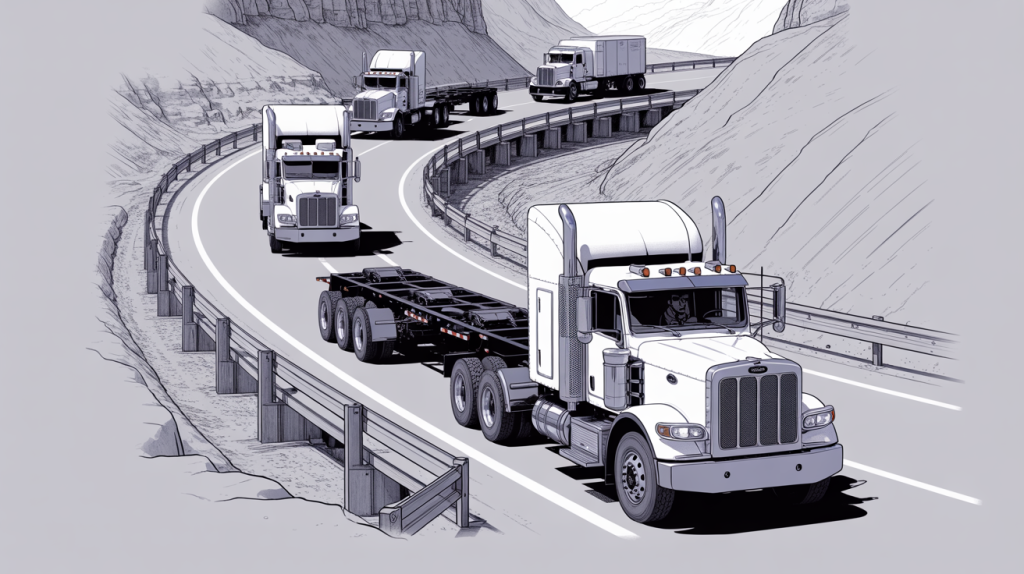
A practical way to build that margin is to treat compliance as the baseline, then apply a project-level risk process like risk management for heavy haul projects to catch what checklists miss.
3) Documentation can become a distraction
Standards require documents. That’s fair. The issue is when crews become document-focused instead of risk-focused. A clean binder doesn’t prevent a strike on an overhead line. A permit doesn’t prevent a load shift. Documents help only when they reflect a plan that was actually thought through.
If you want to keep documentation useful, it should behave like a “decision record” for the move, not a pile of pages.
The 5 safety pillars that separate “compliant” from “trusted”
Pillar A: Securement built around the cargo, not the trailer
Tie-down strategy should be cargo-driven. Weight distribution, center of gravity, friction surfaces, and movement points should determine the plan. If you’re moving big iron, start with flatbed securement best practices and then scale up the method for oversized dimensions.
Pillar B: Route certainty (clearances, bridges, and “human reality”)
A safe route is more than height and weight. It includes:
- turn geometry
- shoulder conditions
- traffic patterns and peak times
- emergency pull-off options
- communication handoffs for escorts
The more complex the move, the more valuable it becomes to simulate “what happens if” scenarios. That’s where simulation-based planning can prevent expensive mistakes.
Pillar C: Risk management that lives throughout the move
Risk management is not a meeting you do once. It’s a living process: before dispatch, at staging, after the first hour on the road, and before every major choke point.
Pillar D: Seasonal safety planning (standards rarely go far enough)
Standards are general; seasons are specific. Build weather-trigger rules:
- “If winds exceed X, we stop.”
- “If smoke reduces visibility below Y, we stage.”
- “If freeze-thaw risk exists, we re-check braking and traction plan.”
Pillar E: Continuous improvement (the missing “standard”)
This is the piece most competitors don’t do well: collecting what went wrong (and what nearly went wrong) and turning it into a better process. For a deeper critique of where the industry is strong, and where it’s still behind, keep a dedicated internal review process aligned with ongoing safety standards review (yes, even revisiting this topic periodically).
What this means for customers (not just search engines)
Customers don’t buy “compliance.” They buy predictability.
When safety standards are implemented as a system:
- the move is less likely to be delayed
- cargo is less likely to be damaged
- job sites get fewer disruptions
- the entire project timeline becomes calmer
That is why strong safety content supports both trust and conversions, and it’s also why the main safety hub page should connect everything in one place, like a safety management and compliance pillar that ties planning, securement, and seasonal risk into one clear framework.
Conclusion
Current heavy haul safety standards provide a solid foundation, especially around securement discipline, inspection habits, and planning requirements. But heavy haul projects succeed when a carrier goes beyond minimums and builds a safety system that matches the real world, changing routes, changing weather, changing risks, and changing jobsite demands. When the standards are treated as a living workflow instead of a checkbox exercise, the result is simple and powerful: safer moves, fewer surprises, and more trust from the people paying for the transport.