Calculating Axle Weight Distribution for Heavy Loads (Simple Method + Real-World Checks)
Freedom Heavy Haul can offer expedited Pickup and Delivery for any size shipment anywhere in the USA. Contact us today for No Hassle, No Pressure Pricing.
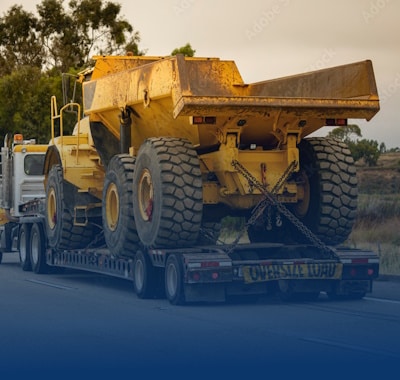
Axle weight distribution is the practical math behind a safe heavy haul. It answers one question that matters more than the total load number: how much weight is each axle group actually carrying once the cargo is placed on the trailer.
Accurate axle weight distribution is essential for permits, bridge compliance, braking performance, and road safety in heavy haul operations.
What axle weight distribution really means
When you set a machine or component on a trailer, the weight doesn’t “spread evenly” by default.
Weight distribution depends on:
- where the cargo’s center of gravity sits
- how far axle groups are from that center
- how stiff the suspension is and how it equalizes load
- whether the trailer is level and properly aired
- how the tractor’s fifth wheel position affects the system
Instead of treating the load as a single number, treat it as a balance system where distance from axle groups controls force distribution.
The simplest way to understand it: a balance beam model
Think of the trailer like a long plank with support points (axle groups). If the cargo sits closer to one support point, that support point carries more weight.
This is why moving a load even 6–12 inches can change axle readings in a meaningful way, especially on heavy pieces with high center-of-gravity weight.
That’s also why trailer choice matters. A trailer built for flexibility and positioning helps you optimize distribution, which connects directly with choosing the right trailer for your heavy haul needs.
What you’re trying to accomplish
Your distribution plan should aim for three outcomes:
- Legal axle group weights for the states and routes involved
- Stable handling under braking, curves, and crosswinds
- Bridge-friendly load footprint so the route stays viable
If you ignore the third one, you might pass axle group limits and still run into route restrictions. That’s where bridge engineering considerations for heavy haul becomes relevant.
The practical field method most teams use
This does not need to be overly theoretical; most teams use a repeatable field method:
Step 1: Identify axle groups
Before loading, define the groups you’ll measure:
- steer axle
- drive axles
- trailer axle group(s)
If you are using a specialized multi-axle setup, review how those groupings behave because axle configurations and load optimization affects the whole plan.
Step 2: Know the cargo center of gravity points
For equipment like dozers, excavators, transformers, or large components, confirm:
- where the center of gravity is located (front-heavy or rear-heavy)
- whether attachments shift that center (buckets, booms, counterweights)
If you guess here, everything downstream becomes unreliable.
Step 3: Choose a starting placement (your “baseline”)
Place the load in a reasonable starting position based on experience:
- keep it low and centered where possible
- align it so the trailer remains balanced left-to-right
- avoid placements that force extreme pin weight or extreme rear loading
Then you test reality.
Step 4: Scale it (the truth step)
This is where distribution planning becomes measurable reality.
Use a certified scale or portable axle scales and record:
- steer weight
- drives weight
- trailer group weight(s)
Now you have the actual axle distribution.
Step 5: Adjust placement using a controlled move
If one group is overweight:
- move the load away from that group
- move it toward the underweight group
- re-scale and confirm
Small adjustments matter, so treat it like a series of controlled changes rather than random shifting.
This is also where route constraints come back into play. A distribution fix that requires moving the load backward might create clearance issues later, which is why it’s smart to align your plan with low-clearance planning for oversized loads.
A simple “distance rule” that helps teams think clearly
Without using complicated formulas, here’s the mental model:
- Moving the load forward increases steer and drive weights and usually reduces trailer group loading.
- Moving the load backward increases trailer group loading and usually reduces steer and drive loading.
That single idea helps you predict what will happen before you make changes.
When bridge concerns change the axle plan
Some loads are not limited by axle group weight as much as they are limited by bridge behavior and spacing.
If your move involves older bridges or sensitive infrastructure, you may need:
- spread axle arrangements
- additional axles for footprint
- stricter placement rules to meet route approvals
This is a route-planning problem, not just a loading problem, which connects naturally to heavy haul route planning.
Real-world checks before you roll
Once weights look good, do these quick checks:
- Trailer level: a tilted trailer can shift weight unexpectedly
- Tire and suspension readiness: unequal pressures change load distribution
- Securement: a load can’t be “perfectly distributed” if it isn’t firmly held
- Turning behavior: distribution affects stability in curves and off-ramps
Securement is its own discipline, and if the cargo is oversized or irregular, you’ll want to align distribution planning with modern securement strategies for oversized cargo.
Common mistakes that cause axle distribution failures
- assuming the equipment’s weight is evenly balanced
- skipping the first scale reading (then you’re blind)
- moving the load too much at once and losing control of the adjustments
- optimizing for axle limits but ignoring bridge footprint and route restrictions
- forgetting that attachment weight changes everything
Conclusion
Axle weight distribution turns heavy haul planning from assumption-based to measurable, compliant, and stable transport execution. When you identify axle groups, confirm the cargo center of gravity, place the load with intent, then validate with real scale readings, you gain control over permits, route viability, and road safety. A heavy load can only travel smoothly when the weight sits where the trailer system can carry it correctly, and that is exactly what axle distribution planning makes possible.