Heavy Haul Equipment & Trailers: Engineering Oversized Transport
Freedom Heavy Haul can offer expedited Pickup and Delivery for any size shipment anywhere in the USA. Contact us today for No Hassle, No Pressure Pricing.
Heavy haul transport is not just “a bigger truck doing a bigger job.” It’s a planned engineering move where the trailer, the axle setup, and the route constraints must fit together like parts of the same machine. When those parts match, the haul is stable, legal, and predictable. When they don’t, even a short trip can turn into delays, re-permitting, and safety risks.
This article explains how heavy haul equipment and trailers work together, what really determines the right setup, and how to think about dimensional cargo in a way that protects the load, the road, and the schedule.
Why equipment selection is the foundation of a successful heavy haul
A heavy haul plan starts with the load, but it succeeds because of the setup.
The trailer choice affects:
- how high the cargo sits from the road
- how weight spreads across axles
- how well the load handles turns, grades, and braking
- how much flexibility you have when routes get tight
If you want a simple starting framework, begin with choosing a trailer that matches your cargo and route instead of choosing a trailer based on what looks “common.”
The three questions that decide the right trailer setup
1) What is the cargo “shape problem”?
Some cargo is heavy, some cargo is long, some is tall, and some is all three. Each one creates a different trailer requirement.
When the cargo is wide, tall, or unusually shaped, you’ll usually need <a href=”/specialized-trailers-for-dimensional-cargo/”>trailers designed for dimensional freight</a> to keep height controlled and stability reasonable.
2) What is the cargo “weight problem”?
Weight changes everything, especially how the load must be supported and distributed.
Your plan becomes much stronger when you understand how axle layouts affect load performance, because “more axles” is not always the same as “better control.” The goal is balanced loading, predictable handling, and permit-friendly distribution.
3) What is the route “constraint problem”?
A trailer that works perfectly on paper can fail in the real world because routes have limits:
- overhead wires
- bridges with posted limits
- tight turns and roundabouts
- construction zones and detours
That’s why many heavy haul decisions are actually route decisions. If clearance is the main issue, review how oversized loads safely manage low-clearance hazards before locking the trailer plan.
Specialized heavy haul trailers and what they’re built to solve
The term “specialized trailer” is often used loosely, but it usually means the trailer is designed to solve a specific problem:
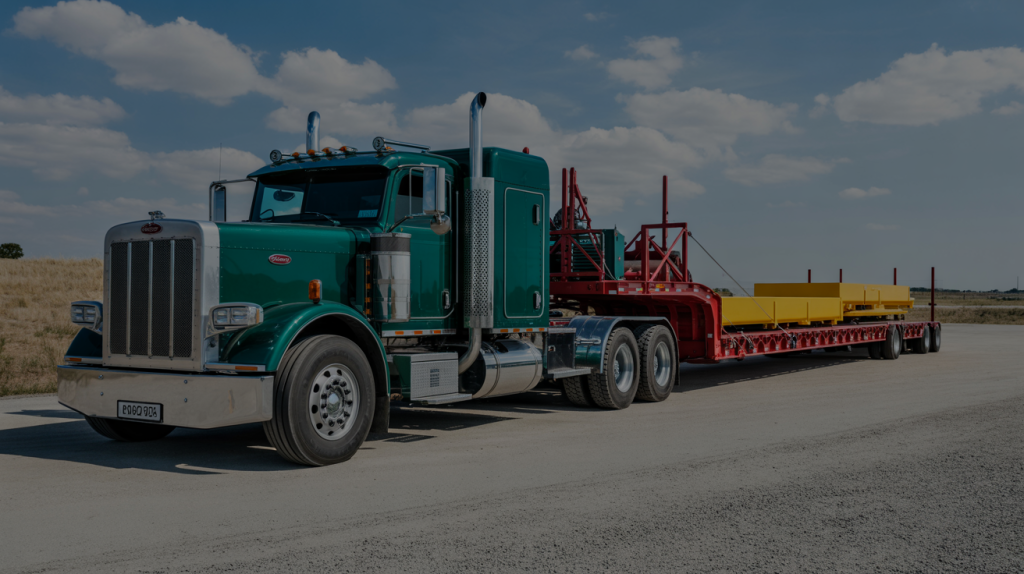
- reduce overall height
- handle extreme weight
- support long or flexible cargo
- improve turning behavior
- allow better loading and unloading
A helpful overview is how specialized trailers are used in real heavy haul projects, because it connects trailer selection to actual transport conditions, not just general descriptions.
Specialized hauling equipment and the “support system” around the trailer
Heavy haul work rarely succeeds with only a truck and trailer. Many moves require supporting equipment or additional tools to control the load and reduce risk, such as:
- rigging and lifting coordination
- securement systems matched to cargo type
- load-leveling tools
- escort coordination and communications
If you want to build a complete picture of what’s involved, this breakdown of specialized hauling equipment helps clarify what supports the trailer and why it matters.
Axles: the quiet factor that decides legality and control
Trailers carry weight, but axles decide whether weight is manageable and acceptable.
Axles influence:
- road and bridge compliance
- tire and suspension stress
- turning behavior
- stability under braking
- whether the load “feels calm” or “feels risky” on the road
A practical way to strengthen your planning is to use axle weight distribution calculations as part of the early planning process, before permits get locked and before dispatch timing becomes difficult to change.
Bridge considerations: where planning becomes real engineering
When loads get large enough, bridges stop being background details and become a central planning factor. Many issues show up here:
- bridge weight limits and enforcement routes
- posted restrictions vs. structural realities
- axle spacing impacts on bridge loading
- detours that add mileage, time, and cost
If your moves touch sensitive infrastructure, bridge engineering considerations for heavy haul is the place to deepen planning, especially when routing options are limited.
Putting it together: a simple equipment-first planning flow
Here’s a clean sequence that keeps planning logical:
- Define cargo realities (weight, dimensions, lifting points, sensitivity).
- Identify the route constraints (clearances, bridges, tight turns, construction).
- Select the trailer type that solves the biggest constraint first.
- Choose axle configuration that spreads weight correctly and handles turns safely.
- Confirm equipment support needs (loading, securement, escorts, staging).
- Validate the plan against real-world limitations (not just maps).
This flow keeps the job grounded. It also makes your planning easier to explain to customers, because it shows a calm, professional method, not guesswork.
Conclusion
Heavy haul equipment planning is engineering in motion. The trailer is not just a platform, it’s a control system for height, weight, stability, and route compliance. When you match trailer type, axle setup, and route constraints early, the haul becomes safer, smoother, and far more predictable. The strongest heavy haul operations don’t just “haul big loads.” They design the move, using the right trailers, the right equipment, and a plan that respects real-world limits.