Heavy Haul Safety Management: Building Control Into Every Oversized Move
Freedom Heavy Haul can offer expedited Pickup and Delivery for any size shipment anywhere in the USA. Contact us today for No Hassle, No Pressure Pricing.
Heavy haul safety management is the structured way oversized transport risks are identified, controlled, and reduced before a load ever moves. In heavy haul trucking, safety is not a checklist item or a single inspection. It is the system that connects planning, equipment, people, and decision-making into one controlled operation.
When safety is managed properly, heavy haul transport stops feeling reactive. Routes are chosen with intent. Loads remain stable. Delays are anticipated instead of discovered. Most importantly, drivers, infrastructure, and the public remain protected throughout the move.
This page defines how modern heavy haul safety actually works, beyond basic compliance, and why the most reliable carriers treat safety as an operational framework, not a rulebook.
Why Safety in Heavy Haul Requires a System, Not Just Rules
Oversized and overweight loads amplify every variable on the road. Weight increases braking distance. Height introduces overhead risk. Width affects traffic flow. Length changes turning behavior. Because these forces interact, safety cannot rely on isolated decisions.
A system-based approach ensures that:
- route choices match load behavior
- equipment configuration supports stability
- securement prevents movement under stress
- timing reduces exposure to traffic and weather
- decision authority exists when conditions change
This is the difference between “allowed to move” and “safe to move.”
Load Securement as the First Safety Anchor
Every safety system starts with load control. A load that shifts, flexes, or rotates introduces instability no matter how well the route was planned.

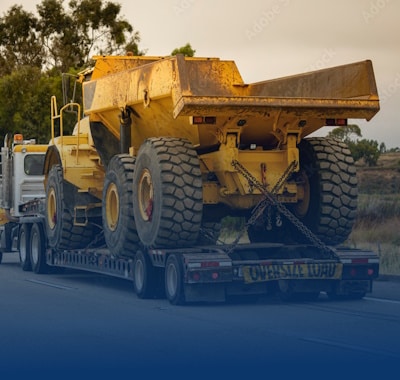
Effective safety management begins by applying best practices for securing heavy equipment on flatbed trailers, where tie-down angles, anchor ratings, blocking, and re-check intervals are treated as engineering decisions rather than habits.
As loads grow larger or more complex, many carriers move beyond standard methods and adopt advanced load securement strategies for oversized cargo, especially when equipment geometry or center of gravity creates unusual force patterns.
Securement is not about strength alone. It is about predictability.
Route Planning as a Safety Discipline
In heavy haul transport, route planning is a safety function before it is a logistics function. A route that technically “works” can still be unsafe if it leaves no margin for error.
Advanced teams go beyond basic mapping and apply advanced techniques in heavy haul route optimization, evaluating bridge behavior, roadway geometry, clearance consistency, traffic interaction, and recovery options along the corridor.
This approach transforms the route from a path into a controlled environment.
Risk Management Happens Before the Truck Moves
Risk in heavy haul is rarely random. Most failures trace back to unaddressed assumptions, about weight, clearance, weather, traffic, or timing.
That is why mature operations focus on structured risk management strategies for heavy haul projects,
identifying where things could go wrong and neutralizing those points early.
Risk management in this context means:
- defining go / no-go thresholds
- assigning authority to stop a move
- planning contingencies, not improvisation
- documenting decisions before execution
When risk is managed intentionally, surprises become rare.
Safety Standards Must Be Understood, Not Memorized
Regulatory standards exist to protect infrastructure and lives, but they are often misused as checklists rather than frameworks. True safety leadership comes from understanding why standards exist and how they apply to real-world loads.
A strong safety culture benefits from a critical review of current heavy haul safety standards, ensuring that compliance supports safety rather than replacing judgment.
This mindset prevents rule-following from becoming blind execution.
Environmental Conditions Are Safety Variables
Weather and environmental conditions do not create risk, they expose it.
Heavy haul trucking safety during wildfire season requires its own planning logic around air quality, road closures, and emergency access.
In colder regions, traction, braking response, and equipment behavior change dramatically. Proactive carriers prepare through preparing heavy haul trucks for winter road conditions, adapting speed, routing, and inspection routines accordingly.
At the other extreme, heat creates stress on tires, brakes, and hydraulics. This is where heavy haul equipment maintenance for extreme temperatures
Environmental awareness is operational awareness.
Using Simulation to Reduce Real-World Risk
As projects grow more complex, many carriers now test safety before execution. Digital modeling allows teams to evaluate turns, axle loading, clearance interaction, and convoy movement without real-world exposure.
This is why simulation-based planning in heavy haul projects is becoming a key tool for identifying failure points before they appear on public roads.
Simulation does not replace experience, it multiplies it.
Safety Culture Is Built on Decision Authority
No safety system works if drivers and crews feel pressured to proceed when conditions are unsafe. Strong safety management gives authority to pause, reassess, and adapt without penalty.
This culture depends on:
- realistic schedules
- clear communication channels
- documented decision rules
- leadership support for cautious choices
Safety becomes consistent when good decisions are supported, not questioned.
Why Safety-First Content Builds Real Authority
From a search perspective, comprehensive safety coverage signals topical completeness. From a customer perspective, it reduces uncertainty.
Construction companies, equipment owners, and project managers do not only want transport, they want confidence. When a site explains heavy haul safety as a connected system, it demonstrates competence without selling.
That combination is what builds long-term trust.
Conclusion: Safety Is the Structure That Holds Heavy Haul Together
Heavy haul safety management is not a department or a checklist. It is the structure that keeps oversized transport controlled, predictable, and professional. When securement, routing, risk planning, standards awareness, environmental readiness, and decision authority work together, safety stops being reactive and becomes routine.
A carrier that explains heavy haul safety completely does more than meet expectations, it sets them. And in modern search and real-world decision-making alike, completeness is what separates true authority from surface-level competition.