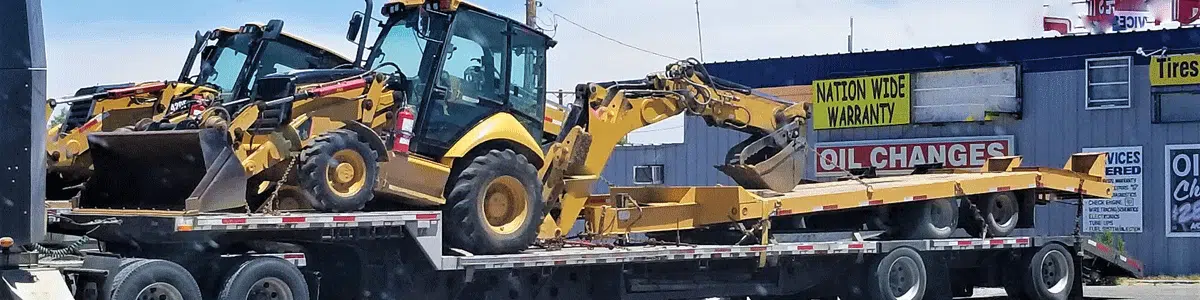
Heavy haul trucking costs vary significantly based on the size and weight of your equipment, the distance, the type of trailer required, and permit requirements along your route. On average, heavy haul transport costs between $5 and $15 per mile, but loads that require specialized equipment, multi-state permits, or escort vehicles can run $20 to $30+ per mile.
This guide breaks down every factor that affects your quote so you know what to expect — and how to avoid overpaying.
Distance is the single biggest driver of your total cost. Here’s a general range for common haul distances:
| Distance | Estimated Cost Range | Notes |
|---|---|---|
| Under 100 miles | $500 – $2,500 | Short hauls often have minimum charges |
| 100 – 500 miles | $1,500 – $7,500 | Most regional hauls fall in this range |
| 500 – 1,000 miles | $4,000 – $15,000 | Multi-state permitting adds cost |
| 1,000 – 2,000 miles | $8,000 – $25,000 | Cross-country; 4–7 permits typical |
| 2,000+ miles | $15,000 – $40,000+ | Superloads, full permit packages |
Note: These are estimates only. Your exact cost depends on the factors below. Request a free quote for an accurate number on your specific load.
Legal weight limits vary by state but are generally set at 80,000 lbs for standard loads. The moment you exceed that threshold, you’re in oversize/overweight territory and permits become required. The heavier your load, the more permits you need — and the more route restrictions apply.
Wide, tall, and long loads all create complications. Legal limits (which vary by state) are generally:
Loads that are both overweight AND oversized are the most complex to permit and route — and typically the most expensive per mile.
The trailer type needed for your load has a direct impact on cost. Specialized equipment costs more to operate and is in higher demand:
| Trailer Type | Typical Use Case | Cost Impact |
|---|---|---|
| Flatbed | Standard freight, steel, lumber, machinery | Base rate |
| Step Deck / Drop Deck | Taller freight that can’t go on a flatbed | +10–20% |
| Lowboy | Heavy equipment: excavators, bulldozers, cranes | +20–40% |
| RGN (Removable Gooseneck) | Equipment that drives on/off the trailer | +25–45% |
| Double Drop / Stretch RGN | Extra-long or extra-tall equipment | +40–70% |
| Multi-Axle Configurations | Super heavy loads; distributes axle weight | +50–100%+ |
Every state you cross requires a separate oversize/overweight permit. Permit fees vary by state, load configuration, and processing speed:
A coast-to-coast haul crossing 10 states can easily generate $500–$2,000 in permit fees alone. Freedom Heavy Haul handles all permit research, applications, and coordination as part of your quote.
Wide or long loads require pilot cars (also called escort vehicles) to travel ahead and/or behind the load. Requirements are state-mandated and vary by load width and length:
Each escort vehicle typically costs $1.50 – $3.00 per mile for independent providers. For a 1,000-mile haul with two escorts, that’s $3,000 – $6,000 in escort costs alone.
Some routes are more complicated — and more expensive — than others. Factors that drive up route costs include:
Fuel represents a significant portion of any long-haul rate. Most heavy haul carriers apply a fuel surcharge based on current DOE diesel prices. When diesel is high, expect surcharges of 30–40% above base rates. Fuel surcharges are typically quoted as part of your all-in rate with Freedom Heavy Haul — there are no surprise add-ons after your quote is confirmed.
Here’s a rough breakdown of typical costs for common equipment categories:
| Equipment Type | Typical Weight Range | Cost Per Mile (Est.) |
|---|---|---|
| Excavators (20–50 ton) | 40,000 – 100,000 lbs | $7 – $14/mile |
| Bulldozers / Dozers | 30,000 – 150,000 lbs | $6 – $18/mile |
| Cranes (mobile) | 50,000 – 200,000+ lbs | $10 – $25/mile |
| Construction Modular / Buildings | 40,000 – 200,000 lbs | $8 – $20/mile |
| Oil & Gas Equipment (tanks, vessels) | 50,000 – 300,000+ lbs | $10 – $30/mile |
| Mining Equipment | 80,000 – 500,000+ lbs | $12 – $35/mile |
| Agricultural Equipment (combines) | 30,000 – 70,000 lbs | $5 – $12/mile |
| Wind Turbine Components | Varies widely | $15 – $40/mile |
These are estimates based on typical load profiles. Actual quotes depend on exact measurements, route, and current market conditions.
When you get a quote from Freedom Heavy Haul, your all-in price includes:
There are no hidden fees. If something changes after your quote is confirmed (new permit requirements discovered, route change needed), we communicate that before proceeding — not after delivery.
To give you the most accurate price, we need a few key details:
The more detail you provide, the faster and more accurate your quote will be. Vague requests (“I have a big piece of equipment I need moved”) take more time to price than specific requests with measurements and addresses.
For standard loads, quotes are typically ready within 2–4 hours. Superloads or loads requiring route surveys may take 24–48 hours. Emergency or expedited moves can be quoted faster — call (866) 305-6018 for urgent requests.
There’s no official minimum, but heavy haul trailers and permits make the most economic sense for loads over 45,000 lbs or over legal dimensions. Lighter or smaller loads are often better served by standard flatbed or step deck transport.
Yes. Fuel prices fluctuate throughout the year and are the main driver of seasonal rate changes. Spring is typically the busiest period for construction and agriculture moves, which can push rates slightly higher. Winter weather in northern states can add cost for ice roads, delays, and route changes.
Yes — we can give you a rough ballpark based on equipment type and general weight class. But for a firm, bindable quote, we need actual dimensions. If your equipment hasn’t been measured, we can often work from manufacturer specs or model numbers.
Yes. All Freedom Heavy Haul shipments are fully insured under our cargo and liability coverage. You receive a certificate of insurance before your load ships.
The best way to know what your haul will cost is to talk to us directly. Our team can assess your load, pull permit requirements for your route, and give you a firm all-in number — usually within hours.
Request a Free Quote or call us at (866) 305-6018. No obligation, no pressure — just an accurate number you can plan around.