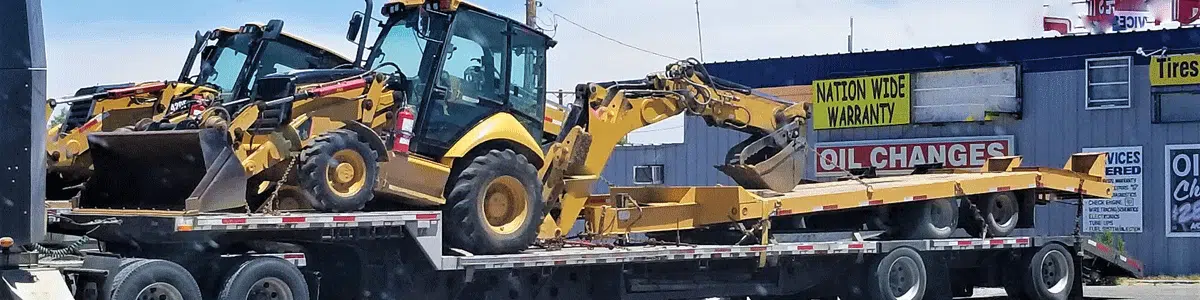
Freedom Heavy Haul provides full-service heavy haul trucking and oversize load transport throughout Hawaii. All heavy equipment entering Hawaii arrives by ship, requiring coordination between ocean freight and ground transport on each island. Hawaii’s unique road network and strict weight restrictions make permitting expertise essential for every oversize move. Whether you’re moving a single piece of construction equipment or coordinating a complex multi-load industrial project, our team handles everything from equipment selection to permit processing to final delivery.
Freedom Heavy Haul operates a full fleet of specialized transport trailers in Hawaii, including lowboy trailers for construction and mining equipment, RGN (removable gooseneck) trailers for tall machinery requiring drive-on loading, step deck and double drop trailers for moderately oversized freight, flatbed trailers for standard heavy cargo, and multi-axle platforms for superloads up to 500+ tons.
We move construction, utility infrastructure, tourism development, port-based logistics equipment across Hawaii, with in-house permit handling for every state line crossed. Our dispatch team operates 24/7, and we provide free route surveys for any load requiring bridge analysis or height restriction planning. Common equipment we transport in Hawaii includes excavators, cranes, bulldozers, combines, tractors, drilling rigs, generators, transformers, pressure vessels, and oversized industrial machinery of all types.
Every move is coordinated by an experienced logistics team familiar with Hawaii’s road network, seasonal weight restrictions, and permit requirements. We also arrange pilot cars and law enforcement escorts where required — all included in your quote.
In Hawaii, any load exceeding the following thresholds requires a permit from the Hawaii Department of Transportation (HDOT):
Permits must be obtained before the load moves. Standard permits in Hawaii typically take 24-72 hours to process. Superloads may require engineering studies, route surveys, and 2-4 weeks of advance planning. Freedom Heavy Haul’s permit specialists handle all applications, fees, and compliance coordination on your behalf.
Travel restrictions in Hawaii may include daylight-only movement windows, holiday blackout periods, and seasonal weight restrictions during spring thaw. Our team stays current on all Hawaii DOT rules and will plan your move around any applicable restrictions.
Freedom Heavy Haul serves the full range of industries requiring heavy equipment transport in Hawaii, with a particular focus on construction, utility infrastructure, tourism development, port-based logistics. We understand the specific equipment, timing constraints, and regulatory requirements for each sector and tailor our transport planning accordingly.
Our Hawaii customers include general contractors, mining operators, agricultural producers, oil and gas operators, utility companies, equipment dealers, and industrial manufacturers. If your business moves heavy equipment in Hawaii, we have the trailers, permits, and expertise to do it right.
Ready to move heavy equipment in Hawaii? Call Freedom Heavy Haul at (866) 305-6018 for a free quote, or fill out our online quote request form. Tell us your load dimensions, weight, origin, and destination, and our team will respond quickly with a detailed transport plan and competitive rate.
We serve all major cities and regions in Hawaii, including Honolulu, Hilo, Kailua-Kona, Maui, and everywhere in between. No job is too big or too remote — contact us today.
Freedom Heavy Haul serves every corner of Hawaii, with particular experience on the state’s primary freight corridors: H-1 (Lunalilo Freeway) and H-2/H-3 on Oahu are the primary heavy haul corridors, Saddle Road (Daniel K. Inouye Highway) on the Big Island connecting Hilo to Kailua-Kona, Queen Ka’ahumanu Highway (Hwy-19) on the Big Island, and the Honoapiilani Highway (Hwy-30) on Maui. Whether your move originates in Honolulu or a remote industrial facility, our route planners know the approved oversize corridors, weight-restricted bridge crossings, and permit timing requirements specific to Hawaii’s road network.
We serve all major cities and population centers in Hawaii, including Honolulu, Hilo, Kailua, Kapolei, Pearl City, Waimalu, and Mililani, as well as rural areas, mine sites, farm operations, and industrial facilities throughout the state.
Hawaii’s economy generates significant demand for heavy equipment transport across multiple sectors: construction (Honolulu’s Oahu continues significant commercial and residential development — cranes, excavators, and concrete equipment are in constant demand on the island), military (US Pacific Fleet and US Army Pacific Command headquarters generate defense equipment transport — JBPHH, Schofield Barracks, Marine Corps Base Hawaii), tourism infrastructure (resort construction and renovation on all major islands), agriculture (Maui’s pineapple and coffee operations, Big Island macadamia nut and coffee production), and renewable energy (Hawaii has aggressive renewable energy mandates — wind, solar, and geothermal equipment moves are ongoing on Oahu and the Big Island). Our team has direct experience with the equipment types, timing constraints, and regulatory requirements across all of these sectors.
Issuing Authority: Hawaii Department of Transportation (HDOT)
Hawaii’s heavy haul environment is unique — all equipment must arrive by ocean freight (barge or container ship), and the road network on each island is independent. HDOT issues island-specific permits. Oahu’s H-1 freeway has strict dimensional limits due to its urban nature and numerous bridge structures. Inter-island equipment moves require maritime coordination as well as land transport permits on both the departure and arrival islands.
Hawaii restricts oversize movement on H-1 and major Oahu roads during peak hours. Island-specific restrictions vary — Maui and the Big Island have fewer peak-hour restrictions but have more severe geographic constraints (active lava zones on the Big Island, Haleakala summit road restrictions on Maui).
Hawaii moves require maritime logistics expertise as well as ground transport coordination. Our team manages the full transport chain — from the mainland port of origin through ocean freight to the receiving island, including HDOT permits, harbor access coordination, and final delivery to the job site. This end-to-end capability is rare among heavy haul carriers.
Freedom Heavy Haul serves every corner of Hawaii, with particular experience on the state’s primary freight corridors: H-1 (Lunalilo Freeway) and H-2/H-3 on Oahu are the primary heavy haul corridors, Saddle Road (Daniel K. Inouye Highway) on the Big Island connecting Hilo to Kailua-Kona, Queen Ka’ahumanu Highway (Hwy-19) on the Big Island, and the Honoapiilani Highway (Hwy-30) on Maui. Whether your move originates in Honolulu or a remote industrial facility, our route planners know the approved oversize corridors, weight-restricted bridge crossings, and permit timing requirements specific to Hawaii’s road network.
We serve all major cities and population centers in Hawaii, including Honolulu, Hilo, Kailua, Kapolei, Pearl City, Waimalu, and Mililani, as well as rural areas, mine sites, farm operations, and industrial facilities throughout the state.
Hawaii’s economy generates significant demand for heavy equipment transport across multiple sectors: construction (Honolulu’s Oahu continues significant commercial and residential development — cranes, excavators, and concrete equipment are in constant demand on the island), military (US Pacific Fleet and US Army Pacific Command headquarters generate defense equipment transport — JBPHH, Schofield Barracks, Marine Corps Base Hawaii), tourism infrastructure (resort construction and renovation on all major islands), agriculture (Maui’s pineapple and coffee operations, Big Island macadamia nut and coffee production), and renewable energy (Hawaii has aggressive renewable energy mandates — wind, solar, and geothermal equipment moves are ongoing on Oahu and the Big Island). Our team has direct experience with the equipment types, timing constraints, and regulatory requirements across all of these sectors.
Issuing Authority: Hawaii Department of Transportation (HDOT)
Hawaii’s heavy haul environment is unique — all equipment must arrive by ocean freight (barge or container ship), and the road network on each island is independent. HDOT issues island-specific permits. Oahu’s H-1 freeway has strict dimensional limits due to its urban nature and numerous bridge structures. Inter-island equipment moves require maritime coordination as well as land transport permits on both the departure and arrival islands.
Hawaii restricts oversize movement on H-1 and major Oahu roads during peak hours. Island-specific restrictions vary — Maui and the Big Island have fewer peak-hour restrictions but have more severe geographic constraints (active lava zones on the Big Island, Haleakala summit road restrictions on Maui).
Hawaii moves require maritime logistics expertise as well as ground transport coordination. Our team manages the full transport chain — from the mainland port of origin through ocean freight to the receiving island, including HDOT permits, harbor access coordination, and final delivery to the job site. This end-to-end capability is rare among heavy haul carriers.
We transport all categories of oversize and overweight equipment in Hawaii, including construction machinery (excavators, cranes, bulldozers), agricultural equipment (combines, planters, tractors), industrial machinery, oil and gas equipment, mining equipment, and specialty cargo.
Yes. Any load exceeding 8’6″ wide, 13’6″ tall, or 80,000 lbs gross vehicle weight requires an oversize or overweight permit in Hawaii. Permits are issued by the Hawaii Department of Transportation (HDOT). Freedom Heavy Haul handles all permitting in-house.
Rates depend on load dimensions, total weight, distance, number of permits required, and whether pilot cars or law enforcement escorts are needed. Contact Freedom Heavy Haul at (866) 305-6018 for a free, accurate quote tailored to your specific load and route.
For standard oversize loads in Hawaii, 3-7 business days of notice is typical. For superloads (150,000+ lbs or 16+ feet wide), plan for 2-4 weeks lead time. Expedited service is available when timing is critical.
Yes. We coordinate all pilot car and escort requirements for Hawaii, including front and rear pilot vehicles, law enforcement coordination when required, and utility line lifts as needed. All escort services are arranged by our team.