Innovative Load Securement Strategies for Oversized Cargo
Freedom Heavy Haul can offer expedited Pickup and Delivery for any size shipment anywhere in the USA. Contact us today for No Hassle, No Pressure Pricing.
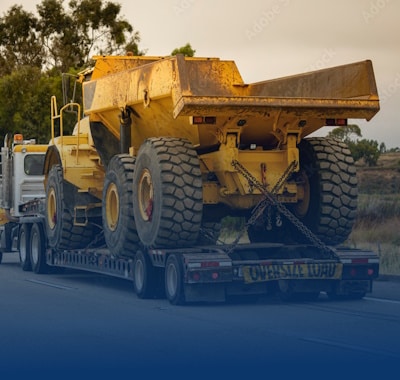
Oversized cargo securement isn’t “more chains.” It’s engineering control: you’re designing a system where the cargo geometry, the trailer, and the tie-down forces work together so the load cannot shift under real highway stress. When that system is done right, the trip feels calm, no creeping movement, no mystery slack, no surprises at the first hard brake.
This article sits inside your broader heavy haul safety management plan, because “innovative” securement is really about one thing: reducing risk while keeping the setup repeatable and inspectable.
A quick “audit break” of the usual securement pattern
Many securement guides follow the same rhythm: confirm weight → pick chains → tie four corners → re-check. That’s useful, but it can miss the real problem with oversized cargo:
Oversized loads often fail in the “in-between” moments, wind gusts, deck flex, road crown, vibration, and torsion, where a standard pattern is technically compliant but practically vulnerable.
So in this article, instead of a step-by-step checklist, we’ll use a strategy menu: pick the strategies that match the cargo’s failure mode.
Strategy 1: Design against the cargo’s “dominant failure mode”
Every load has a favorite way to misbehave. Your job is to identify it early.
- A tall load tends to lean and amplify sway
- A smooth-bottom steel piece tends to slide
- A long load tends to twist and walk
- A multi-part load tends to self-loosen as parts settle differently
When you name the failure mode, your securement becomes targeted and efficient, because each tie-down has a purpose, not just a position.
For a baseline setup on standard machines, the four-corner approach still matters, see flatbed securement basics for heavy equipment, but oversized cargo usually needs a smarter “why” behind the “where.”
Strategy 2: Add anti-slide control before you add more tension
Oversized cargo often has less friction than people think. Smooth steel on a deck can behave like ice once vibration starts.
Innovative anti-slide upgrades include:
- Friction interfaces (approved mats or high-friction surfaces) under contact points
- Positive blocking where allowed (captured blocks that can’t eject)
- Mechanical “capture” thinking: instead of only pulling down, prevent lateral travel with geometry
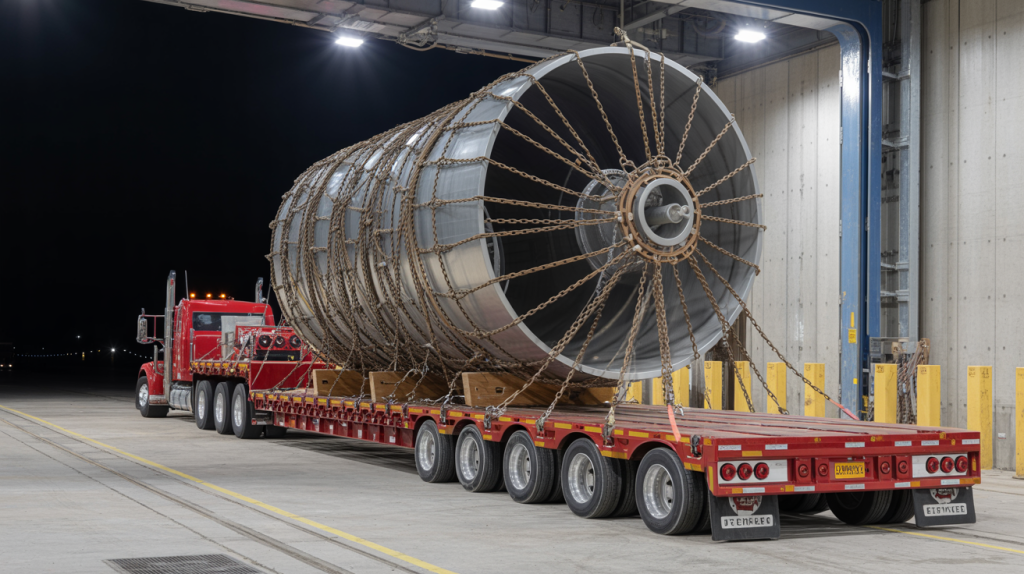
The idea is simple: friction reduces chain workload, and reduced workload reduces loosening and failure risk.
Strategy 3: Use “indirect securement” when direct tie-downs create bad angles
Sometimes the best tie-down point is not reachable, or direct angles create weak vertical force. That’s when indirect methods help:
- Bridles that distribute force across two points instead of one
- Spreader-style routing to avoid crushing edges or side-loading hooks
- Geometry-first angles that generate real down-and-out restraint rather than just sideways pull
When angles improve, the load seats better, and the system stays stable longer, especially in rough-road vibration.
Strategy 4: Stop micro-movement, because micro-movement becomes slack
Here’s the quiet enemy: micro-shift.
A load that moves 2–3 mm per mile will eventually create visible slack, even if it looked perfect at departure. That’s why advanced securement treats vibration like a constant force.
Practical micro-movement controls:
- Prevent metal-on-metal rubbing where possible
- Protect edges so tie-downs don’t slowly “saw” into corners
- Use tie-down paths that don’t change shape under flex
- Keep tensioning hardware positioned to resist vibration back-off
This is also where standard-setting thinking matters. If you’re building a system across many loads and drivers, you’ll benefit from reviewing heavy haul safety standards so your team is consistent, not improvisational.
Strategy 5: Match securement to route forces, not just cargo weight
A lighter oversized load can be more dangerous than a heavier compact load if the route adds stress.
Route stress multipliers include:
- Long downhill braking zones
- Sharp turns and roundabouts
- Crosswind corridors, open plains, bridges
- Rough construction zones and uneven pavement transitions
Securement must anticipate those forces, which is why pairing securement with route optimization techniques isn’t “nice to have”, it directly affects how the load behaves.
Strategy 6: Use simulation to catch failure before it happens
On complex or high-value projects, simulation isn’t about fancy tech, it’s about removing guessing.
Simulation helps you test:
- Where the load wants to rotate during braking and turning
- How the trailer flex changes tie-down angles
- Whether a certain securement plan creates uneven force concentration
- How many re-check intervals you realistically need
That approach connects naturally with simulation in heavy haul project planning, because securement is part of project engineering, not a last-minute yard routine.
Strategy 7: Build a “securement plan” like a risk plan
For oversized cargo, a good securement plan is basically a mini risk plan:
- Define the cargo’s dominant failure mode
- Choose anti-slide and anti-rotation measures
- Select tie-down routing that avoids edge damage and bad angles
- Set inspection intervals based on route stress
- Assign responsibility for re-tension checks and documentation
If you want this to scale across jobs, connect it to risk management strategies for heavy haul projects so securement becomes a repeatable company habit.
Mini playbook: which strategy should you pick?
If the load is smooth and heavy: prioritize friction + blocking before tension
If the load is tall: prioritize anti-lean geometry and balanced lateral restraint
If the load is long: prioritize anti-twist and “walk prevention” controls
If the route is harsh: increase inspection frequency and adjust angles for bounce control
If the cargo is complex/high-value: use simulation + written securement plan
Conclusion
Innovative oversized cargo securement is not about making the trailer look “busy.” It’s about building a stable system where friction, geometry, and force work together so the load cannot gradually shift under real-world road stress. When you identify the cargo’s dominant failure mode, strengthen anti-slide controls, improve angles with smart routing, and align securement with route forces, you get what every heavy haul operation wants: a trip that stays controlled from the first mile to the final escort stop, safely, predictably, and professionally.