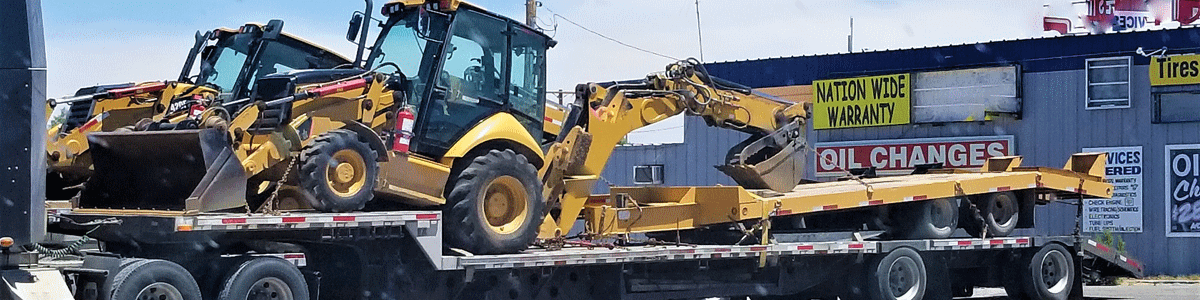
The lowboy trailer is the workhorse of the heavy equipment transport industry. With a deck height of just 18–24 inches off the ground, lowboys provide the clearance headroom needed to legally move tall construction machinery, mining equipment, and industrial loads that would exceed height limits on any other trailer type. Freedom Heavy Haul operates lowboy trailers in all 48 contiguous states, with in-house permit handling for every move.
Lowboy trailers are engineered specifically for oversize, heavy loads that require a low center of gravity and maximum legal height clearance. Key specifications:
Two primary lowboy designs are used in heavy haul: fixed-neck (gooseneck attached) and detachable-neck (hydraulic detach). The detachable-neck design allows the front of the trailer to be lowered to ground level for drive-on loading of rubber-tracked equipment — ideal for excavators and dozers.
Lowboy trailers are the go-to choice for heavy construction and mining equipment, including:
If the equipment has tracks or oversized dimensions that would exceed 13’6″ on a flatbed or step deck, a lowboy is almost always the correct trailer choice.
Choose a lowboy over other trailer types when:
When to choose an RGN over a lowboy: if the equipment is extremely tall and requires the absolute lowest deck height possible (8–18 inches), the removable gooseneck trailer provides even more clearance headroom and easier loading for certain equipment types. For loads that are tall but within standard height limits, a step deck may suffice and cost less.
Most lowboy loads require at least one oversize permit, because the equipment being transported almost always exceeds one or more of the legal thresholds:
Freedom Heavy Haul’s in-house permit team handles all applications, typically processing standard permits in 24–72 hours. Multi-state routes require permits from every state crossed. Pilot car requirements kick in for loads over 12 feet wide (front escort) and 14 feet wide (front and rear). Some states require law enforcement escort for loads over 16 feet wide.
Lowboy transport costs depend on several factors: distance traveled, number of states (and permits) involved, load weight (heavier loads require more axles = higher rates), load dimensions (wider/taller = more escorts = higher cost), fuel surcharges, and seasonal demand. As a general benchmark:
These ranges are estimates only — superloads, extreme widths, and complex routing can significantly increase costs. Call (866) 305-6018 for a free, accurate quote on your specific lowboy move.
Ready to move your load? Call Freedom Heavy Haul at (866) 305-6018 for a free quote, or submit your load details online. We serve all 48 contiguous states with in-house permit handling, route surveys, and 24/7 dispatch. Tell us your load dimensions, weight, origin, and destination — we’ll respond quickly with the right trailer recommendation and a competitive rate.
A lowboy trailer (also called a lowbed) is a specialized flatbed trailer with a very low deck height — typically 18 to 24 inches — designed to transport tall heavy equipment while staying within legal height limits. The low deck gives operators 2-3 feet of extra clearance compared to a standard flatbed.
Standard 2-axle lowboy trailers carry 40,000–48,000 lbs. Adding axles increases capacity: 3-axle lowboys handle up to 60,000 lbs, and multi-axle configurations can handle 80,000–150,000+ lbs. For extreme superloads, modular multi-axle platforms can exceed 500 tons.
Both are low-deck trailers for heavy equipment. The key difference is the gooseneck: an RGN (Removable Gooseneck) has a detachable front that allows the trailer to be rested on the ground for drive-on loading — ideal for tall equipment that can’t be rigged or craned onto a trailer. Lowboys have a fixed or non-removable gooseneck, which requires ramps or a crane for loading.
Usually yes. Most heavy construction equipment loads on a lowboy exceed 8’6″ in width or 80,000 lbs GVW, triggering permit requirements. Pilot car requirements begin at 12 feet wide in most states. Freedom Heavy Haul coordinates all pilot car and escort arrangements as part of your move.
Call Freedom Heavy Haul at (866) 305-6018 or fill out our online quote form. Provide your load dimensions (height, width, length), weight, origin, and destination. Our team responds quickly with a detailed transport plan and competitive rate.