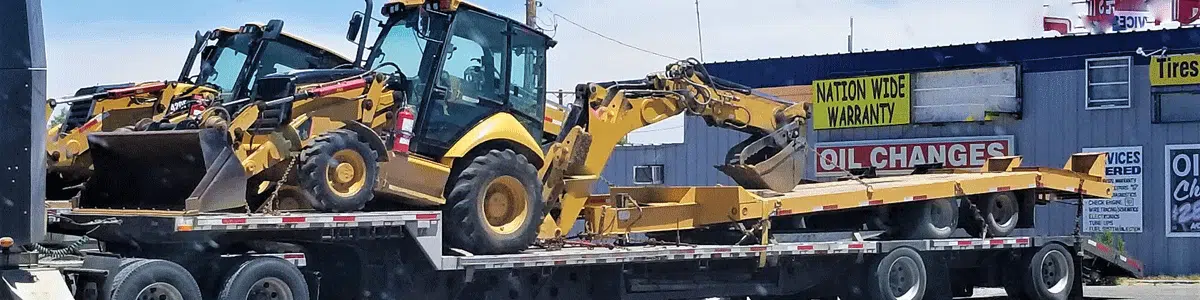
When a load exceeds what any standard trailer can handle — whether by weight, dimensions, or both — multi-axle trailers are the answer. From 7-axle configurations handling 150,000-pound loads to 24-axle platforms moving nuclear components and massive industrial machinery, multi-axle transport represents the pinnacle of heavy haul capability. Freedom Heavy Haul manages multi-axle moves of all complexities in all 48 contiguous states, including full superload routing, engineering studies, and permit management.
Multi-axle trailers come in several configurations, each suited to different weight and dimension requirements:
SPMTs (Self-Propelled Modular Transporters) are the most versatile multi-axle system — hydraulically driven, independently steerable, and configurable in virtually unlimited widths and lengths. They’re used for the largest and most complex industrial moves in the world.
Multi-axle transport is required when loads exceed the capacity or legal limits of conventional trailers:
Multi-axle transport is required when:
Multi-axle moves always require advance planning of 2–6 weeks minimum, full route surveys with bridge analysis, and often law enforcement escort throughout transit. They are significantly more expensive than standard oversize moves — but for loads that require them, there is no alternative.
All multi-axle / superload moves require special permits that go beyond standard oversize or overweight permits:
Freedom Heavy Haul’s permit team manages the entire superload permitting process — from initial route feasibility through final permit issuance in every state along the route.
Multi-axle transport is the most expensive category of heavy haul, reflecting the complexity of permits, engineering, and escort requirements. Cost components typically include:
Multi-axle moves are always custom-quoted. Call (866) 305-6018 to discuss your specific load — we’ll assess feasibility, provide a routing recommendation, and give you a detailed cost estimate.
Ready to move your load? Call Freedom Heavy Haul at (866) 305-6018 for a free quote, or submit your load details online. We serve all 48 contiguous states with in-house permit handling, route surveys, and 24/7 dispatch. Tell us your load dimensions, weight, origin, and destination — we’ll respond quickly with the right trailer recommendation and a competitive rate.
A superload is a load that exceeds the thresholds for standard oversize/overweight permits. While definitions vary by state, superloads typically exceed 150,000 lbs gross vehicle weight, 16 feet in width, 16 feet in height, or 120 feet in total length. Superloads require special permits, engineering studies, route surveys, and law enforcement escort in most states.
With enough axles, theoretically there is no upper limit — SPMT (Self-Propelled Modular Transporter) systems can be configured with dozens of axle lines and have moved loads exceeding 10,000 tons in industrial settings. In practical highway transport, loads of 500–1,000 tons are achievable with proper permitting and engineering. Freedom Heavy Haul has experience with loads up to 500+ tons.
Superload permitting typically takes 2–6 weeks, depending on the states involved and load complexity. The process includes: initial route feasibility (1–3 days), bridge analysis engineering study (1–2 weeks), state permit applications in every state (1–3 weeks), utility coordination (1–2 weeks), and law enforcement scheduling (1 week+). All timelines run in parallel where possible. Freedom Heavy Haul manages the entire process.
SPMT stands for Self-Propelled Modular Transporter. These are hydraulically powered, computer-controlled transport platforms that can be linked in any configuration to create the exact footprint needed for a specific load. Unlike conventional trailers, SPMTs are self-propelled (no truck needed), can move in any direction including sideways and diagonally, and can hydraulically raise and lower to transfer loads. They’re used for the world’s largest industrial moves.
Call Freedom Heavy Haul at (866) 305-6018. For superloads, be prepared to provide: load dimensions (all four: height, width, length, weight), origin and destination addresses, required delivery window, and any known route constraints. We’ll assess feasibility, identify permit requirements, and provide a detailed proposal including timeline and cost estimate.