
When your equipment is too tall or too heavy for a flatbed or step deck, a lowboy trailer is the answer. When that equipment can drive on under its own power, a removable gooseneck (RGN) lowboy makes loading faster and removes the need for a crane. Freedom Heavy Haul arranges RGN and lowboy transport for construction equipment, industrial machinery, and oversized loads across all 48 states, from standard 48-foot lowboys to multi-axle and stretch configurations for the heaviest moves.
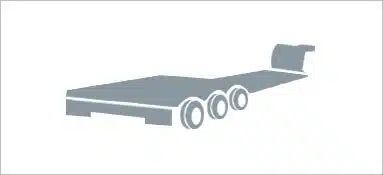
A lowboy trailer (also called a low-bed or double drop trailer) has a deck just 18–24 inches off the road — far lower than a standard flatbed at 48–54 inches. That low deck lets tall equipment move within the 13.5-foot height limit. The “double drop” design drops behind the gooseneck and rises again at the rear, creating the low center well where equipment sits. For a full breakdown, see what a lowboy trailer is.
RGN stands for Removable Gooseneck. The gooseneck — the front section that connects to the truck — detaches and lowers to the ground, creating a ramp. Excavators, bulldozers, wheel loaders, and other self-propelled equipment drive directly onto the deck. Once loaded, the gooseneck reattaches for transport. An RGN is a type of lowboy: “lowboy” describes the low deck, “RGN” describes the loading method.
Our guide to the difference between a lowboy and an RGN covers the tradeoffs in more depth.
See lowboy and RGN trailer dimensions for detailed measurements. For over-length items such as bridge beams, a stretch RGN trailer extends the well.
A lower deck keeps tall equipment legal or close to legal height:
That’s why RGN and lowboy trailers are the default for most tracked equipment — they reduce permit complexity and cost.
Use a lowboy when:
A flatbed or step deck is enough when equipment fits within the 13.5-foot height and 48,000-lb thresholds. When in doubt, call us and we’ll recommend the most cost-effective trailer for your load.
Many lowboy loads require oversize or overweight permits. Whether you need them depends on the loaded dimensions:
Freedom Heavy Haul coordinates permits, routing, and escort requirements as part of our oversized equipment transport and super load hauling services. For what drives the price of a move, see our breakdown of lowboy trucking rates.
Share your equipment dimensions (length, width, height, weight) plus pickup and delivery addresses. We determine the trailer configuration, permit requirements, and routing.
Permits are filed for every state on the route. Timing depends on each state’s permit office, and super loads that need engineering review take longer.
On an RGN, equipment drives on. On a fixed-neck lowboy, loading is done by crane or forklift. The load is inspected and secured before departure.
The load moves on its permitted route, and unloading is coordinated with your crew at delivery.
RGN stands for Removable Gooseneck — a trailer whose front gooseneck section detaches to create a loading ramp.
An RGN is a type of lowboy. “Lowboy” is the broader category of trailers with a low center deck; RGN describes the detachable gooseneck used for drive-on loading. Fixed-neck lowboys share the low deck height but require crane loading.
Standard lowboys handle roughly 40,000–80,000 lbs depending on axle configuration. Multi-axle configurations carry significantly more under permit, and the heaviest super loads may need specialized trailers. Weight capacity is also limited by road and bridge limits on your route.
With an 18–24 inch deck, equipment up to about 11–12 feet tall typically ships without a height permit. Taller equipment can often move with permits, though thresholds vary by state.
No. The gooseneck detaches and creates a drive-on ramp, so your excavator or tracked equipment drives onto the deck under its own power.
A stretch RGN has an extendable well, typically from about 29 feet up to 50 feet or more. It’s used for unusually long equipment, such as bridge components or long-boom machines.
It depends on load dimensions and the states involved. Wide loads commonly require escorts once they pass state width thresholds, and some states require police escorts for super loads. We coordinate escort requirements so you don’t have to arrange them separately.
They’re the same thing. “Double drop” and “lowboy” are used interchangeably for a trailer with a low center deck that drops behind the gooseneck.
Sometimes, depending on total weight and each piece’s dimensions. We’ll advise on feasibility during quoting.
Call (866) 305-6018 or use the quote form on this page. Have your equipment’s make, model, dimensions, and weight ready, along with pickup and delivery addresses.