
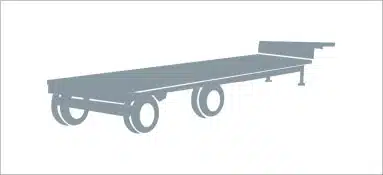
A step deck trailer (also called a drop deck trailer) is the practical choice when your equipment is too tall for a standard flatbed but doesn’t need a lowboy. With an upper deck at flatbed height and a lower main deck roughly 34–36 inches off the ground, step decks carry equipment up to about 10 feet tall at legal height — no height permit in most states. Freedom Heavy Haul arranges step deck transport across all 48 states and coordinates permits for any shipment that exceeds standard dimensions.
A step deck trailer has two deck levels: a short upper deck (at standard flatbed height, about 53 inches) and a longer lower main deck that “steps down” to about 34–36 inches. That two-level design keeps most equipment at a loaded height of 10–11 feet — well below what the same load would reach on a flatbed trailer. A standard step deck allows freight up to 10 ft tall before a permit is needed, and a low-profile step deck allows up to about 10.6 ft.
Need more capacity? A tri-axle step deck trailer adds weight capacity in states that allow it.
Choose a step deck when:
Choose a lowboy when equipment is over 10 feet tall, over 48,000 lbs, or is tracked equipment that benefits from RGN drive-on loading. Our guide to choosing between step deck and lowboy trailers walks through the decision in more detail.
Most step deck loads ship without oversize permits if they’re within standard limits. Permits are required when:
When a load goes beyond those limits, Freedom Heavy Haul coordinates the permits as part of our oversized equipment transport service.
Step deck trailers carry equipment and cargo that is too tall for a standard flatbed (over 8.5 feet) but doesn’t require the low profile of a lowboy. Common uses include compact construction equipment, forklifts, scissor lifts, agricultural equipment, and industrial machinery.
Standard step decks handle 42,000–48,000 lbs of cargo. Tri-axle step decks can carry more in states that allow higher axle weights. For heavier loads, a lowboy with a multi-axle configuration is the right choice.
With a 34–36 inch deck height, equipment up to about 10 feet tall typically stays under the 13.5-foot legal limit. Taller equipment may move with height permits depending on the route and states involved.
Not always. If your load stays within standard limits (8.5 ft wide, 13.5 ft tall, 53 ft long, 80,000 lbs GVW), no permit is required.
They’re the same trailer. “Step deck” and “drop deck” are used interchangeably for the two-level design with an upper and lower deck.
Yes, if the forklift is rated for the equipment weight and the loading area allows a safe approach. Many step decks also carry ramps for wheeled or tracked equipment. Unlike an RGN, a step deck has no detachable gooseneck for front drive-on loading.
Tell us the equipment dimensions (height is most critical) and weight. We’ll confirm whether a step deck works or a lowboy is required. Call (866) 305-6018 for a free assessment.