Preparing Heavy Haul Trucks for Winter Road Conditions
Freedom Heavy Haul can offer expedited Pickup and Delivery for any size shipment anywhere in the USA. Contact us today for No Hassle, No Pressure Pricing.
Winter changes the rules of heavy haul trucking because traction, visibility, braking distance, and mechanical reliability all shift at the same time. A heavy haul truck still does the same job, moving oversized and overweight cargo safely, but cold air, ice, slush, and road chemicals add new failure points that don’t show up in mild weather.
This guide explains how to prepare a heavy haul truck for winter conditions in a practical way, from tire decisions and air systems to lighting, securement, routing, and “stop-or-go” safety triggers. The goal is simple: make winter predictable before it surprises you.
Why winter preparation matters more for heavy haul than standard trucking
A heavy haul move carries extra risk because:
- The load weight increases stopping distance even on dry pavement.
- A wide or tall load becomes a wind sail in gusts and crosswinds.
- Trailer dynamics change on slick surfaces, especially on curves and grades.
- Road closures and chain restrictions can force detours that don’t match permits.
In winter, small mistakes scale up quickly. That’s why winter readiness belongs inside a broader safety system like a complete safety management and compliance approach, where planning and decision-making are treated as part of the operation, not optional extras.
Start with tires and traction like your life depends on it (because it does)
Winter traction is not a “driver skill” problem. It is a rubber-to-road physics problem.
Choose the right tire setup for your region and route
- Use winter-rated or severe-service tires if you operate in persistent snow/ice regions.
- Check tread depth aggressively; winter performance drops fast when tread is low.
- Confirm tire pressure daily because cold temperatures lower PSI and change contact patch behavior.
Carry the tools to regain traction safely
You don’t want to discover you’re missing critical gear on the shoulder in freezing wind.
- approved chains (for tractor and trailer where required)
- chain tensioners and repair links
- traction aids and gloves designed for cold handling
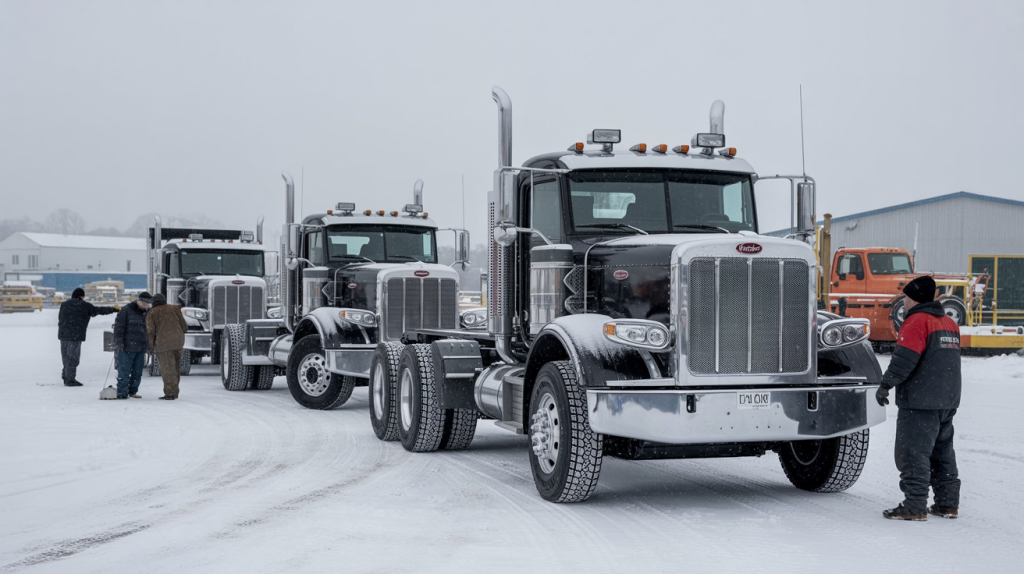
If your winter move includes steep grades or mountain passes, traction planning should be treated like route strategy, not an afterthought. The mindset is similar to what we cover in high-level route optimization methods, where you prepare for constraints before they appear.
Air systems, brakes, and moisture control
Cold weather exposes air and brake issues that might stay hidden in summer.
Air system moisture is a winter hazard
Moisture can freeze in air lines and valves, creating inconsistent brake response.
- Drain air tanks more frequently.
- Confirm air dryer performance and service intervals.
- Watch for slow build times and pressure instability during warm-up.
Brakes need winter realism, not winter hope
Braking changes on ice and packed snow, and heavy haul loads amplify that change.
- Verify brake adjustment and inspect for uneven wear.
- Test brake response early in the day, not after you’re committed to the route.
- Teach the team to treat “normal stopping distance” as a summer concept.
If your operation formalizes risk thresholds (like visibility triggers, grade limits, and traction minimums), you’ll reduce pressure-based decisions later. That’s a core idea in risk planning for heavy haul projects, especially in winter when conditions can change within miles.
Cooling systems, fuel, and cold-start reliability
Winter breakdowns are rarely dramatic. They’re usually preventable.
Engine and cooling readiness
- Confirm coolant is rated for your expected temperatures.
- Inspect hoses, clamps, and belts, cold makes weak parts fail.
- Check block heater function if your trucks stage in very cold locations.
Fuel gelling and contamination prevention
Diesel fuel can gel in low temperatures if not treated properly.
- Use season-appropriate fuel sources when possible.
- Keep tanks fuller to reduce condensation buildup.
- Replace fuel filters proactively before winter peaks.
Extreme cold and extreme heat share one truth: systems fail faster under stress. If you maintain trucks for temperature extremes year-round, the principles in maintenance strategies for harsh temperatures apply directly to winter prep.
Lights, visibility, and “being seen” as a safety system
Winter visibility isn’t only about fog and snowfall. It’s also about road spray, grime, and early darkness.
Lighting check that matches winter reality
- Headlights and auxiliary lights aligned and clean
- marker lights checked across tractor and trailer
- strobes and escort visibility lighting confirmed
Keep lenses clean during the move
Carry cleaner, wipes, and tools to remove salt spray and ice buildup. A light that exists but can’t be seen is not a safety feature.
Securement: winter vibration, freeze-thaw, and tension changes
Securement doesn’t stop being important in winter, it becomes more sensitive.
Cold can change tension behavior, and rough winter surfaces increase vibration.
- Perform early securement checks and then re-check after the first 30–60 minutes.
- Watch edge protection points because winter bounce can cut into straps over time.
- Use reference marks so movement is visible without guesswork.
For practical securement fundamentals, use flatbed securement best practices. If your cargo is oversized or unusually shaped, the advanced thinking in innovative securement strategies helps you plan tie-down geometry that stays stable when the road gets ugly.
Winter routing: plan for closures, chain zones, and safe staging
Winter routing is not only “avoid snow.” It’s about controlling where you might be forced to stop.
Pre-plan staging like it’s part of the permit
- Identify safe pullouts that can fit your trailer length.
- Choose staging points near services, not in dead zones.
- Build a “turn-back plan” if a pass closes.
Use decision triggers before you’re committed
Examples of winter triggers:
- visibility drops below a safe convoy threshold
- ice accumulation starts on key surfaces
- chain requirement activates beyond your operational capability
- winds exceed the stability comfort margin for your load profile
If you want those triggers to be consistent across dispatch, drivers, and escorts, build scenarios in advance using simulation-based project planning. That preparation reduces arguments and hesitation when weather turns.
Driver habits that keep winter moves controlled
Winter safety is not about being “brave.” It’s about being boring and consistent.
- Accelerate smoothly to protect traction.
- Avoid sharp steering inputs that can induce trailer drift.
- Increase following distance beyond normal standards.
- Reduce lane changes and passing decisions in mixed traffic.
- Use escorts as early-warning sensors, not only for traffic control.
If you want a benchmark for what “good safety” looks like industry-wide, the critical lens in a review of heavy haul safety standards helps frame why winter procedures should be written and followed, not improvised.
Quick winter-prep checklist for heavy haul dispatch days
Truck and tractor
- tires inspected, pressures adjusted for cold
- chains onboard, correct size, not damaged
- air tanks drained, air dryer verified
- brakes inspected and tested
- coolant, heater, and cold-start readiness confirmed
- fuel treatment and filters verified
Trailer and load
- lights, markers, and reflectors checked and cleaned
- securement tension checked and re-check plan set
- edge protection and friction points confirmed
- escort communication tested
Route and decision plan
- alternate routes validated for feasibility
- staging points mapped
- chain zones and closure risks reviewed
- stop triggers agreed before departure
Conclusion
Preparing heavy haul trucks for winter road conditions is not a single task, it’s a layered system. Winter affects traction, braking, visibility, equipment reliability, and routing at the same time, so preparation has to be equally complete. When tires and air systems are winter-ready, securement checks are more frequent, routes include staging options, and clear risk triggers exist, winter hauling becomes calmer and safer. The best winter moves feel almost uneventful, and that’s exactly the point.