Gooseneck Trailer Weight Limits: What You Need to Know Before You Haul
Freedom Heavy Haul can offer expedited Pickup and Delivery for any size shipment anywhere in the USA. Contact us today for No Hassle, No Pressure Pricing.
You’ve seen them on highways, hauling everything from excavators to livestock. That distinctive curved neck extending over the truck bed isn’t just for looks—it’s engineering that lets you move serious weight without turning your truck into a swaying disaster.
Here’s what most people get wrong about gooseneck trailers: they focus on the trailer’s capacity and forget about everything else that matters. The truth? Your trailer might handle 30,000 pounds, but if your truck can’t pull it, your hitch can’t hold it, or your brakes can’t stop it, those numbers mean nothing.
Let’s break down what actually matters when you’re moving heavy loads.
Gooseneck Trailer Quick Reference
| Category | Range/Details | Key Facts |
| Weight Capacity | 16,000 – 30,000 lbs GVWR | Standard models average 16,000 lbs; heavy-duty industrial trailers reach 30,000-36,000 lbs |
| Trailer Empty Weight | 4,700 – 10,000 lbs | 30-foot trailer: ~7,500 lbs empty40-foot trailer: ~9,600 lbs empty |
| Typical Load Capacity | 10,000 – 23,000 lbs | Actual cargo capacity = GVWR minus trailer weight |
| Length Options | 20 – 44 feet | Smaller (20-24 ft) for light equipmentLarger (30-44 ft) for construction machinery |
| Truck Requirements | ½-ton to 1-ton+ pickups | Light loads (10K): Half-ton with tow packageHeavy loads (25K+): One-ton diesel with DRW |
| Hitch Ball Size | 2-5/16 inches | Standard size rated for 30,000 lbs |
| Tongue Weight | 15-25% of trailer weight | Heavier than bumper-pull (10-15%) due to over-axle mounting |
| Turning Radius | Tighter than bumper-pull | Approximately 20% better maneuverability in tight spaces |
| CDL Requirement | Often required | Federal law: CDL needed if GVWR exceeds 10,000 lbs with multiple axles |
| Common Uses | Construction, agriculture, transport | Heavy equipment, livestock, vehicles, materials, tiny homes |
| Advantage Over Bumper-Pull | Up to 10,000 lbs more capacity | Better stability, reduced sway, improved weight distribution |
Understanding Gooseneck Trailer Weight Ratings
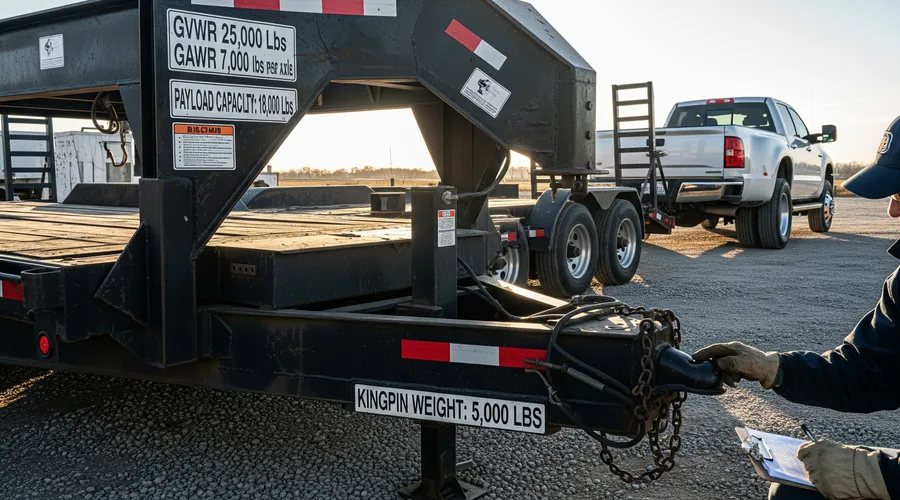
The number stamped on your trailer’s VIN plate isn’t a suggestion. It’s the Gross Vehicle Weight Rating (GVWR)—the absolute maximum your trailer can weigh when loaded, including the trailer itself.
Most gooseneck trailers have a GVWR between 16,000 and 30,000 pounds, but here’s where people mess up: they assume that’s how much cargo they can haul. Wrong.
A 30-foot gooseneck typically weighs around 7,500 pounds empty. If it has a 25,000-pound GVWR, you’ve got roughly 17,500 pounds of actual payload capacity. Load it with 20,000 pounds of equipment, and you’ve just turned your trailer into a liability and broken the law.
Every axle has a weight rating. A trailer with three 7,000-pound axles gives you a 21,000-pound total capacity—assuming the frame, tires, and everything else can handle it. Exceed that, and you’re looking at axle failure, tire blowouts, or worse.
Your tires matter more than you think. They each have load ratings, and if they’re underinflated or mismatched, you’re gambling with a blowout at highway speed. Check them. Every time.
What Can You Actually Haul?
Gooseneck trailers aren’t picky, but they do have strengths. Here’s what they excel at:
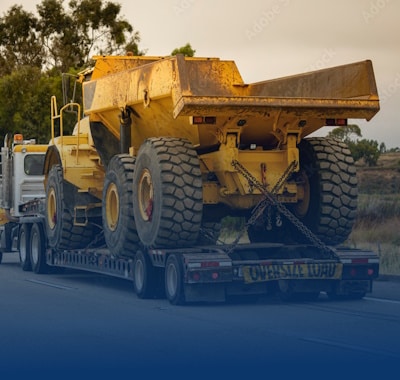
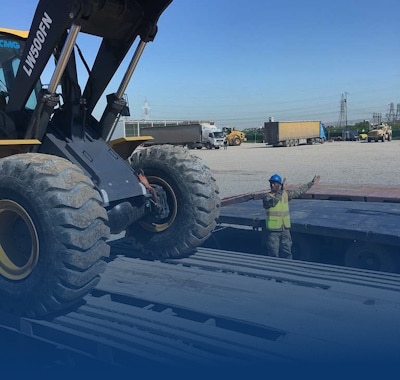
Construction Equipment: Excavators, bulldozers, tractors, and skid steers fit naturally on gooseneck flatbeds. The low-profile deck makes loading easier than fighting with ramps on a bumper-pull.
Livestock Transport: The stable, smooth ride is easier on animals, and you can configure multiple stalls or pens. Horses, cattle, even show animals—gooseneck livestock trailers are built for this.
Vehicle Hauling: Car dealerships and towing companies use gooseneck car haulers because they can stack multiple vehicles or handle heavy trucks and farm equipment without breaking a sweat.
Materials and Cargo: Steel beams, lumber, pallets of supplies—if it’s heavy and needs to get somewhere, a gooseneck flatbed handles it. The 40-foot models with 102-inch width maximize hauling space.
Tiny Homes: Yes, people move entire houses on these. A properly built tiny home on a gooseneck foundation can travel cross-country if your truck can handle the weight.
Gooseneck trailers are commonly used in construction, agriculture, and the oil and gas industries, where you’re moving drilling rigs, pipes, tanks, and other oversized materials to remote locations.
Matching Your Truck to the Trailer
Your truck is the weak link in most setups. People buy a massive trailer, hook it up to whatever they’re driving, and wonder why it drives like garbage.
For Loads Up to 10,000 Pounds: A half-ton pickup (F-150, Silverado 1500, Ram 1500) with a proper towing package can handle this. You’ll want the heaviest tow rating available—usually the crew cab with the longer bed and the most powerful engine option. Maximum towing on these trucks ranges from 12,000 to 14,000 pounds, so you’ve got some headroom.
For Loads Between 10,000-20,000 Pounds: Step up to a three-quarter-ton truck (F-250, Silverado 2500HD, Ram 2500). These trucks offer conventional towing capacities of 20,000 pounds and gooseneck capacities up to 22,500 pounds when properly equipped with the diesel engine and tow packages.
For Loads Between 20,000-30,000 Pounds: One-ton trucks with dual rear wheels (F-350 DRW, Silverado 3500HD DRW, Ram 3500 DRW) are your only real option. The Ford F-350 Super Duty leads the pack with up to 38,000 pounds of gooseneck towing capacity, while the Silverado 3500HD and Ram 3500 can pull 36,000-37,000 pounds when maxed out.
Don’t just look at the towing capacity. Check your Gross Combined Weight Rating (GCWR)—that’s the maximum weight of your truck plus the trailer plus everything in both. Exceed it, and your insurance company will have a field day if something goes wrong.
Four Critical Factors People Ignore
Several factors should be considered when choosing a vehicle to haul a gooseneck trailer, including:
1. Towing Capacity: This is the obvious one, but people still screw it up. Your door jamb sticker lists the maximum your truck can tow. That number assumes you’re not carrying anything else. Add passengers, tools, fuel cans, and a toolbox, and your actual capacity drops.
2. Vehicle Weight: Heavier trucks tow better. A diesel one-ton with dual rear wheels isn’t just more stable—it has the mass to control what’s behind it. Lighter trucks get pushed around.
3. Braking System: Your trailer needs its own brakes, and your truck’s system needs to be strong enough to handle the combined weight. Electric trailer brakes are standard on gooseneck trailers, but your truck needs a brake controller that’s properly calibrated. Skip this, and you’ll find out the hard way when you need to stop fast.
4. Axle Ratio: Lower numerical ratios (like 3.73:1) give you better towing power at the cost of fuel economy. Higher ratios (like 3.21:1) are great for empty highway driving but struggle under load. Most heavy towing setups use 3.73:1 or 4.10:1 ratios.
The Gooseneck Advantage: Why It Matters
The difference between a gooseneck and a bumper-pull isn’t subtle. Gooseneck trailers can tow up to 10,000 pounds more than most bumper-pull trailers, but the real advantage is how they handle.
Bumper-pull trailers attach behind your truck, creating a long lever arm that amplifies every bump and turn. Gooseneck trailers connect over the rear axle, putting the weight where your truck can actually control it. Less sway. Tighter turns. More stability in wind.
The hitch point over the rear axle gives drivers a tighter turning radius, which matters when you’re navigating construction sites, farm gates, or backing into tight loading docks.
You also get bonus storage. That space under the gooseneck neck? Perfect for toolboxes, jacks, straps, or anything else you need within reach.
When to Call the Professionals
Some loads shouldn’t be a DIY project. If you’re moving something that requires permits, pilot cars, route surveys, or special equipment, professional heavy haul trucking companies have the equipment, expertise, and experience to safely transport oversize and overweight cargo.
They know the regulations. They handle the permitting. They plan routes to avoid low bridges, weight-restricted roads, and other obstacles. They carry the insurance that protects you if something goes wrong.
The cost varies based on weight, size, distance, and complexity. Get quotes from multiple companies, but don’t just pick the cheapest—ask about their equipment, insurance, and track record.
What It Costs to Haul Heavy
Heavy haul trucking can be expensive due to the specialized equipment and expertise required to transport oversize and overweight cargo. The price depends on several factors:
- Weight and Size: Heavier, larger loads cost more. Simple math.
- Distance: Cross-country hauls cost more than local moves.
- Route Complexity: Difficult routes with obstacles require more planning and sometimes pilot vehicles.
- Permits and Escorts: Oversize loads need permits. Really big loads need escort vehicles. Both add cost.
Compare multiple quotes, but remember: cheap often means inexperienced. When you’re moving a $200,000 excavator, save money somewhere else.
The Bottom Line
Gooseneck trailers are workhorses. They handle loads that would destroy a bumper-pull and do it with better stability and control. But they’re only as good as the truck pulling them and the person making decisions about weight, distribution, and safety.
Know your trailer’s GVWR. Know your truck’s towing capacity and GCWR. Understand how tongue weight affects both. Check your tires, brakes, and hitch before every trip.
If you’re hauling within limits, maintaining your equipment, and making smart decisions, a gooseneck trailer will serve you for decades. Push it too hard, ignore the numbers, or skip maintenance, and you’re creating a problem that could end badly.
Do it right. The extra five minutes checking weight ratings and tire pressure beats the alternative every single time.
Need expedited pickup and delivery for heavy equipment? Freedom Heavy Haul handles shipments of any size across the USA. No hassle. No pressure. Just straight answers and reliable service. Contact us today for pricing.
Frequently Asked Questions About Gooseneck Trailers
Do I need a CDL to tow a gooseneck trailer?
Federal law requires a CDL if your gooseneck trailer has a GVWR over 10,000 pounds and multiple axles. That covers most gooseneck trailers on the road. Some states have additional requirements, so check your local regulations. If you’re hauling commercially, you’ll almost certainly need one. If you’re using it for personal farm or ranch work, rules vary by state.
Can I pull a gooseneck trailer with a half-ton truck?
Yes, but only smaller trailers. A properly equipped half-ton truck can handle gooseneck trailers up to about 10,000-12,000 pounds total weight. Beyond that, you’re pushing it. The truck might have the rated capacity on paper, but handling, braking, and safety suffer. If you’re regularly hauling heavy loads, step up to a three-quarter-ton or one-ton truck.
What’s the difference between a gooseneck and a fifth-wheel trailer?
Both connect over the rear axle, but fifth-wheel hitches use a kingpin and locking plate system, while gooseneck hitches use a simple ball mount. Fifth-wheels offer slightly better high-speed stability, but gooseneck trailers turn tighter and are easier to hook up. Fifth-wheels are popular for RVs; goosenecks dominate in commercial, agricultural, and construction work.
How do I know if my load is distributed properly?
Your tongue weight should be 15-25% of the total trailer weight. Too light, and the trailer will sway. Too heavy, and you’ll overload your truck’s rear axle. Use a truck scale to weigh your setup if you’re unsure. Load heavy items over the trailer axles, not all the way at the back or front.
Can I use a gooseneck trailer to haul horses or livestock?
Absolutely. Gooseneck livestock trailers are common because the stable ride is easier on animals, and you can configure stalls or pens however you need them. The smooth towing reduces stress on horses during transport. Just make sure your trailer has proper ventilation, non-slip flooring, and enough headroom for the animals you’re hauling.
What regular maintenance does a gooseneck trailer need?
Check tire pressure and tread before every trip. Grease the coupler and ball every few months or after heavy use. Inspect brakes annually. Look for cracks in welds, rust on the frame, and damage to the deck. Replace worn safety chains. Keep electrical connections clean and functional. Neglect maintenance, and small problems become expensive failures.
How do I attach a gooseneck trailer safely?
Park on level ground. Lower your tailgate. Back your truck under the trailer until the ball is directly under the coupler. Lower the coupler onto the ball and lock it. Attach safety chains in an X-pattern under the coupler. Connect the breakaway cable to a secure point on the truck frame, not the hitch. Plug in the electrical connection. Test your lights and brakes before moving.
What are common problems with gooseneck trailers?
Uneven tire wear from imbalanced loads or low pressure. Worn coupler from lack of lubrication. Electrical issues from corroded connections. Cracked welds from overloading or rough roads. Brake failure from skipping maintenance. Most problems come from neglect or overloading. Keep up with maintenance and respect weight limits, and your trailer will last.
Can I store a gooseneck trailer outside?
You can, but it shortens the trailer’s life. Protect the coupler and hitch from weather with a cover. Keep tires inflated to prevent flat spots. Use wheel chocks on level ground. If possible, park under a roof or tarp to prevent rust and sun damage to tires and paint. Outdoor storage works, but covered storage is better.
Is powder coating better than paint on a gooseneck trailer?
Powder coating looks great, but it’s not always better. If it’s not applied over primer, scratches let water underneath, and rust spreads invisibly. Quality paint with proper prep and primer often lasts longer and is easier to repair. If you’re buying powder-coated, ask if it was primed first. If not, expect touch-ups down the road.