

You just bought a riding lawn mower from someone three counties over. Or maybe you’re moving and need to haul your trusty John Deere to the new property. Either way, you’re staring at a 500-pound machine wondering how you’re supposed to get it from point A to point B without destroying your truck bed, your back, or the mower itself.
Here’s what most articles won’t tell you upfront: transporting a riding lawn mower isn’t rocket science, but it’s one of those jobs where doing it wrong can cost you thousands in damage or send you to the ER with a herniated disc.
I’ve watched people try to muscle a 600-pound Cub Cadet into a pickup truck using nothing but determination and poor judgment. Spoiler alert: it didn’t end well. The smart approach? Know your weight limits, prep your machine properly, and use the right equipment for the job.
What You’re Actually Dealing With
Most riding lawn mowers weigh between 400 and 600 pounds. That’s not a typo. Your lightweight rear-engine rider might clock in around 340 pounds, while a standard lawn tractor can push 600 pounds or more. Zero-turn mowers? Those beasts can easily hit 1,000 pounds, and commercial models sometimes exceed 1,500 pounds.
To put that in perspective, you’re moving something that weighs as much as a grand piano or a small motorcycle. The difference is that pianos don’t have exposed blades, fuel tanks, or awkward weight distribution that makes them tip if you look at them wrong.
Quick Weight Reference
| Mower Type | Typical Weight Range | Example Models |
| Rear-Engine Rider | 300-450 lbs | Troy-Bilt TB30R (340 lbs) |
| Standard Riding Mower | 400-600 lbs | John Deere E100 (435 lbs), Craftsman T110 (475 lbs) |
| Lawn Tractor | 470-800 lbs | Husqvarna YTH18542 (490 lbs) |
| Zero-Turn Mower | 600-1,000+ lbs | Cub Cadet 60″ (1,100 lbs) |
| Commercial Units | 800-2,000 lbs | John Deere X950R (1,800+ lbs) |
Add fuel (6.3 pounds per gallon), attachments, and accessories, and you’re looking at even more weight. That full tank of gas you forgot to drain? That’s another 12-18 pounds, plus a serious fire hazard during transport.
The Real Cost of Getting It Wrong
Skip the prep work and you’re gambling with expensive consequences. I’ve seen blade-damaged truck beds, bent deck spindles from improper tie-downs, and cracked engine blocks from mowers that shifted during transport. One guy I know lost $2,000 in repair costs because he didn’t secure his mower properly and it slammed into the cab of his truck at the first hard brake.
Beyond the mower damage, there’s your vehicle to consider. Most standard SUVs and trucks have towing capacities between 3,500 and 7,000 pounds, but that doesn’t mean you should max it out. Your vehicle’s actual capacity depends on the trailer weight plus the mower weight plus any other cargo. Check your owner’s manual before you commit to anything.
Step 1: Prep Your Mower Like Your Money Depends On It (Because It Does)
Transporting a riding lawn mower can be a daunting task, but it is important to prepare the machine for safe transportation. This isn’t optional. Skip these steps and you’re asking for trouble.
Remove the Blades and Attachments
Take off every blade, baggers, mulching kits, and any accessories you’ve added. This does three things: reduces weight, prevents damage to the blades during transport, and eliminates sharp edges that could cut through straps or damage your truck bed.
Store all the hardware in a labeled bag. Trust me on this. Nothing’s worse than arriving at your destination and realizing you have no idea which bolt goes where. Take photos before you disassemble anything.
Drain Every Last Drop of Liquid
Gas, oil, coolant – all of it needs to go. This is a safety issue, not a suggestion. Fuel vapors in an enclosed trailer can ignite. Oil can leak all over your truck bed or trailer deck. Even a small spill makes a mess that takes hours to clean.
Run the engine until it sputters dry, then disconnect the fuel line if you can. Tilt the mower to drain remaining oil (check your manual for the right angle). Some people use a siphon pump for gas, which works but takes longer.
Clean It
Scrape off caked-on grass clippings, dirt, and mud. This helps you spot any existing damage before transport, and it keeps your truck or trailer cleaner. More importantly, you can actually see what you’re doing when you’re securing tie-down straps.
Disconnect the Battery
Remove the battery entirely or disconnect the negative terminal. You don’t want any chance of the mower accidentally starting during transport. Wrap the battery terminals with electrical tape to prevent shorts.
Step 2: Choose Your Transport Method (And Actually Use the Right One)
If your riding lawn mower is lightweight enough, you can potentially tow it with a standard vehicle. But “lightweight enough” is doing a lot of work in that sentence. A 340-pound rear-engine rider? Maybe. A 600-pound lawn tractor? You need a trailer or a truck with a proper ramp system.
Truck Bed Loading
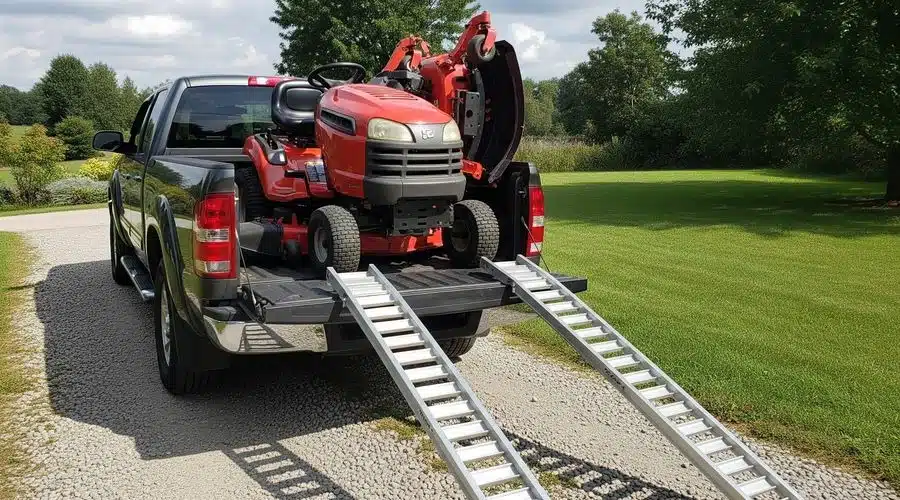
If you have a full-size pickup, you might think you can just drive the mower up into the bed. Stop. Think about this for a second. You need loading ramps rated for at least 1,500 pounds (double your mower’s weight for safety margin), and you need two people minimum.
Here’s the process that won’t kill you:
- Position heavy-duty aluminum ramps at a shallow angle (15-20 degrees maximum)
- Check that the ramps are secured to the truck bed and won’t slip
- Have someone guide you while you slowly drive the mower up
- Never walk alongside the mower while it’s on the ramps
- Use wheel chocks once the mower is in the bed
Most importantly: never attempt to lift a mower weighing over 100 pounds. Back injuries from improper lifting contribute to thousands of emergency room visits annually. Get help or use mechanical assistance.
Trailer Transport
For most people, a trailer is the smart move. A small utility trailer for a lawn mower can handle 300-800 pound mowers easily, and tilt-bed trailers make loading significantly easier because you’re not fighting gravity on a steep ramp.
Flatbed trailers work great for heavier machines. The deck is lower to the ground, which means a gentler loading angle. You can also transport multiple mowers at once if you’re moving equipment for a landscaping business.
When choosing a trailer to haul a lawn mower, check the Gross Vehicle Weight Rating (GVWR). Your mower plus the trailer weight should be well below your vehicle’s towing capacity. Factor in 20% safety margin.
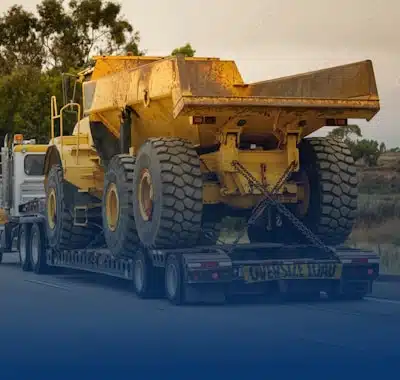
Professional Shipping
Sometimes the smart play is handing it off to a heavy haul trucking company. This makes sense when:
- You’re shipping across states (300+ miles)
- The mower is worth more than $3,000
- You don’t have appropriate towing equipment
- You need insurance coverage for the transport
Shipping costs vary wildly based on distance, mower size, and service type. Expect to pay anywhere from $1.50 to $3.50 per mile for professional lawn mower transport. A 500-mile shipment typically runs $400-800 for open transport, $600-1,200 for enclosed.
That sounds expensive until you compare it to renting a truck and trailer for a long-distance move, paying for fuel, and spending two days on the road. For many people, professional lawn mower shipping is actually cheaper and far less stressful.
Step 3: Secure It Properly (Or Watch It Slide Around Like a Hockey Puck)
This is where most people mess up. They use cheap ratchet straps from the dollar store, crank them down until the mower frame creaks, and wonder why everything shifted during the first sharp turn.
The Right Way to Strap Down Your Mower
Use four heavy-duty ratchet straps rated for at least 1,500 pounds each. Attach them to the mower frame, never to the deck or plastic body panels. The frame is the only part strong enough to handle the tension.
Position the straps at 45-degree angles from each corner of the mower. This creates a net that holds the machine in place from multiple directions. Some people use only two straps front to back – don’t do this. Side-to-side movement will destroy your mower and your truck bed.
Tighten the straps until the mower can’t rock or shift, but don’t overtighten. You’re trying to prevent movement, not crush the frame. Check the straps every 50 miles during transport. Vibration loosens them.
Add wheel chocks for extra security. These are cheap insurance against a strap failure. Position one chock in front of each front wheel and one behind each rear wheel.
What About Towing?
Some lightweight riding mowers can be towed behind a vehicle using a lawn mower towing adapter. This only works for machines under 400 pounds, and you need to follow specific guidelines:
- Remove the mower deck
- Disconnect the drive belt
- Ensure all wheels can roll freely
- Use a proper towing bar, not rope or chain
- Keep speeds under 10 mph
- Only travel short distances (under 5 miles)
Honestly? Towing is usually more trouble than it’s worth. You’re better off using a trailer in most situations.
How Much Does It Actually Cost to Ship a Lawn Mower?
Let’s talk real numbers. If you’re paying someone else to move your riding lawn mower, here’s what you can expect:
Local transport (under 50 miles): $150-$300
Regional shipping (50-300 miles): $300-$600
Cross-country transport: $800-$1,500+
Those prices are for standard open-trailer transport. Enclosed trailer shipping adds 50-80% to the cost but protects your mower from weather and road debris.
Factors that affect lawn mower shipping cost:
- Weight and dimensions: Heavier mowers cost more because they require larger trailers and more fuel
- Distance: Obviously, farther = more expensive
- Accessibility: Rural pickup or delivery points may incur extra fees
- Time of year: Peak moving season (May-September) means higher prices
- Insurance: Add 10-15% for full coverage beyond standard liability
Most reputable shipping companies include tracking, basic insurance, and door-to-door service in their base price. Watch out for companies that quote low then hit you with hidden fees for “fuel surcharge” or “administrative costs.”
When to Call a Pro (And Which Pro to Call)
You should seriously consider hiring a professional hauling company when:
- The mower is too heavy for your equipment (over 600 pounds)
- You’re shipping long distance (200+ miles)
- You don’t have a truck and trailer
- The mower is brand new or particularly valuable
- You physically can’t do the loading/unloading safely
Working with a specialized transport company eliminates most of the headaches. They handle loading, securing, transport, insurance, and unloading. You just coordinate pickup and delivery times.
What to Expect from Professional Lawn Mower Transport
Here’s how the process typically works:
Step 1: Get multiple quotes. Fill out online forms with your mower’s weight, dimensions, pickup location, and delivery destination. You should receive quotes within 24-48 hours.
Be specific about your mower model. “Riding lawn mower” isn’t helpful. “John Deere X350 lawn tractor, 542 pounds, 42-inch deck” gets accurate quotes.
Step 2: Choose your carrier carefully. Don’t automatically go with the cheapest bid. Check reviews, verify insurance coverage, and ask about their experience with lawn mower transport specifically. A company that usually hauls cars might not know the specific requirements for securing lawn equipment.
Step 3: Prepare your mower using the steps I outlined earlier. The transport company will expect the mower to be clean, drained of fluids, with blades removed. Document the condition with photos before the carrier arrives.
Step 4: Be available for pickup and delivery. Most companies offer a delivery window rather than an exact time. Clear your schedule or have someone available to accept the delivery and inspect the mower before signing the delivery receipt.
Step 5: Inspect everything carefully upon delivery. Check for new scratches, dents, or mechanical damage. Report issues immediately while the driver is still there. Once you sign the receipt, proving damage becomes much harder.
The Stuff Nobody Tells You (But Should)
After transporting dozens of lawn mowers over the years, here are the lessons I learned the hard way:
Weather matters: Don’t transport in heavy rain or snow if you can avoid it. Wet conditions make loading dangerous and increase the risk of your mower sliding around despite straps.
Insurance is worth it: If you’re shipping a mower worth more than $1,000, get additional insurance beyond the carrier’s basic coverage. Standard carrier liability usually maxes out at $0.60 per pound, which doesn’t come close to replacement value.
Take photos of everything: Document the mower’s condition before, during, and after transport. These photos are your evidence if something goes wrong.
Know your local regulations: Some states require special permits for towing trailers over certain weights. Don’t assume your regular driver’s license covers everything.
Spring for the enclosed trailer on expensive machines: That extra $300 is nothing compared to replacing a damaged mower deck because someone threw a rock on the highway.
FAQ: The Questions Everyone Actually Asks
Can I transport a riding lawn mower without draining the gas?
No. Legally and practically, this is a terrible idea. Gas vapors are highly flammable, spills damage equipment, and many transport companies will refuse to load a mower with fuel in the tank. Drain it.
How do I transport a riding lawn mower without a trailer?
Your options are limited to: loading it in a full-size pickup truck bed using heavy-duty ramps, hiring a professional transport service, or renting a trailer. Towing the mower directly behind your vehicle only works for very short distances with lightweight machines.
Do I need special equipment to load a riding mower into a truck?
Yes. At minimum you need aluminum loading ramps rated for 1,500+ pounds, wheel chocks, and heavy-duty ratchet straps. You also need at least one other person to help guide the mower during loading.
How much does it cost to ship a lawn mower across the country?
Expect $800-$1,500 for coast-to-coast transport using open trailer service. Enclosed trailers run $1,200-$2,000+. Get quotes from multiple carriers because prices vary significantly.
Can I move a riding lawn mower without starting it?
Yes, but it’s harder. You’ll need to manually push or pull it onto the trailer using ramps and several people. Riding mowers are heavy and awkward to maneuver without power. Some models have a bypass valve that disengages the transmission for easier pushing.
What’s the best trailer for hauling a riding lawn mower?
A tilt-bed utility trailer in the 5×8 or 6×10 size range handles most residential riding mowers. The tilting feature makes loading dramatically easier. Make sure the GVWR exceeds your combined mower and trailer weight by at least 20%.
The Bottom Line
Moving a riding lawn mower comes down to three things: proper preparation, the right equipment, and realistic assessment of what you can handle yourself versus when to call for help.
Don’t be the person who thinks they can muscle a 500-pound machine into a truck bed using a couple of 2x4s as ramps. Don’t skip draining the fluids because “it’s only a short trip.” And definitely don’t use rope from your garage to secure a thousand pounds of steel and sharp blades.
Do the prep work, use appropriate equipment, secure everything properly, and your mower will arrive in the same condition it left. Skip corners and you’re looking at damaged equipment, potential injuries, and a much bigger bill than if you’d done it right the first time.
If you’re moving a mower long distance or dealing with a particularly heavy machine, working with a professional heavy haul trucking company eliminates most of the risk and stress. Sometimes paying someone who does this for a living is the smartest money you’ll spend.