You need to move a 60,000-pound excavator from Texas to Ohio. The first quote comes in at $4,800. The second is $7,200. Same equipment, same distance, wildly different prices. What gives?
Lowboy trucking rates aren’t pulled from thin air. They respond to weight, permits, routes, timing, and a dozen other variables that can swing your final bill by thousands. If you’re planning equipment transport and want to avoid sticker shock, here’s what determines what you’ll pay and how to make sense of competing quotes.
What Lowboy Trucking Actually Means
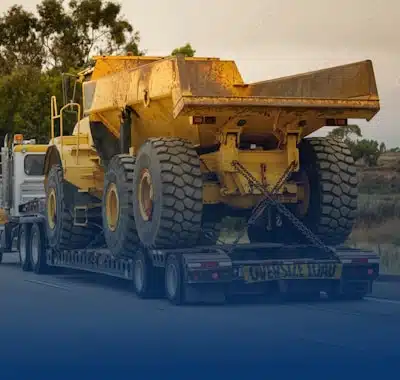
A lowboy trailer sits lower to the ground than standard flatbeds, with the deck tucked between the truck’s rear axles and the trailer’s rear wheels. This design handles tall, heavy loads that would exceed height limits on regular trailers.
The low center of gravity means better stability when hauling construction equipment, agricultural machinery, or industrial assets. You can load excavators, bulldozers, tractors, combines, and cranes without worrying about clearance issues on most highways.
Why Lowboy Trailers Work for Heavy Machinery
Standard flatbeds sit around 60 inches off the ground. Lowboys drop that to 18-24 inches. When you’re moving a piece of equipment that stands 12 feet tall, those extra inches of clearance matter.
Loading becomes simpler too. Equipment can drive directly onto the deck without steep ramps. Operators appreciate this when dealing with expensive machinery where damage during loading eats into profits fast.
The trade-off? Lowboy transport services cost more than standard freight. The trailers themselves run $50,000 to $100,000 new, require specialized training to operate, and demand more careful route planning. Those costs flow through to your quote.
Current Lowboy Hauling Rates: What the Market Shows
Heavy haul rates per mile in 2025 range from $3.00 to $8.00 per mile for standard permitted loads. Legal loads under 80,000 pounds and within standard dimensions run closer to $3.50-$4.50 per mile. Push into oversize territory and rates climb toward $5.00-$8.00 per mile, sometimes higher for super-wide loads.
Here’s where distance plays tricks with pricing. A 100-mile local haul might cost $6.00 per mile because fixed costs (permits, loading time, fuel for positioning) get spread across fewer miles. That same equipment moving 1,000 miles might average $3.50 per mile since those fixed costs dilute over the longer distance.
Sample Lowboy Trucking Rates by Equipment Type
| Equipment | Typical Weight | Distance | Estimated Cost |
| Mini Excavator | 15,000 lbs | 200 miles | $900-$1,200 |
| Bulldozer (D6) | 35,000 lbs | 500 miles | $2,200-$3,000 |
| Tractor (Large Farm) | 22,000 lbs | 300 miles | $1,400-$1,900 |
| Excavator (Mid-Size) | 50,000 lbs | 800 miles | $3,500-$5,000 |
| Crane (Mobile) | 80,000 lbs | 1,000 miles | $5,500-$8,500 |
| Combine Harvester | 45,000 lbs | 600 miles | $2,800-$4,200 |
These numbers assume legal dimensions or minimal oversize permits. Exceed 12 feet wide, 13’6″ tall, or require multi-state permits, and you’re looking at additional costs that can push quotes 30-50% higher.
What Drives Lowboy Transport Costs Up or Down
Load Weight and Axle Configuration
A two-axle lowboy maxes out around 40,000 pounds legally. Push to 60,000 pounds and you need a three-axle setup. Hit 80,000-100,000 pounds and you’re into specialized multi-axle configurations that cost more per mile to operate.
Weight distribution matters as much as total weight. Equipment with uneven weight placement requires more careful securing, potentially additional axles, and sometimes route restrictions that add miles and time.
Dimensions That Trigger Permit Fees
Width beyond 8’6″ needs permits in most states. At 10 feet wide, you’re looking at $100-$300 in permit fees per state. Cross 12 feet and pilot car requirements kick in, adding $1.50-$2.00 per mile for escort services.
Height over 13’6″ starts triggering route surveys to verify clearance under bridges and power lines. These surveys can cost $500-$2,000 depending on distance and complexity. If your load needs bucket truck services to lift overhead lines temporarily, expect another $1,200-$4,000 per occurrence.
Length restrictions vary by state, but trailers extending past 75 feet total (truck plus trailer plus overhang) usually need additional permits and possibly rear escorts.
Route Complexity and Seasonal Restrictions
Moving equipment through urban areas costs more. Cities mean tighter turns, bridge weight limits, restricted travel hours, and sometimes police escorts. A cross-country haul that detours around major metros to avoid these headaches might add 200 miles but save $2,000 in fees and delays.
Winter hauling in northern states adds risk and cost. Snow, ice, and reduced visibility can shut down oversized moves for days. Some carriers charge winter surcharges of 10-15% for moves during December through February.
Harvest season and construction season create demand spikes. Rates for lowboy trucking jump 15-20% during peak agricultural periods (late summer through fall) when combines and tractors flood the transport market.
Fuel Surcharges and Market Fluctuations
Diesel prices directly impact heavy haul freight rates. Most carriers add fuel surcharges calculated weekly based on national diesel averages. When diesel jumps from $3.50 to $4.50 per gallon, expect surcharges to add 8-12% to your base rate.
Market capacity also swings pricing. When construction booms and trailer availability drops, rates climb. During economic slowdowns, excess capacity can push rates down 10-20% as carriers compete for loads.
Hidden Costs That Inflate Your Final Bill
Permits Across Multiple States
Each state charges separately for oversize permits. A load moving from California to New York might cross eight states, each wanting $150-$400 for a single-trip permit. Budget $1,500-$3,000 for permit costs alone on cross-country permitted loads.
Some states sell annual permits for frequent haulers, but these typically run $1,000-$5,000 per state and only make sense if you’re moving 10+ loads annually on similar routes.
Pilot Car and Escort Requirements
Loads 12-14 feet wide need one pilot car front or rear. At 14-16 feet wide, you need both. Beyond 16 feet, add police escorts in most jurisdictions.
Pilot car rates run $1.50-$2.00 per mile. Police escorts cost significantly more—$75-$150 per hour with minimum charges of 4-8 hours even for short moves. A 500-mile haul with dual pilot cars adds $1,500-$2,000. Throw in police escorts and you’re looking at another $1,000-$2,500.
Loading and Unloading Fees
Most quotes assume the shipper handles loading and unloading. Need the carrier to arrange crane services, forklifts, or specialized rigging? That’s extra.
Crane rental for loading runs $200-$800 per hour depending on capacity needed. A complex load requiring rigging specialists can add $1,000-$3,000 to the total cost. Some lowboy transportation companies build these costs into their quotes; others hit you with them as separate line items.
Overnight Parking and Delays
Oversized loads can’t always complete moves in one shot. Travel restrictions (no night moves, no weekend moves in certain areas) mean overnight stops. Secure parking for oversized loads costs $50-$150 per night.
Delays at loading or unloading sites trigger detention charges. Most carriers allow 2-4 hours for loading before charging $75-$150 per hour for additional time. A shipper who isn’t ready when the truck arrives can easily add $500-$1,000 in unexpected charges.
Local vs Long-Distance Equipment Hauling Rates
Short Haul Economics (Under 200 Miles)
Local moves show higher per-mile rates because fixed costs don’t scale. A 50-mile haul might cost $500-$800 total, working out to $10-$16 per mile. The carrier still burns half a day positioning equipment, dealing with paperwork, and completing the move.
On short hauls, you’re paying for the service more than the distance. Equipment hauling rates for local moves often quote as flat fees rather than per-mile calculations.
Long Haul Rate Scaling (500+ Miles)
Once you hit 500+ miles, the per-mile rate drops significantly. A 1,000-mile move averaging $3.50 per mile totals $3,500—far better economics than two 500-mile moves at $4.50 per mile each.
Long-distance lowboy service requires different planning. Multi-day trips mean driver rest requirements, overnight parking, and potential weather delays. Good carriers build buffer time into schedules to avoid rushing equipment through unsafe conditions.
Getting Accurate Quotes: Information Carriers Need
Essential Details for Precise Pricing
Vague requests get vague quotes. You need to provide:
Equipment specifics: Make, model, and year help carriers understand what they’re moving. A 2024 Caterpillar 320 excavator has known dimensions; a “medium excavator” requires guesswork.
Exact weight: Dry weight from manufacturer specs works. Include attachments if they’re staying mounted. A 40,000-pound excavator with a 5,000-pound bucket becomes a 45,000-pound transport problem.
Dimensions: Length, width, and height with any attachments. Measure at the widest and tallest points. An excavator with boom extended might be 14 feet tall; with boom lowered, 11 feet. That difference changes permit requirements.
Pickup and delivery locations: Full addresses, not just cities. A pickup site with tight access, weight-restricted bridges nearby, or difficult terrain affects pricing. Some carriers won’t even quote without seeing site photos.
Timeline: When does the equipment need to move? Rush jobs cost 20-40% more. Flexible timing lets carriers consolidate moves or work around restrictions more efficiently.
Questions to Ask Potential Carriers
Before signing with any heavy haul truck company, verify:
All-in pricing or itemized? Some quotes include permits, escorts, and fuel surcharges. Others list a base rate and add fees later. Get clarity upfront.
Insurance coverage limits: What’s covered if something goes wrong? Most carriers carry $1 million in cargo insurance, but high-value equipment might need supplemental coverage you’ll pay for.
Experience with your equipment type: A carrier who regularly moves excavators understands securement better than one who mainly hauls tractors. Ask for references on similar moves.
Route planning: Who handles permit applications and route surveys? Professional carriers manage this; budget operators might dump it on you.
For more info, check out our guide on heavy haul trucking to understand how experienced carriers handle complex logistics.
Comparing Lowboy Trailer Trucking Companies
What Experience Actually Means
Years in business matters less than successful moves of similar equipment. A company with 20 years hauling agricultural equipment might struggle with industrial machinery they’ve never touched.
Look for carriers with proper DOT licensing, up-to-date insurance, and clean safety records. The FMCSA website lets you check safety ratings, accident history, and compliance records for any carrier with a DOT number.
Reading Between the Lines on Quotes
Suspiciously low quotes usually mean something’s missing. Common tricks include:
Base rate only: Quote shows $3.00 per mile but doesn’t include fuel surcharge, permits, or escorts that add 40% to the final bill.
Brokered loads: Some companies aren’t actual carriers—they broker your load to someone else. Nothing wrong with brokers if they’re transparent, but hidden broker fees inflate costs.
Inadequate insurance: Carrier quotes low because they’re underinsured. You save $500 on the transport but risk tens of thousands if something goes wrong.
Cost vs Service Quality Balance
The cheapest quote rarely delivers the best value. Equipment damage, missed delivery windows, or surprise fees can cost more than paying a premium rate upfront.
At Freedom Heavy Haul, we provide competitive rates while treating customers like family. Our same-day quotes cover everything from loading to delivery—no hidden fees, no surprises. We transport cranes, bulldozers, tractors, combines, and more across the USA, ensuring your equipment arrives safely and on schedule. Get a quote online here or call us at (888) 214-3117.
Understanding Removable Gooseneck (RGN) vs Fixed Neck Pricing
When RGN Trailers Make Sense
Removable gooseneck lowboys detach at the front, letting equipment drive straight onto the deck without ramps. This matters for heavy, low-clearance equipment that can’t handle steep loading angles.
RGN trailers cost more to operate—more maintenance points, heavier empty weight reducing payload capacity, and generally higher trailer purchase prices. Expect RGN rates to run $0.50-$1.00 per mile higher than fixed-neck lowboys for comparable loads.
For loads over 1,000 miles, RGN rates average around $3.00-$4.00 per mile for legal-weight configurations. Specialized RGN setups with additional axles for super-heavy loads push rates toward $5.00-$7.00 per mile.
Fixed Gooseneck Trade-offs
Fixed gooseneck lowboys (FGLs) use fold-down ramps for loading. They’re lighter, simpler to maintain, and cheaper to operate. Rates run $2.50-$3.50 per mile for standard loads.
The catch? Not all equipment can safely load via ramps. Track-driven equipment with high ground pressure might damage ramp mechanisms. Very heavy equipment might exceed ramp weight ratings. Know your equipment’s loading requirements before accepting a fixed-gooseneck quote that you can’t actually use.
Seasonal Rate Fluctuations and Booking Strategy
Peak Season Premium Pricing
Agricultural equipment moves spike during planting season (March-May) and harvest (August-October). Combine and tractor transport demand overwhelms carrier capacity, pushing rates up 20-30%.
Construction equipment follows different patterns. Spring through fall sees heavy demand as projects ramp up. Winter slowdowns in northern states create excess capacity, sometimes offering 15-20% discounts for flexible shippers.
How Far Ahead to Book
Last-minute freight gets hammered with premium charges. Need a lowboy tomorrow? Expect rates 40-60% above normal. Carriers know you’re stuck and price accordingly.
Book 2-4 weeks ahead for standard moves, 4-6 weeks for oversized loads requiring route surveys. High-demand seasons require even longer lead times—8-10 weeks during harvest isn’t unreasonable for agricultural equipment.
Advance booking also lets you negotiate. Carriers filling return trips or positioning equipment offer discounts to avoid deadhead miles. A flexible shipper willing to work around the carrier’s schedule can save 10-20%.
Preparing Equipment for Transport: Avoiding Extra Charges
Pre-Transport Inspection Checklist
Document equipment condition before loading. Take photos showing all sides, note existing damage, check fluid levels, and verify attachments are secure.
Drain fuel tanks to 1/4 full or less. Full tanks add weight and create safety hazards. Diesel weighs about 7 pounds per gallon; a 100-gallon tank adds 700 pounds when full.
Remove or secure loose items. Mirrors, antennas, warning lights—anything that might vibrate loose during transport should be removed or properly secured. Carriers won’t accept liability for items you knew were loose.
Loading Site Requirements
The truck needs solid, level ground to position the trailer. Soft dirt, steep grades, or tight access add complications that might require additional equipment at your expense.
Overhead clearance for loading matters. Lowboys sit low, but the truck towing them doesn’t. Verify you have 14+ feet of clearance for the truck to maneuver during loading.
Schedule loading for when operators and equipment are ready. The truck shows up on time; your operator doesn’t? You’re paying detention charges while everyone waits.
Regulatory Compliance: What Affects Your Quote
State-by-State Permit Variations
California, Texas, and Florida have some of the strictest oversize regulations. Expect higher permit costs and more restrictive routing through these states.
Midwest states generally offer more flexibility for agricultural equipment during harvest season, with expedited permits and relaxed travel restrictions. This can save both time and money during peak demand.
Hours of Operation Restrictions
Many states prohibit oversize moves at night. Some ban weekend travel. Holiday restrictions shut down transport during major holiday periods.
These restrictions extend transport times, potentially adding overnight parking charges and driver costs. A move that could complete in two days might stretch to four when factoring in travel windows.
At Freedom Heavy Haul, we’re here to help you with the complex rules of oversize load transport. We handle route planning, permit applications, and escort coordination so you can focus on your business rather than transportation logistics.
Insurance and Liability: Understanding Coverage
What Standard Cargo Insurance Covers
Most carriers maintain $1 million in cargo insurance covering damage during transport. This typically excludes mechanical failure, pre-existing damage, or damage from improper loading/unloading.
Read the fine print. Some policies exclude certain equipment types, have high deductibles, or limit coverage based on equipment age. A 15-year-old bulldozer might only be covered at depreciated value, not replacement cost.
When Supplemental Coverage Makes Sense
Equipment worth over $100,000 often requires supplemental insurance costing 1-3% of the equipment’s value. A $500,000 crane might need $5,000-$15,000 in additional coverage.
Consider the deductible structure. A $25,000 deductible on a $1 million policy means you’re self-insuring the first $25,000 of any claim. Supplemental policies can lower deductibles to more manageable levels.
Real-World Pricing Examples
Case Study: Regional Construction Equipment Move
A contractor needed a 45,000-pound excavator moved 350 miles from Kansas City to Denver. The equipment measured 11 feet wide and 12 feet tall—just over standard limits.
Base transport rate: $3.75/mile × 350 miles = $1,312.50
Overwidth permit (Kansas): $125
Overwidth permit (Colorado): $150
Single pilot car: $1.75/mile × 350 miles = $612.50
Fuel surcharge (12%): $157.50
Total cost: $2,357.50
The same move during off-peak winter months quoted at $2,100 total—about 11% less due to lower demand and waived fuel surcharges.
Case Study: Cross-Country Agricultural Equipment
A farmer sold a combine harvester weighing 48,000 pounds, measuring 13 feet wide and 13 feet tall. Transport ran from Iowa to North Carolina, roughly 1,100 miles.
Base transport rate: $3.25/mile × 1,100 miles = $3,575
Permits (5 states): $1,200
Dual pilot cars: $2.00/mile × 1,100 miles = $2,200
Route survey fee: $800
Fuel surcharge: $430
Total cost: $8,205
The shipper received quotes ranging from $6,800 to $9,500. The lowest quote excluded pilot cars and permits; the highest included full insurance coverage and guaranteed delivery within 72 hours.
Quick Reference: Lowboy Transport Costs
| Cost Factor | Typical Range | Notes |
| Base Rate (Legal Load) | $3.50-$4.50/mile | Varies by distance and region |
| Base Rate (Permitted) | $4.50-$8.00/mile | Depends on size and permits |
| Oversize Permit | $100-$400/state | Varies significantly by state |
| Pilot Car Service | $1.50-$2.00/mile | Per car, multiple may be needed |
| Police Escort | $75-$150/hour | 4-8 hour minimums common |
| Fuel Surcharge | 8-15% of base | Fluctuates with diesel prices |
| Loading/Unloading | $200-$3,000 | If carrier must arrange |
| Route Survey | $500-$2,000 | For complex oversized moves |
Key Facts About Lowboy Trucking
| Metric | Detail |
| Standard Lowboy Deck Height | 18-24 inches from ground |
| Typical Deck Length | 48-53 feet (extendable to 75+ feet) |
| Maximum Legal Width | 8’6″ (wider requires permits) |
| Maximum Legal Height | 13’6″ (taller requires permits) |
| Weight Capacity Range | 40,000-100,000+ lbs depending on axles |
| Most Common Configuration | 2-3 axle trailer behind tri-axle tractor |
| Average Industry Rate | $3.00-$5.00/mile for standard loads |
| Peak Season Rate Premium | 20-30% above baseline |
Making Sense of Your Options
Lowboy trucking rates respond to measurable factors: weight, dimensions, distance, permits, and timing. Understanding these variables helps you evaluate quotes accurately rather than just picking the lowest number.
The real question isn’t “what’s the cheapest option” but “what’s the total delivered cost including all fees, delays, and risks?” A quote that’s $1,000 lower but arrives late or damages equipment costs more in the long run.
Work with carriers who explain their pricing, show you exactly what’s included, and have proven experience moving equipment like yours. Check out our expertise in heavy machinery transport to see how professional handling protects both your equipment and your budget.
Whether you’re moving a single excavator across state lines or coordinating seasonal equipment transfers, knowing what drives lowboy transportation costs helps you plan better and avoid surprises. The numbers matter, but so does working with people who understand what’s at stake when your expensive machinery is rolling down the highway on someone else’s trailer.
Frequently Asked Questions
What’s the average cost per mile for lowboy trucking?
Lowboy rates range from $3.50-$4.50 per mile for legal loads and $4.50-$8.00 per mile for permitted oversized loads. Short hauls under 200 miles typically cost more per mile due to fixed expenses, while long-distance moves over 500 miles average lower rates.
How much do oversize permits add to my transport cost?
Expect $100-$400 per state for oversize permits. A cross-country haul crossing six states could add $1,200-$2,400 in permit fees alone. Loads requiring pilot cars add another $1.50-$2.00 per mile, and police escorts run $75-$150 per hour.
What information do I need to get an accurate lowboy hauling quote?
Provide exact equipment weight, dimensions (length, width, height), make and model, pickup and delivery addresses, and your timeline. Vague details lead to vague quotes that often increase once carriers see the actual equipment.
Why do lowboy trucking rates vary so much between companies?
Pricing differences reflect what’s included. Some quotes cover only base transport while others include permits, escorts, fuel surcharges, and insurance. Experience level, equipment quality, and seasonal demand also impact rates significantly.
When is the cheapest time to book lowboy transport?
Winter months (December-February) and off-peak seasons offer 15-20% lower rates due to reduced demand. Avoid agricultural peak seasons (March-May for planting, August-October for harvest) when rates jump 20-30% and trailer availability drops.