Transportation Route Planning for Heavy Hauls
Freedom Heavy Haul can offer expedited Pickup and Delivery for any size shipment anywhere in the USA. Contact us today for No Hassle, No Pressure Pricing.
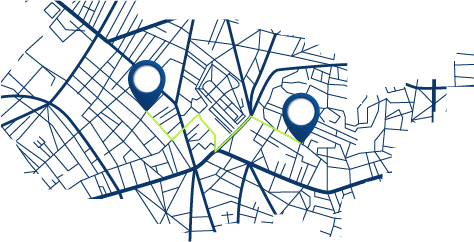
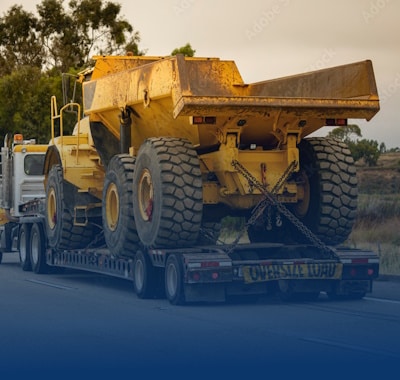
Transportation route planning for heavy hauls is the practical work of turning an oversized move into a drivable, legal, low-risk trip. It’s where a carrier proves, before dispatch, that the load can physically fit, legally travel, and realistically reach the destination without getting trapped by bridges, turns, time restrictions, or overhead obstacles.
For the complete big-picture workflow that this step supports, see how heavy haul transport projects are planned and executed.
Route Planning Starts With “What the Road Must Tolerate”
A heavy haul route is chosen around constraints, not convenience. The first question is never “what’s the fastest way?” The first question is “what can safely and legally carry this setup?”
That depends on:
- exact travel height, width, and overall length
- gross weight plus axle group weights
- trailer type and axle spacing
- turning behavior and off-tracking through corners
When those factors are clear, route planning becomes a controlled decision instead of trial and error.
Build the Route in Layers, Not in One Click
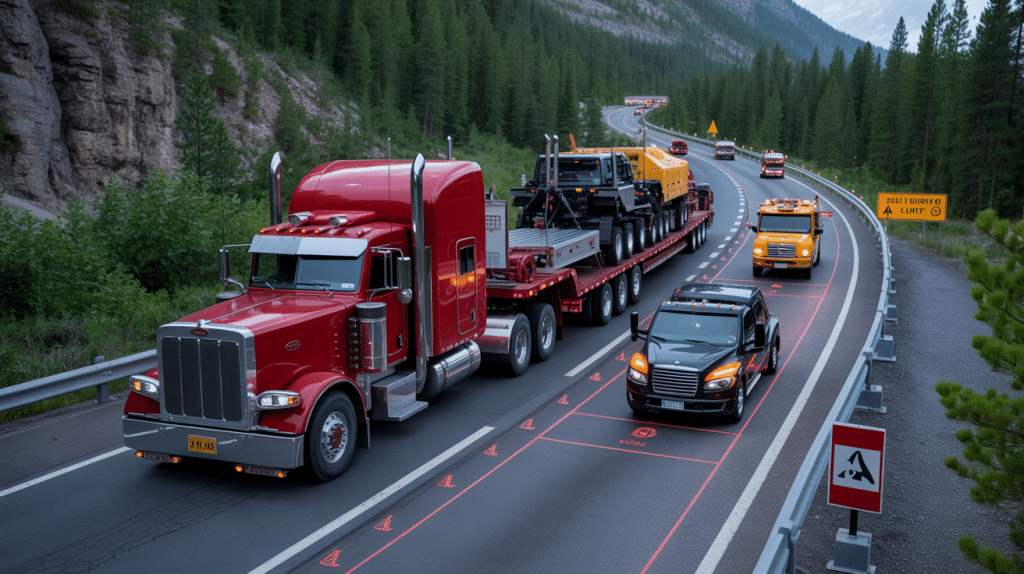
A reliable plan is usually assembled in layers:
- Primary corridor selection
Major highways and designated truck routes reduce surprises because they’re built to handle commercial traffic. - Feasibility verification
Planners validate the corridor against clearance points, bridge constraints, and “tight geometry” areas. - Last-mile reality check
The most common failures happen near pickup and delivery, where roads are narrower and turns are sharper.
Bridge Limits and Axle Groups Decide What’s Possible
With heavy haul, the critical number is often not total weight, it’s how that weight spreads across axle groups. A route may look perfect, but a single bridge rating can make it unusable.
This layered approach keeps the plan honest, especially in the final miles.
That’s why route planning connects directly to axle weight distribution strategy. A smarter axle configuration can unlock safer corridors, reduce detours, and make approvals easier.
Clearance Planning Must Include the “Overhead Reality”
Routes fail quickly when height is treated casually. Overpasses, signal arms, cable lines, and local utility crossings can turn a smooth plan into a sudden stop.
In situations where overhead exposure is likely, early coordination for overhead clearance prevents last-minute rescheduling and avoids unsafe improvisation in public spaces.
Hazard Review: Predict the Stop Points Before They Stop You
Strong route planning includes a hazard review that asks, “Where will this trip try to break?” That mindset catches problems early, tight turns, weak shoulders, narrow bridges, construction funnels, or sensitive corridors.
A practical companion to this step is hazard identification during heavy haul transport, because the best plan is the one that removes the biggest unknowns before the load is rolling.
Timing Isn’t a Detail, It’s Part of the Route
Heavy haul routes often come with time windows. Travel restrictions, rush-hour limitations, daylight rules, and local constraints can shape the entire schedule. Even if the corridor is “correct,” the timing can still make it impossible.
Weather can tighten those windows further. That’s why route planning often pairs with <a href=”/planning-for-adverse-weather-conditions-in-heavy-haul-transport/”>adverse weather planning</a>, especially for tall loads, long distances, or seasonal routes.
Staging Points Turn a Route Into an Operation
A good route isn’t only the roads between A and B. It also includes places where the convoy can pause safely if something changes.
Smart planning identifies:
- safe inspection pull-offs
- staging areas near metro corridors
- meetup points for escorts when required
- safe “hold zones” if traffic, weather, or timing shifts
This is how a heavy haul route becomes resilient instead of fragile.
The Last Gate: Equipment Readiness Must Match the Route
Even the best route can fail if the equipment isn’t ready for it. Grades, braking demands, and long distance stress test every component. If mechanical readiness is weak, route planning becomes irrelevant.
That’s why a route plan is strongest when it’s supported by pre-trip inspection discipline, so the convoy can actually execute the plan without avoidable roadside disruptions.
Conclusion
Transportation route planning for heavy hauls is the step that transforms oversized hauling from “possible” into “predictable.” When the corridor is verified for bridges, clearances, hazards, timing windows, and staging options, and when axle distribution and equipment readiness support the plan, the move stays controlled from start to finish. That control protects the public, protects the load, and protects the customer’s schedule, which is exactly what professional heavy haul transport is supposed to deliver.