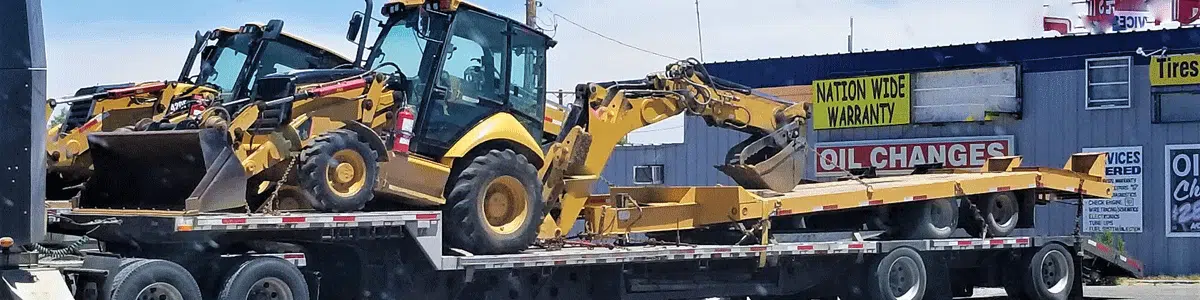
Freedom Heavy Haul provides professional equipment hauling services for construction, industrial, agricultural, and mining machinery across all 48 contiguous states. Whether you need to move a single excavator across three states or coordinate a fleet of heavy equipment from a decommissioned job site, our team manages every detail — permits, trailers, escorts, routing, and on-time delivery.
We are a licensed, fully insured, DOT-compliant carrier with an in-house permit department, a national network of specialized drivers, and 24/7 dispatch. Our job is to make your equipment move as simple and stress-free as possible.
See our equipment hauling services page for a full list of equipment categories and trailer specifications.
Different equipment requires different trailer configurations. Our fleet includes:
| Trailer Type | Typical Weight Capacity | Best For |
|---|---|---|
| Standard flatbed | Up to 48,000 lbs | Standard machinery, no height issue |
| Step deck / drop deck | Up to 48,000 lbs | Taller equipment needing lower deck |
| Removable gooseneck (RGN) | 40,000–80,000 lbs | Drive-on equipment, tall machinery |
| Multi-axle (3+ axles) | 80,000–150,000+ lbs | Heavy single-piece equipment |
| Multi-axle superload platforms | 150,000–500,000+ lbs | Transformers, large cranes, mining equipment |
Actual capacity depends on axle spacing and state bridge formula rules, not just trailer type — this is why we confirm exact trailer assignment after reviewing your equipment’s real weight and dimensions, not before.
We begin by collecting your equipment specs: make and model, dimensions (L × W × H), operating weight, pickup location, and delivery destination. Our team reviews rigging points, loading requirements, and any special handling needs before confirming a trailer type and price.
Our in-house permit specialists file for every state permit required along the approved route. Permit timelines vary by state — most are issued within 1–5 business days, though some states require longer lead time for overweight loads. We stay ahead of permit delays so your scheduled pickup isn’t impacted.
We assign an experienced driver with the right CDL endorsements and oversize transport training for your load. We confirm trailer condition, load securement equipment, and all compliance documentation before dispatch.
You receive real-time GPS updates throughout the haul. Our 24/7 dispatch team monitors every load and proactively communicates any weather, route, or permit delays. Escort vehicles travel with the load as required by state regulations.
We coordinate directly with your site contact for delivery logistics — job site access, unloading area, and any crane or rigging support needed on-site. Signed proof of delivery and full documentation are provided at completion.
Our equipment hauling clients come from a wide range of industries:
Here are real moves we’ve completed — with full details on equipment, route, challenges, and outcomes:
We provide equipment hauling services nationwide, with established routes in all major freight corridors:
Texas ·
Georgia ·
Florida ·
California ·
Ohio ·
North Carolina ·
Michigan ·
Louisiana ·
Colorado ·
North Dakota
Before pickup, drain fluids that could leak in transit, retract any booms or arms to their most compact position, remove any detachable accessories or attachments if possible, and secure any loose parts. Our driver will confirm load readiness at pickup and handle final tie-down per DOT securement regulations.
Equipment hauling costs depend on equipment dimensions, total weight, distance, number of states crossed, permit costs, and trailer type required. Regional single-machine moves often run $800–$3,000, while long-distance or super-heavy loads can be $10,000–$30,000+. Contact us for a free, itemized quote.
Yes. Non-operational equipment is common in our business. We coordinate rigging and crane services if the machine can’t be driven or winched onto the trailer. Let us know about any non-operational condition when you request your quote so we can plan appropriately.
For standard equipment moves, 3–5 business days is usually sufficient for permit processing and carrier assignment. For superloads, complex routes, or moves requiring utility coordination, 2–4 weeks lead time is recommended. Emergency and expedited service is available for urgent situations.
Yes. Freedom Heavy Haul carries comprehensive cargo insurance for all loads in transit. Our policies meet or exceed FMCSA minimum requirements, and our team provides documentation of coverage upon request. You may also want to confirm your own equipment insurance covers transit — many commercial equipment policies do include inland marine coverage.
Yes — this is most of what we do. Weight and axle-spacing rules vary by state (some use the federal bridge formula, some have their own), and our permit team accounts for the most restrictive state on your route when planning axle configuration and permits, not just the origin or destination state.
Multi-piece moves need more coordination than a single machine: we typically ask for 1–2 weeks lead time to sequence pickups, assign the right trailer to each piece, and stage permits so multiple trucks aren’t waiting on the same bottleneck state.
Freedom Heavy Haul makes it easy to get a fast, accurate quote for your equipment move. Call us at (866) 305-6018 anytime — 24 hours a day, 7 days a week — or submit your equipment details online for a written quote within hours.