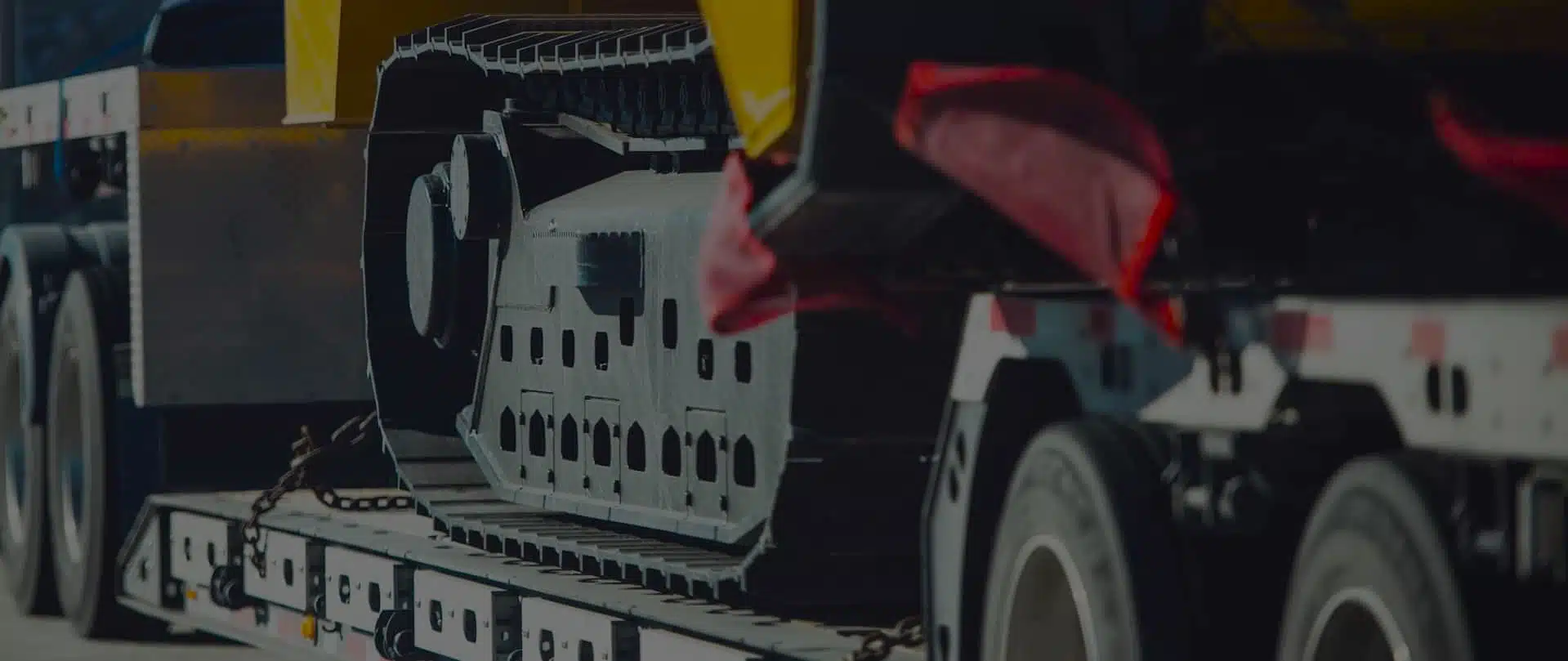
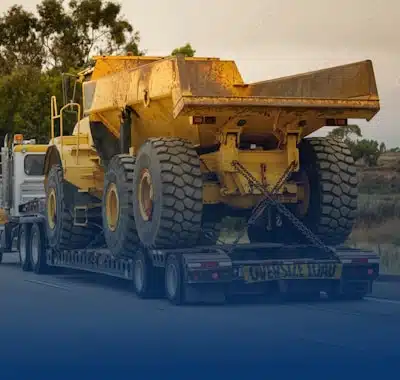
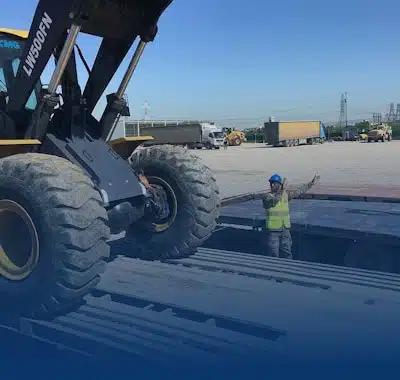
Transporting heavy equipment isn’t standard freight. Here’s a complete guide to how heavy equipment hauling works — from choosing the right trailer to permits, costs, and what you need to do before the truck arrives.
What Is Heavy Equipment Transport?
Heavy equipment transport (also called heavy equipment hauling or heavy equipment shipping) is the specialized movement of machinery, vehicles, and industrial equipment that exceeds standard freight limits due to weight, size, or both.
Unlike standard LTL or FTL freight, heavy equipment transport requires:
- Specialized trailers matched to the load’s dimensions and weight
- Oversize/overweight permits from every state the load crosses
- Pilot and escort vehicles when loads exceed certain widths or heights
- Certified drivers with training and experience specific to oversize loads
- Route surveys for super loads or unusual dimensions
If your equipment has tracks, oversized tires, extended booms, or can’t be dismantled for standard freight — it’s a heavy equipment haul.
Types of Heavy Equipment We Transport
Construction Equipment
Construction is the most common category in heavy equipment transport. Each machine type has its own transport requirements:
Excavators
Weight range: 10,000 – 200,000+ lbs depending on size class
Common trailer: RGN (removable gooseneck) — tracks require a drive-on ramp
Typical concerns: boom/arm extension adds height; may need to be lowered or removed; counterweights sometimes shipped separately
Bulldozers and Dozers
Weight range: 15,000 – 130,000+ lbs
Common trailer: RGN or lowboy
Typical concerns: blade dimensions often push width beyond 8.5 ft; blade removal may be required for wider units
Motor Graders
Weight range: 30,000 – 65,000 lbs
Common trailer: RGN or flatbed depending on model
Typical concerns: the moldboard (blade) extends width significantly; many graders require disassembly of cab mirror assemblies
Cranes (Mobile and Crawler)
Weight range: 50,000 – 500,000+ lbs
Common trailer: Multi-axle hydraulic for heavy cranes; lowboy or RGN for smaller units
Typical concerns: boom must typically be removed and shipped separately; counterweights may be a separate load; heavy units require super load permits
Compactors and Rollers
Weight range: 20,000 – 50,000 lbs
Common trailer: Lowboy or RGN
Typical concerns: smooth drum rollers are often wider than standard; padfoot compactors have irregular surface profiles that affect securing
Excavator Attachments and Buckets
Shipped separately from the machine in most cases; standard flatbed or step deck if within weight limits
Skid Steers and Compact Track Loaders
Weight range: 6,000 – 12,000 lbs
Common trailer: Flatbed or step deck (often multiple units per load)
These are small enough that permits are usually not required unless multiple units push the load over 48,000 lbs
Oil, Gas, and Energy Equipment
Transformers
Weight range: 50,000 – 500,000+ lbs
Among the most complex heavy equipment moves. Large power transformers may weigh hundreds of thousands of pounds and require multi-axle hydraulic platform trailers, extensive route surveys, and weeks of permit lead time. Fluid management and tilt considerations add additional requirements.
Generators and Power Units
Weight range: 20,000 – 150,000 lbs
Common trailer: RGN or lowboy; smaller generators on flatbed
Industrial generators for data centers, hospitals, or oilfield use often have extended dimensions requiring permits.
Wind Turbine Components
Blades: 15,000 – 30,000 lbs each, up to 200 feet long
Nacelles: up to 100,000 lbs
Tower sections: 40,000 – 50,000 lbs each
Wind turbine transport is specialized even within heavy haul — blade length often requires hydraulic stretch trailers and complex route analysis for turns and overhead clearances.
Pressure Vessels and Tanks
Custom dimensions; typically RGN or lowboy for cylindrical vessels
Vessels over 14 feet wide require extensive permitting; some qualify as super loads.
Drilling Equipment
Masts, substructures, and rig components are among the most complex moves in the industry. Rig moves often involve dozens of loads over multiple days.
Mining Equipment
Haul Trucks (Off-Road)
These are among the heaviest pieces of equipment ever transported on public roads. Komatsu 785s and Caterpillar 785s run 80,000+ lbs bare. Partial disassembly (body removal, wheel removal) is standard procedure.
Large Loaders and Scrapers
Weight range: 40,000 – 200,000+ lbs
Multi-axle trailers for the largest units; partial disassembly often required
Agricultural Equipment
Large Tractors (100+ HP)
Weight range: 15,000 – 50,000 lbs
Common trailer: Flatbed or RGN depending on size
Width is the typical concern — large tractors with duals can push beyond permit-free dimensions
Combines and Harvesters
Weight range: 25,000 – 65,000 lbs
Common trailer: RGN or lowboy
Headers are typically removed and shipped on a separate flatbed
How to Match Your Equipment to the Right Trailer
| Equipment Type | Recommended Trailer | Why |
|---|---|---|
| Tracked excavator | RGN | Drive-on loading; lowest deck height |
| Wheeled excavator | Lowboy or RGN | Depends on height; RGN preferred |
| Bulldozer | RGN | Drive-on; low deck clears height |
| Motor grader | RGN or Flatbed | Smaller models fit flatbed |
| Mobile crane | Lowboy | Crane height requires low deck |
| Large transformer | Multi-axle hydraulic | Weight distribution critical |
| Generator (<40K lbs) | Flatbed | Weight within range |
| Wind turbine blade | Stretch RGN | Length requires extending deck |
| Large tractor | Flatbed or Step Deck | Typically within weight limits |
| Combine | RGN | Width/height require low deck |
If you’re unsure which trailer fits your equipment, call us at (866) 305-6018 with the make, model, and any attachments — we’ll identify the right configuration before quoting.
The Heavy Equipment Transport Process: Step by Step
Step 1: Quote and Planning
Provide the carrier with:
- Make, model, and year of the equipment
- Weight (actual scale weight if available; otherwise manufacturer spec)
- Overall dimensions: height, width, length — including all attachments
- Origin and destination (exact addresses or coordinates)
- Timeline (when it needs to arrive)
- Any special conditions: fragile components, fluid considerations, access restrictions at origin or destination
An accurate quote requires accurate dimensions. Overestimating weight by 20,000 lbs can push a load into a higher permit tier — and estimating under creates compliance problems en route.
Step 2: Permit Acquisition
For most loads, we file for all state permits simultaneously. Standard timeline:
- Under 200,000 lbs, standard dimensions: 3–5 business days
- Super loads (200,000+ lbs or extreme width/height): 2–4 weeks; some states require engineering surveys
Every state on the route requires its own permit. A Los Angeles to Atlanta move crosses 5–6 states — that’s 5–6 separate permit applications, sometimes with different annual fee structures, travel hour restrictions, and axle weight requirements.
Step 3: Route Survey
For large or tall loads, a physical route survey is required before movement. Our route team:
- Checks bridge weight ratings against the load’s axle weights
- Identifies low overhead clearances (utility lines, bridges, overpasses)
- Flags tight turns or narrow stretches requiring coordination
- Notes state-line check-in requirements
For super loads, states often require a licensed professional engineer to certify the route.
Step 4: Equipment Preparation
We’ll provide a preparation checklist specific to your equipment type. Generally:
- Remove or fold all components that extend beyond the main body (mirrors, booms, buckets)
- Drain or reduce fluid levels if required by state regulations
- Lock cab doors; secure loose contents
- Confirm the equipment will start and drive (for tracked equipment loaded via RGN ramp)
Step 5: Loading
RGN loading: the gooseneck detaches and lowers to ground level; the equipment drives up the ramp and onto the deck under its own power.
Lowboy loading: requires a forklift or crane to place equipment from the side.
Flatbed loading: typically by crane or forklift.
Our drivers supervise all loading and handle securing — chains, binders, and blocking per DOT securement regulations.
Step 6: Transit and Monitoring
For long-haul and high-value moves, Freedom Heavy Haul provides real-time GPS tracking. Pilot car coordination, state police escorts (when required), and daily status updates are included.
Step 7: Delivery and Unloading
We coordinate with your site to ensure access is clear for the trailer configuration. Unloading reverses the loading process; your team or a hired crane takes over once the load is on the ground.
How Much Does Heavy Equipment Transport Cost?
Cost is determined by five factors:
1. Distance
Per-mile rates decrease on longer hauls. Short moves (under 200 miles) are often priced as flat minimums; long hauls (500+ miles) benefit from per-mile economics.
2. Equipment Weight and Dimensions
Heavy, wide loads require more specialized equipment, more permits, and more escort vehicles. A 120,000-lb transformer costs more to move than a 40,000-lb excavator over the same route.
3. Number of States Crossed
Each state is a permit fee. Multi-state hauls across 4–6 states add $200–$1,200 in permit costs on typical loads; super loads can add thousands per state.
4. Escort/Pilot Vehicle Requirements
Escort vehicles cost $1.50–$3.00 per mile per vehicle. A 500-mile move requiring two escorts adds $1,500–$3,000.
5. Market Conditions and Timing
Rates fluctuate with fuel prices, equipment availability, and regional demand. Short-notice moves (under 72 hours) carry a premium.
Typical Cost Ranges
| Load Type | Distance | Typical Range |
|---|---|---|
| Excavator (40,000 lbs) | 0–300 miles | $1,500 – $3,500 |
| Excavator (40,000 lbs) | 300–1,000 miles | $3,000 – $7,000 |
| Large Crane (150,000 lbs) | 200–600 miles | $10,000 – $25,000 |
| Power Transformer (300,000 lbs) | Multi-state | $30,000 – $80,000+ |
| Wind Turbine Blade | 300–800 miles | $6,000 – $15,000 |
These are general ranges. Get a firm quote for your specific move — Freedom Heavy Haul provides all-in quotes that include permits, escorts, and fuel surcharges.
What Sets Heavy Equipment Transport Apart from Standard Freight
Standard freight brokers and general trucking companies often don’t have:
- In-house permit teams with established state DOT relationships
- Owned specialized equipment (RGN, multi-axle, stretch trailers)
- Drivers certified and experienced with oversize loads
- Route survey capability
When your excavator is chained to a trailer on an interstate, you want the carrier who does this every day — not one that occasionally handles oversized freight. Freedom Heavy Haul’s entire operation is built around heavy haul.
Get a Quote for Your Heavy Equipment Move
Tell us the make, model, dimensions, and route — we’ll quote you in under an hour during business hours.
📞 (866) 305-6018 — answered 7 days a week
Or use our online quote form for a written response.
Freedom Heavy Haul serves all 48 contiguous states. Licensed, bonded, and insured.