Choosing the wrong trailer isn’t just inefficient — it can create permit violations, damage your equipment, and delay your project. Here’s exactly how each trailer type works and which loads belong on which trailer.
Why Trailer Selection Matters in Heavy Haul
In standard freight, trailer choice is mostly about cube and weight. In heavy haul, trailer selection determines:
- Whether your load clears bridges and overpasses (deck height)
- How the equipment gets loaded (self-drive vs crane)
- What permits are required (deck height + load height = total height)
- Whether the move is even legal (some loads can only move on specific trailer configurations)
Getting this right at the quoting stage prevents rework, delayed permits, and surprises at the pickup site.
RGN Trailer (Removable Gooseneck)
How It Works
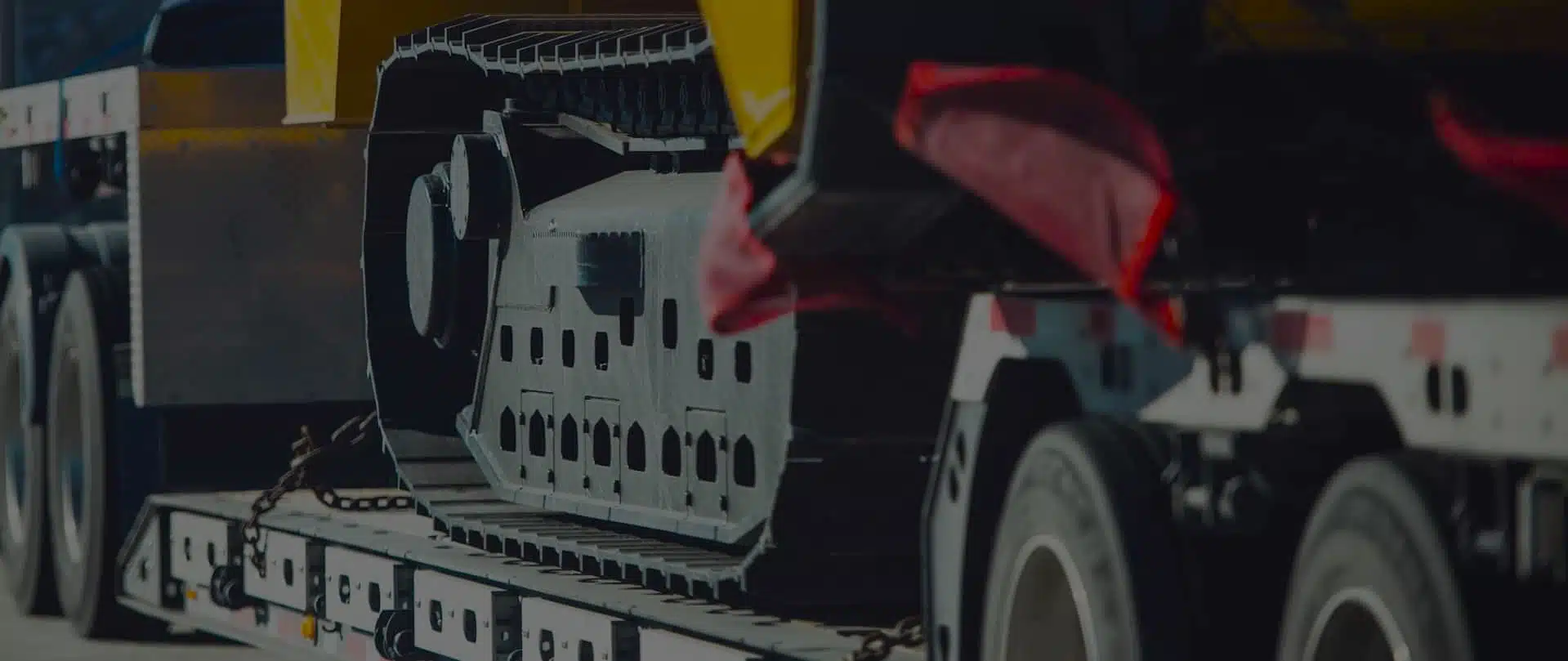
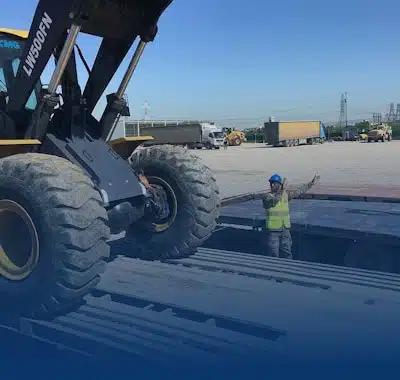
An RGN trailer’s gooseneck — the front portion that connects to the truck — can be hydraulically detached. When removed, the front of the trailer drops to ground level, creating a built-in loading ramp. Tracked equipment drives directly onto the deck under its own power. No crane required.
Deck Specifications
- Deck height: 18–24 inches from ground
- Standard deck length: 29–53 feet
- Stretch RGN: Extends hydraulically to 65–80 feet for long loads
- Standard weight capacity: 40,000 – 80,000 lbs
- Heavy-duty RGN: Up to 150,000 lbs with additional axles
What Loads Belong on an RGN
The RGN is the workhorse trailer of construction equipment transport. It’s the right choice when:
- Equipment has rubber tracks or steel tracks (excavators, bulldozers, track loaders)
- Equipment is too tall for a flatbed or step deck but can self-load
- Load dimensions don’t require the ultra-low deck of a lowboy but need the drive-on feature
- Load is long (stretch RGN extends for wind turbine blades, long beams, extended booms)
Best for: Excavators, bulldozers, dozers, motor graders, crawlers, tracked dozers, compact track loaders (multiple units), agricultural crawlers, crawler cranes, wind turbine blades (stretch RGN)
RGN Limitations
- Self-loading requires the equipment to be operational (drives on under its own power)
- Non-operational equipment on an RGN requires a crane for side-loading
- Minimum turning radius is larger than flatbed configurations — tight loading areas can be a challenge
Lowboy Trailer
How It Works
A lowboy has a fixed gooseneck and an ultra-low well (the main deck section drops lower than the front and rear). Equipment is loaded from the side using a crane or overhead equipment — it doesn’t drive on. The low well maximizes usable height clearance for tall loads.
Deck Specifications
- Deck height (in the well): 18–24 inches
- Deck length: 24–53 feet
- Standard weight capacity: 40,000 – 80,000 lbs
- Heavy-duty lowboy: Up to 150,000 lbs
What Loads Belong on a Lowboy
The lowboy is the right choice when height clearance is the primary constraint and the equipment cannot self-load (or the geometry of self-loading doesn’t work). This is common with:
- Very tall machines where every inch of clearance matters
- Non-operational equipment
- Loads with an irregular base that can’t drive safely up a ramp
Best for: Large excavators (especially 90-ton+ class), tall mobile cranes, mining shovels, large industrial equipment where crane loading is standard practice
Lowboy vs RGN: Which Do You Choose?
This is the most common question in heavy haul trailer selection. The short answer:
| Situation | Pick |
|---|---|
| Equipment has tracks and can self-load | RGN |
| Equipment is tall but can be crane-loaded | Lowboy |
| Equipment is tall AND can self-load | Either (RGN preferred — no crane cost) |
| Equipment is non-operational | Lowboy (crane-load from side) |
| Load is very long (50+ feet) | Stretch RGN |
In practice, an RGN is more versatile. A lowboy is the right call when height clearance is so tight that the few-inch difference in deck configuration matters, or when crane loading is already planned.
Flatbed Trailer
How It Works
A flatbed is the simplest configuration: a flat, open deck at standard height with no sides or roof. Loading is typically via forklift from the sides or crane from above.
Deck Specifications
- Deck height: 48–60 inches from ground
- Deck length: 48–53 feet
- Weight capacity: Up to 48,000 lbs
- Width: Up to 8.5 feet without permits; wider with permits
What Loads Belong on a Flatbed
Flatbeds are the right choice when:
- Load doesn’t exceed height limits (deck height + load height must stay under 13.5–14 ft)
- Load doesn’t require the ultra-low deck of a lowboy or RGN
- Multiple smaller equipment pieces can be loaded together to maximize the trailer
Best for: Steel beams and structural components, prefabricated building sections, wheeled equipment and vehicles (ATVs, small trucks), agricultural equipment (smaller tractors), pipes and cylindrical cargo, skid steers when height is not a concern, machinery under 40,000 lbs
Flatbed Limitations
The deck height (48–60 inches) eats into your legal height budget fast. If your load is 8 feet tall on a 58-inch deck, you’re at 15.8 feet total — requiring a height permit in most states. When loads approach or exceed 14 feet total height, consider a step deck or lowboy.
Step Deck Trailer (Drop Deck)
How It Works
A step deck has two deck levels: a shorter upper deck (front, at standard height) and a longer lower deck that drops to a lower elevation. The “step” between the two decks allows taller cargo to ride on the lower section while staying within legal height limits.
Deck Specifications
- Upper deck height: 52–60 inches
- Lower deck height: 36–42 inches
- Lower deck length: Typically 38–40 feet
- Weight capacity: Up to 48,000 lbs
- Width: 8.5 feet standard; wider with permits
What Loads Belong on a Step Deck
The step deck fills the gap between flatbed and lowboy. It’s the right choice when:
- Load is too tall for a flatbed but doesn’t need the extreme low clearance of a lowboy
- Load needs side access for loading/unloading (which a lowboy also provides)
- Budget-conscious option for medium-height loads that don’t justify a specialized lowboy
Best for: Machinery in the 6–8 foot height range, construction equipment that’s too tall for flatbed but lighter than typical lowboy loads, agricultural equipment (medium tractors, mowers), modular sections, some cranes and lifts in the 20,000–45,000 lb range
Conestoga Trailer
How It Works
A Conestoga uses a rolling tarp system mounted on an aluminum frame. The tarp rolls from front to back, completely enclosing the cargo during transit. At delivery, the tarp rolls back to provide full open access from above and the sides — faster unloading than a standard enclosed trailer.
Deck Specifications
- Deck height: Similar to flatbed (48–60 inches)
- Deck length: 48–53 feet
- Weight capacity: Up to 48,000 lbs
- Interior height (closed): Up to 10 feet
What Loads Belong on a Conestoga
The Conestoga is the right choice when your load needs weather protection that a standard flatbed can’t provide, but requires crane or top-access unloading at the destination.
Best for: Sensitive industrial machinery with exposed electronics or precision components, finished or coated equipment that can’t be exposed to weather or road debris, crated machinery, steel coils and metal products sensitive to moisture, materials that need to arrive in pristine condition
Conestoga vs Enclosed Van
If you need weather protection, why not just use an enclosed van? Two reasons:
1. Conestoga provides top-down access that a van doesn’t — crane unloading is easy
2. Flatbed-style loading (side and top) is often simpler with industrial equipment
Multi-Axle and Hydraulic Platform Trailers
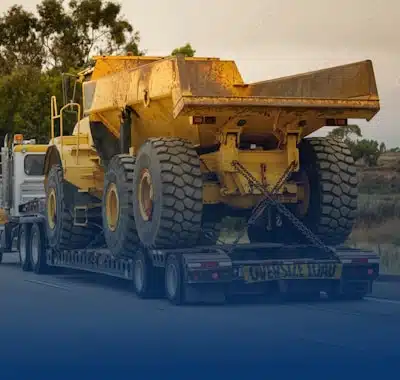
For loads above 150,000 lbs — large power transformers, reactor vessels, industrial modules, the heaviest cranes — standard trailer configurations aren’t enough.
Multi-axle hydraulic trailers (also called modular trailers or SPMT — self-propelled modular transporters) distribute extreme weight across many axle lines. Federal bridge formula limits the weight any single axle group can carry; spreading weight across 6, 8, or more axle lines allows super loads to move legally.
These are specialized equipment that most carriers don’t own. Freedom Heavy Haul operates multi-axle configurations for loads up to 250,000 lbs. For loads beyond that threshold, our partner network extends capacity further.
Quick Selection Guide
| Load Type | Recommended Trailer |
|---|---|
| Tracked excavator (self-propelled) | RGN |
| Non-operational excavator | Lowboy |
| Large bulldozer | RGN |
| Tall mobile crane | Lowboy |
| Steel structural beams | Flatbed |
| Sensitive industrial machinery | Conestoga |
| Medium-height machinery (6–8 ft) | Step Deck |
| Wind turbine blade (100+ ft) | Stretch RGN |
| Large power transformer | Multi-axle hydraulic |
| Multiple small machines | Flatbed (consolidated) |
| Agricultural tractor | Flatbed or RGN depending on size |
| Skid steers (multiple) | Flatbed or RGN |
What Happens When You Pick the Wrong Trailer
Beyond the practical issues (crane costs you didn’t plan for, equipment that won’t fit), the permit implications of the wrong trailer can be significant.
A load that would have cleared height on a lowboy may need a height permit on a flatbed. A load that could have been flatbedded without width permits requires an RGN that adds 6 inches to the load profile. These aren’t just paperwork differences — permits affect legal travel hours, required escorts, and route approvals.
The right trailer selection happens at quoting, not at the pickup site. Freedom Heavy Haul’s dispatch team matches trailer to load before we ever send a truck — and we own the equipment we quote you on.
Ready to Move?
Tell us your load type, dimensions, and route. We’ll identify the right trailer and quote the full move — permits, escorts, fuel, all in.
📞 (866) 305-6018 — 7 days a week
Or request a quote online.
Freedom Heavy Haul operates RGN, stretch RGN, lowboy, flatbed, step deck, Conestoga, and multi-axle configurations for loads up to 250,000 lbs across all 48 contiguous states.