

Electrical switchgear and control units are transported with careful protection, stable support, clean handling, and delivery coordination because these units are not ordinary boxed freight. They may not be as heavy as transformers or generators, but they can be sensitive to moisture, vibration, impact, panel damage, connection-point stress, and poor storage conditions.
A switchgear lineup, control cabinet, relay panel, motor control center, or packaged electrical control unit often supports a larger utility, power, industrial, or infrastructure project. If the unit arrives damaged, wet, misaligned, or late, installation and testing can slow down quickly. That is why the transport plan must protect both the equipment and the project schedule behind it.
Switchgear transport starts with protection, not just weight
Switchgear and control units are often moved as enclosed cabinets, panels, or packaged assemblies. Their size and weight matter, but their condition matters even more. Doors, panels, bus sections, wiring areas, terminals, relays, meters, controls, and connection points may all need protection during loading, transport, and unloading.
When energy, power and utility infrastructure is moved by heavy haul transport, electrical equipment should be treated as system-critical cargo. The load may look simple from the outside, but the equipment inside may be essential to power control, distribution, protection, or monitoring.
Moisture protection is one of the biggest concerns
Electrical equipment does not respond well to uncontrolled moisture. Rain, road spray, humidity, standing water, and poor temporary storage can create risk before the unit is installed. Even when equipment is packaged, the carrier and customer should understand how the unit should be protected during travel.
Weather protection may include:
- sealed packaging
- tarping or shrink wrapping
- covered transport when required
- protected openings
- moisture barriers
- inspection access
- careful staging away from standing water
The protection should shield the unit without hiding problems that need to be checked during loading or delivery.
Vibration and road shock should be considered
Switchgear and control units may contain sensitive internal parts. Even when cabinets are built for industrial environments, road vibration and shock can still affect alignment, mounted components, doors, internal hardware, or protective packaging if the load is not supported correctly.
A safer transport plan should reduce unnecessary movement by using stable deck placement, proper support, controlled securement, and reasonable route planning. The goal is to keep the unit from bouncing, rubbing, shifting, or absorbing repeated force through weak areas.
This is especially important when electrical cargo is part of a larger power system where testing and installation depend on the unit arriving in good condition.
Support points should match the cabinet or frame
Switchgear and control units may sit on skids, bases, frames, pallets, or shipping structures. Those support points matter. If the load is placed unevenly or supported through the wrong area, the cabinet can rack, twist, or settle during transport.
Before loading, the team should confirm:
- whether the unit has a shipping base or skid
- where forklift pockets or lifting points are located
- whether the frame can sit directly on the deck
- whether blocking or mats are needed
- whether panels or doors need extra protection
- whether the unit must remain level
A strong support plan helps the unit travel as a stable assembly instead of a cabinet fighting road movement.
Loading should avoid panel and connection damage
Switchgear may be loaded by forklift, crane, gantry, pallet jack, or other controlled method depending on weight, size, packaging, and site access. The loading method should avoid pushing, lifting, or restraining the unit through weak panels, doors, handles, conduit entries, or connection areas.
A clean loading plan confirms:
- approved lifting or forklift points
- equipment weight
- load balance
- available site space
- trailer height and deck access
- whether packaging can tolerate handling
- who is responsible for guiding the lift or placement
The unit should be placed once, correctly, without repeated dragging, shifting, or rough repositioning.
Securement should hold the unit without crushing it
Electrical control cabinets and switchgear lineups need restraint, but they should not be damaged by restraint. A chain, strap, or binder placed across the wrong surface can dent panels, bend frames, stress doors, or crush protective packaging.
Securement should control:
- forward movement
- rearward movement
- side movement
- vertical movement from road shock
- cabinet or skid movement
- packaging movement
- contact points that may rub or mark surfaces
The load should be held firmly through safe areas. It should not be squeezed into place by force.
Trailer choice depends on height, weight, and protection needs
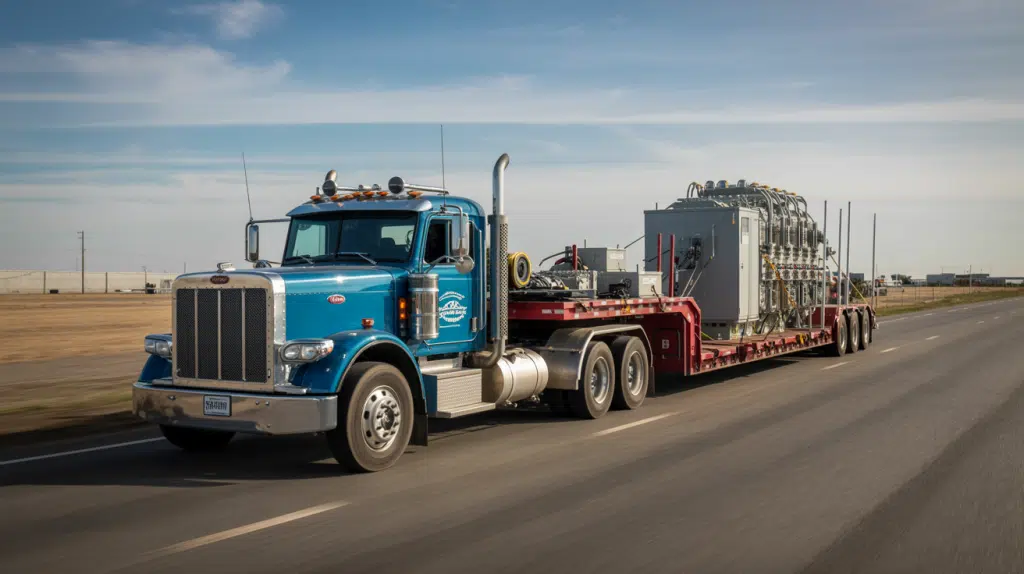
Some switchgear and control units can move on a flatbed or step deck if they are properly packaged, supported, and weather-protected. Larger or taller electrical houses, control rooms, or packaged units may require lower trailers, specialized support, or crane loading.
The trailer decision should consider:
- loaded height
- cabinet length and width
- unit weight
- weather exposure
- securement access
- loading method
- delivery-site access
- whether multiple units must travel together
For heavier energy equipment, transport planning for power generation equipment often follows a similar pattern: the trailer must match the cargo’s weight, support needs, handling method, and project timing rather than just the outside dimensions.
Delivery timing should match installation readiness
Electrical equipment may need to arrive when the site is ready to protect, unload, stage, and install it. If the unit arrives before the building, pad, enclosure, or protected storage area is ready, it may sit exposed longer than planned. If it arrives late, electrical crews, testing teams, or installation schedules may be delayed.
Before delivery, the project team should confirm:
- receiving contact
- correct entrance
- unloading method
- protected staging area
- final placement location
- weather protection after delivery
- crane or forklift availability
- whether installation crews are ready
The best delivery is not simply fast. It is timed so the equipment can move from trailer to safe placement without confusion.
Site access can affect electrical equipment handling
Switchgear and control units are often delivered to substations, industrial plants, utility sites, data centers, construction projects, or power facilities. These sites may have narrow gates, overhead lines, electrical work zones, restricted access, gravel roads, tight interiors, or limited staging areas.
The carrier should know whether the unit will be unloaded outdoors, moved indoors, staged near a pad, placed near an electrical room, or transferred to another handling team. A small access issue can become a major delay if the trailer arrives without the right unloading plan.
Multiple cabinets may need sequencing and labeling
Switchgear and control equipment sometimes moves as several sections or cabinets that must be installed in order. If sections arrive unlabeled, out of order, or staged in the wrong place, the installation crew may lose time sorting and repositioning them.
A cleaner delivery plan includes:
- section identification
- delivery order
- unloading sequence
- staging instructions
- protection requirements
- clear site contact information
- inspection steps at handoff
For utility projects, good organization protects the schedule as much as the equipment.
What utilities and project teams should prepare before transport
Utilities, contractors, and project managers can help protect switchgear and control units by preparing accurate information early.
Helpful details include:
- equipment type and number of sections
- dimensions and weight for each unit
- packaging or weather-protection requirements
- lifting points or forklift-pocket details
- no-contact areas
- whether the unit must remain upright or level
- pickup and delivery site photos
- crane, forklift, or rigging needs
- protected staging requirements
- delivery sequence
- site contact information
These details help the carrier plan the move around the real equipment instead of guessing from basic cargo descriptions.
Conclusion
Electrical switchgear and control units are transported with careful attention to moisture protection, vibration control, support points, loading method, securement, trailer choice, site access, and installation timing. These units may not always be the heaviest loads in utility transport, but they can be some of the most sensitive.
A successful switchgear or control-unit delivery protects the equipment’s condition from pickup to placement. When the unit arrives dry, stable, properly supported, and ready for installation, the utility or power project can continue with fewer delays and less risk.