Extendable trailers help move long oversized loads by giving the cargo more support across its length. Some freight cannot be shortened, folded, or divided into smaller pieces. Long beams, bridge sections, crane booms, wind components, pipe sections, structural steel, and industrial assemblies often need a trailer that can stretch to match the load instead of forcing the load to hang too far beyond the deck.
In heavy haul transport, length changes more than the trailer size. It changes turning behavior, rear swing, staging needs, escort planning, and route selection. That is why an extendable trailer is not just a longer trailer. It is a tool for controlling how long cargo behaves on the road.
Extendable trailers are used when cargo length becomes the main constraint
Some oversized loads are difficult because they are tall. Some are difficult because they are heavy. Long cargo creates a different challenge because it changes how the entire rig moves through space.
A long load may need extra deck length so it can be supported properly. It may also need a trailer that reduces unsafe overhang and keeps the cargo from flexing, bouncing, or shifting during travel.
When customers compare heavy haul trailer types and when each one is used, extendable trailers usually become important when the question is no longer “how much can the trailer carry?” but “can the trailer support the full length of this cargo safely?”
Long loads need support, not just space
A long piece of cargo should not simply hang from a short trailer because it “fits enough.” Poor support can create bending stress, vibration, movement, or uneven pressure points. This matters especially when the load is a structural component, boom section, pipe, blade, beam, or engineered assembly.
A better support plan asks:
- where the cargo is designed to be supported
- how much overhang is safe
- whether the load can flex during transport
- whether support points need padding or blocking
- whether the trailer length matches the cargo’s structural needs
The goal is to carry the load in a way that protects its shape, not just its weight.
Extendable trailers reduce unsafe overhang
Some overhang may be manageable depending on the cargo and regulations, but too much overhang creates risk. It can affect balance, turning, visibility, rear swing, escort needs, and securement. It can also make the load harder for other road users to understand.
An extendable trailer helps reduce that problem by increasing the deck length under the cargo. The load becomes more supported, the securement plan becomes more stable, and the driver has a more predictable trailer system to manage.
The longer the cargo, the more important this support becomes.
Turning behavior is one of the biggest planning issues
Long cargo changes how the trailer turns. The load may swing wider through intersections, take more space in curves, or require extra room when entering gates, job sites, industrial yards, or rural access roads.
A route that works for a normal heavy haul trailer may not work for an extended setup. The trailer length affects:
- turning radius
- rear swing
- lane position
- intersection clearance
- entrance and exit paths
- escort vehicle coordination
That is why extendable trailer moves need route review that focuses on geometry, not just road distance.
Extendable trailers are often used for structural and industrial cargo
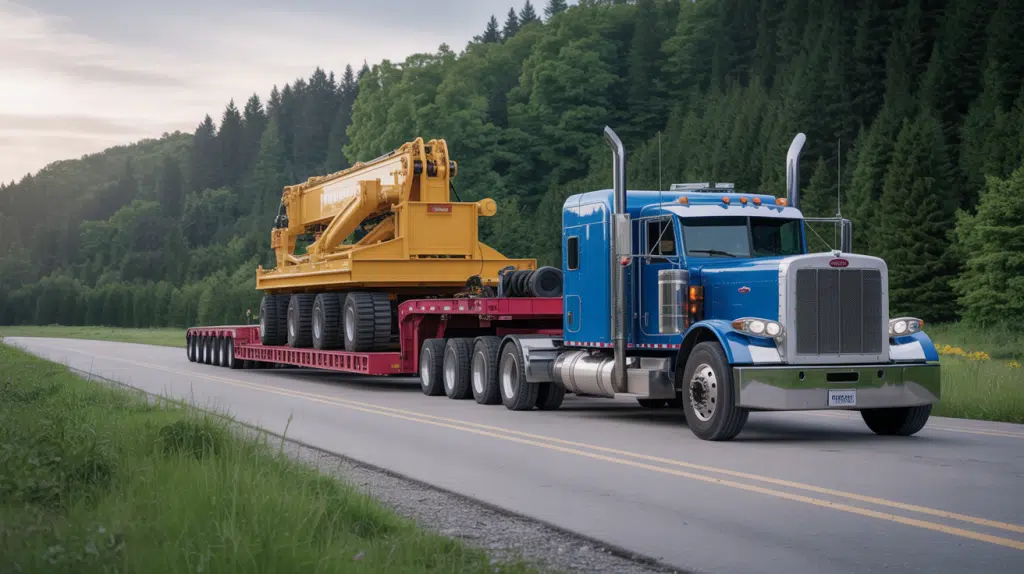
Extendable trailers are common when the cargo’s length cannot be reduced. They may be used for:
- structural beams
- bridge sections
- crane booms
- long machinery frames
- pipe sections
- utility poles
- wind energy components
- long prefabricated assemblies
- industrial steel sections
These loads may not always be the heaviest loads in heavy haul, but their length makes them difficult. In many cases, the route planning is more important than the raw weight.
Weight distribution still matters with long cargo
Long cargo does not remove the need for weight planning. Even if the load is spread across the trailer, the carrier still has to understand where the weight is concentrated. Some long loads are heavier at one end. Some have connection points, reinforced sections, or uneven internal structure that affect how they should sit on the trailer.
Before using an extendable trailer, the plan should confirm:
- total cargo weight
- center of gravity
- support-point locations
- axle loading
- securement access
- route limits
- loading and unloading method
A long load can still overload the wrong part of the trailer if the weight is not placed correctly.
Loading long cargo requires extra control
Loading long cargo is often more delicate than loading a compact machine. The cargo may need a crane, forklift support, multiple lifting points, spreader bars, tag lines, or careful alignment before it settles onto the trailer.
The loading team must avoid twisting, dragging, bending, or placing pressure on unsupported sections. A long beam, boom, pipe, or assembly should land on the trailer in a way that matches the support plan.
The lift or loading method should be chosen before the trailer arrives, not decided after the cargo is already waiting.
Securement must account for length and movement
Long cargo needs securement that controls more than forward and rearward movement. It also needs to control side movement, vibration, flex, and shifting along the support points. A securement plan that works for compact cargo may not be enough for a long load.
A safer securement plan considers:
- restraint at multiple points
- protection against side movement
- support under long spans
- edge protection where needed
- movement from vibration or road shock
- visibility and marking requirements
The cargo should ride as one controlled load, not as a long piece that works against the trailer.
Extendable trailers can increase route and escort needs
A longer trailer setup can make the move more complex. Extra length may require additional escorts, wider turns, route restrictions, staging space, or traffic-control coordination. In some areas, the permitted route may change because of intersections, ramps, construction zones, or final-mile access.
That does not make extendable trailers a bad choice. It simply means the trailer solves one problem while creating planning needs in another area.
Long cargo requires space. The route must provide that space.
When an extendable trailer may not be the best choice
An extendable trailer is not always necessary. If the cargo length is manageable on a standard trailer, or if the load is more limited by weight, height, or loading method, another trailer may be more practical.
Another trailer may be better when:
- the load is tall rather than long
- the cargo is extremely heavy and needs more axles
- the machine needs RGN front-loading access
- the route cannot handle an extended trailer
- the delivery site has no room for long-trailer positioning
- the cargo can be safely divided into shorter sections
The best trailer is the one that solves the dominant constraint without creating unnecessary problems.
What customers should share before requesting an extendable trailer
Customers can help the carrier plan long-load transport by providing accurate cargo and site information early.
Helpful details include:
- total length of the cargo
- weight and center of gravity
- support-point requirements
- lifting or loading method
- pickup and delivery access space
- turning restrictions near both sites
- whether the cargo can be separated
- deadline or delivery window
- photos or drawings of the load
These details help confirm whether an extendable trailer is the right choice and whether the route can support the move.
Conclusion
Extendable trailers help move long oversized loads by supporting cargo that cannot be safely carried on a standard-length trailer. They reduce unsafe overhang, improve support, and help carriers manage long beams, crane sections, pipe, bridge components, wind parts, and industrial assemblies more safely.
The main value of an extendable trailer is control over length. When the trailer supports the cargo properly and the route can handle the extended setup, long-load transport becomes safer, more predictable, and easier to coordinate from pickup to delivery.