Heavy haul trailer selection is one of the most important decisions in oversized equipment transport. The trailer does more than carry the load. It controls loading height, deck space, axle distribution, turning behavior, route clearance, permit requirements, and overall transport cost.
Different loads need different trailer designs. A tall excavator may need a low deck. A long beam may need an extendable trailer. A dense industrial component may need extra axles. A basic machine with manageable dimensions may not need a specialized setup at all. The safest choice is not always the biggest trailer or the most advanced trailer. It is the trailer that matches the cargo, the route, and the job site.
Why heavy haul trailers are not one-size-fits-all
Heavy equipment can be tall, wide, long, dense, fragile, or difficult to load. Each condition changes the trailer decision.
A bulldozer may need a low loading angle to protect its tracks and undercarriage. A crane component may need enough deck length and support. A transformer may need axle capacity and careful weight distribution. A wheel loader may need a trailer that supports safe drive-on loading while keeping travel height under control.
That is why trailer selection starts with the load’s real transport profile, not just its name.
Lowboy trailers are used when height and stability matter
Lowboy trailers are commonly used for heavy equipment because they keep the deck closer to the ground. That lower deck helps reduce overall transport height, which is important when the load must pass under bridges, overpasses, signs, or utility lines.
A lowboy can also improve stability because the machine rides lower during transport. This makes it useful for tall construction equipment, heavy machinery, and loads with a higher center of gravity. When height control is the main planning issue, using a lowboy trailer for heavy equipment transport can make the route more practical and the move easier to manage.
RGN trailers are used when equipment needs easier loading
An RGN trailer, also called a removable gooseneck trailer, is useful when machinery needs to drive onto the deck from the front. The front of the trailer detaches, creating a lower loading angle and a more controlled path for equipment.
This is helpful for excavators, dozers, loaders, and other machines that can move under their own power but need safer loading geometry. When an RGN trailer is used for oversized machinery, the trailer often reduces loading stress and makes pickup or delivery easier at difficult sites.
Step deck trailers work for moderate height and versatile freight
Step deck trailers sit lower than flatbeds but usually higher than lowboys or double-drop trailers. They are often used when the load is too tall for a standard flatbed but does not require the lowest possible deck.
This makes step decks useful for machinery, equipment, and industrial cargo with moderate height concerns. They can provide flexibility without the complexity of more specialized trailer systems. When step deck trailers are used in heavy haul transport, they usually solve a practical middle-ground problem: the load needs more height room than a flatbed provides, but not a full lowboy solution.
Extendable trailers are used for long oversized loads
Some cargo cannot be shortened, folded, or broken down. Long beams, crane sections, pipe sections, bridge components, wind energy parts, and industrial assemblies may need a trailer that can extend to support the length of the load.
Extendable trailers help reduce unsafe overhang and improve support across the cargo. They also change how the load turns, stages, and moves through intersections. When extendable trailers help move long oversized loads, the main goal is not only carrying length. It is controlling the movement behavior of long cargo on real roads.
Multi-axle trailers are used when weight is the main problem
Some heavy haul loads are not difficult because of height or length. They are difficult because of weight. A dense transformer, mining component, industrial vessel, or large machine may need more axle support to distribute weight across the trailer and road system.
Multi-axle trailers spread load across more contact points. This can help with permit approval, bridge review, road protection, and safer handling. When multi-axle trailers are used for extreme heavy haul loads, the trailer is chosen to control weight distribution before it becomes a route or infrastructure problem.
Double-drop trailers reduce transport height
Double-drop trailers have a lower center well between the front and rear deck sections. This design helps carry taller cargo at a lower overall height. For overheight equipment, machinery, tanks, or industrial components, a double-drop trailer can make the difference between a workable route and a route blocked by clearance restrictions.
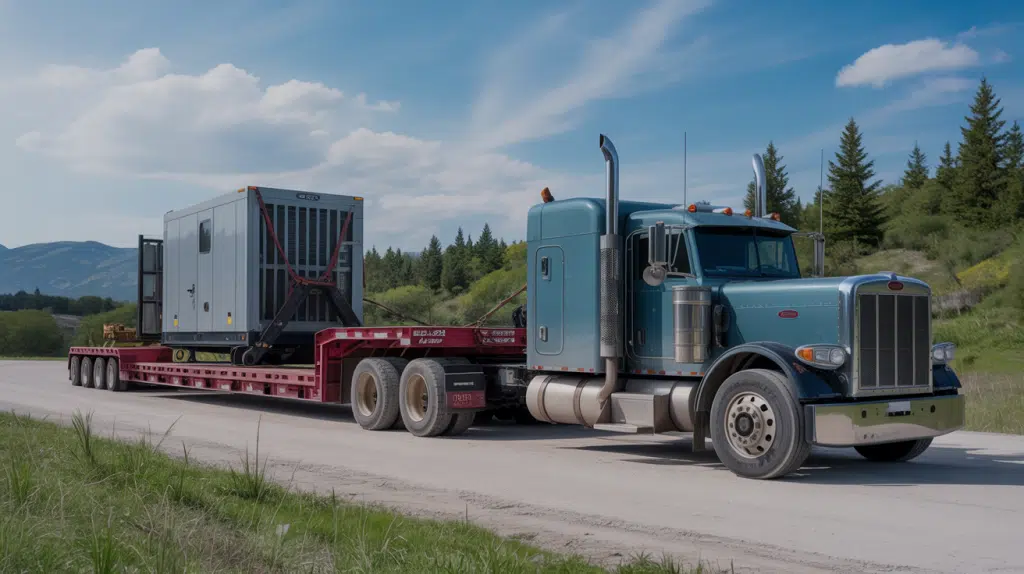
When double-drop trailers reduce transport height, they help the load move through more route options with fewer overhead conflicts. The lower deck does not remove the need for clearance planning, but it gives the transport team more room to work with.
Flatbed trailers are enough for some heavy equipment moves
Not every heavy equipment move needs a highly specialized trailer. If the load has manageable height, weight, width, and securement requirements, a flatbed may be enough. Flatbeds can work well for lower-profile machinery, attachments, smaller equipment, and cargo that does not create major clearance or axle concerns.
The key is knowing when the load truly fits the flatbed option. If the machine becomes too tall, too heavy, too difficult to load, or too complex to secure, a more specialized trailer may be safer. When flatbed trailers are enough for heavy equipment hauling, the decision usually comes from simplicity, not compromise.
Modular trailers support oversized industrial cargo
Some industrial cargo needs a trailer system that can be configured around the load. Modular trailers can support very heavy, unusual, or project-specific cargo by allowing more customized axle layouts, deck arrangements, and support configurations.
These trailers are often used for transformers, plant equipment, vessels, large assemblies, and other cargo where weight, support, and route limits require more than a standard trailer. When modular trailers support oversized industrial cargo, the transport plan becomes more engineered because the trailer is built around the load’s real constraints.
Trailer choice affects permits, routes, and cost
Trailer selection can change the whole project. A lower trailer may reduce clearance issues. More axles may improve weight distribution but increase complexity. An extendable trailer may solve length but require more turning room. An RGN may simplify loading but still need enough site space to detach and align properly.
These decisions affect permits, route planning, escort needs, delivery timing, and pricing. That is why trailer choice affects permits, route planning, and cost across the entire move, not only at the loading site.
How to choose the right heavy haul trailer
A practical trailer decision usually starts with these questions:
- How heavy is the load?
- How tall is it in transport position?
- How wide and long is it?
- Can it drive onto the trailer?
- Does it need crane or forklift loading?
- Does the route have low clearances or bridge limits?
- Does the cargo need special support points?
- Will the delivery site allow the trailer to unload safely?
These questions help narrow the trailer options before the move becomes more expensive or difficult to adjust.
Common mistakes when selecting heavy haul trailers
Trailer mistakes usually happen when the decision is made too quickly. A trailer may be available, but that does not mean it is correct for the load.
Common mistakes include:
- choosing a trailer before confirming real cargo dimensions
- ignoring attachment height or width
- assuming the lowest trailer is always best
- using a flatbed when loading angle or height is a problem
- choosing too few axles for dense cargo
- forgetting about final-mile access
- selecting a trailer that works at pickup but not delivery
The right trailer should support the full move from loading to unloading, not just the road distance in between.
What customers should know before requesting trailer selection
Customers do not need to know every trailer type before requesting transport, but they should provide accurate cargo and site details. That information helps the carrier choose the right setup.
Useful details include:
- equipment make and model
- true weight
- transport height, width, and length
- attachment details
- whether the machine runs and drives
- pickup and delivery site conditions
- access restrictions
- unloading method
- deadline or delivery window
With these details, the trailer decision becomes more accurate and the project becomes easier to plan.
Conclusion
Heavy haul trailer types are used for different transport problems. Lowboys and double-drops help reduce height. RGN trailers improve loading access. Step decks handle moderate height needs. Extendable trailers support long cargo. Multi-axle and modular trailers manage extreme weight and complex industrial loads. Flatbeds work when the cargo is simple enough for a standard deck.
The core reality is clear: the trailer is not just equipment under the load. It is the foundation of the transport plan. When the trailer matches the cargo, route, permits, loading method, and delivery site, heavy haul transport becomes safer, cleaner, and far more predictable.