

Transformers are transported for utility projects through careful planning around weight, support points, route limits, lifting needs, delivery timing, and site readiness. A transformer may look like one solid piece of electrical equipment, but in heavy haul transport it is often one of the most demanding utility loads to move. It can be extremely dense, high-value, sensitive to handling, and essential to a larger power project.
A transformer delivery is rarely just a simple drop-off. It may support a substation upgrade, grid expansion, emergency replacement, industrial power project, or planned outage. If the transformer arrives late, damaged, or in the wrong staging position, the delay can affect crews, cranes, electrical work, and the wider project schedule.
Transformer transport starts with accurate equipment details
A transformer move begins with the real shipping condition of the unit. The carrier needs to know more than the equipment name. The shipping weight, dimensions, lifting points, base frame, oil status, accessories, and protective requirements can all affect how the move is planned.
Before transport, utility teams should confirm:
- transformer weight
- transport height, width, and length
- center of gravity if available
- lifting and jacking points
- base-frame or skid details
- whether radiators, bushings, or accessories travel attached or separately
- whether the unit is oil-filled, drained, or shipped in a specific condition
- pickup and delivery site access
These details help the carrier choose the right trailer, route, permits, loading method, and delivery plan.
Transformers usually need strong weight distribution planning
Transformers are often compact compared with other oversized loads, but their weight can be concentrated. That dense weight affects trailer choice, axle loading, bridge review, and permit approval. A transformer that looks manageable by size may still require specialized heavy haul equipment because of how much force it places through the trailer and road system.
The trailer may need multiple axles, a low deck, modular support, or a configuration that spreads weight more evenly. In utility transport, the best trailer is not always the one that simply fits the transformer. It is the one that carries the transformer in a way roads, bridges, and permits can accept.
Support points matter during loading and travel
A transformer should not be supported casually. The load should rest through areas designed to carry its weight, such as base frames, skids, jacking pads, or manufacturer-approved support points. If the transformer is supported unevenly, road movement can place stress into areas that were not meant to carry transport force.
This is one reason heavy haul transport for energy, power and utility infrastructure requires more than basic trailer capacity. Utility cargo often belongs to a larger electrical system, so support, condition, and installation readiness matter as much as safe arrival.
Lifting and loading should be planned before the trailer arrives
Transformers may be loaded by crane, gantry, jacking system, skidding system, or other controlled handling method. The correct method depends on the transformer’s weight, lifting points, site space, and available support equipment.
A safe loading plan should confirm:
- how the transformer will be lifted or transferred
- whether the site has enough room for lifting equipment
- whether the ground can support the crane or trailer
- where rigging force can safely be applied
- how the transformer will settle onto the trailer
- whether temporary supports or mats are needed
The transformer should be moved slowly and deliberately, with no guessing around lift points or support areas.
Accessories may travel separately
Transformer accessories can create transport complications if they remain attached. Bushings, radiators, conservators, gauges, control cabinets, cooling assemblies, and connection hardware may need removal, protection, or separate transport depending on the project and equipment type.
If accessories travel separately, they still need proper packaging, labeling, securement, and delivery coordination. A transformer can arrive safely, but the project may still slow down if related components are missing, damaged, or delivered out of sequence.
This is where transformer hauling often overlaps with substation equipment moved by heavy haul carriers, because several related electrical components may need to arrive in a planned order for the site to continue.
Route planning must account for bridges and clearances
Transformer routes are often shaped by weight more than distance. A short route may be unsuitable if it includes weak bridges, restricted roads, sharp turns, or poor final-mile access. A longer route may be safer if it supports the loaded trailer configuration more reliably.
Route planning may include:
- bridge capacity review
- axle spacing and weight checks
- overhead clearance review
- road width and turning evaluation
- construction-zone restrictions
- utility-line concerns near the destination
- staging areas before final delivery
A transformer should travel on the route that supports the load, not simply the route that looks fastest.
Weather and road condition can affect transformer moves
Transformer transport may be affected by rain, wind, snow, heat, and rough road conditions. Rain can soften substation access roads or delivery pads. Wind can affect tall or wide trailer profiles. Snow and ice can reduce traction. Rough routes can increase vibration and shock exposure.
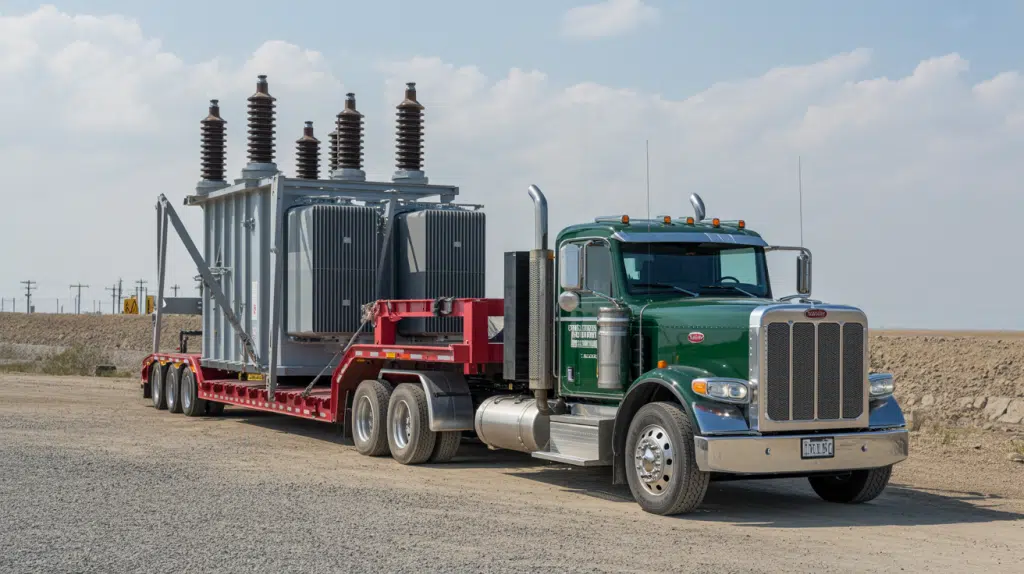
Because transformers are valuable and project-critical, weather planning should be part of the transport schedule. A short delay may be safer than pushing a heavy electrical load into poor access or unsafe unloading conditions.
Securement must hold the transformer without damaging it
Transformer securement should control movement without stressing weak components or sensitive areas. Chains, straps, blocking, and support materials must be placed where the transformer can safely tolerate force.
A proper securement plan should control:
- forward movement during braking
- rearward movement during acceleration
- side movement during turns
- vertical movement from road shock
- vibration-related settling
- contact points that could rub or damage surfaces
The goal is not only to keep the transformer on the trailer. The goal is to keep it stable, protected, and ready for installation.
Delivery timing often follows outage or installation windows
Utility projects often depend on precise timing. A transformer may need to arrive during a planned outage, crane window, substation construction phase, or grid upgrade schedule. If it arrives too early, there may be nowhere safe to stage it. If it arrives late, crews and equipment may wait.
The delivery plan should confirm:
- site readiness
- crane or unloading support
- access road condition
- staging area
- final placement location
- delivery window
- site contact
- whether traffic or utility coordination is required
Transformer delivery should support the project sequence, not force the project team to adjust around a surprise arrival.
Substation access can be the hardest part
Many transformer deliveries become most difficult near the destination. Substations and utility sites may have narrow gates, gravel roads, uneven pads, overhead lines, limited turning room, or restricted staging areas. The final approach may require more planning than the highway route.
Before delivery, the utility team should confirm whether the loaded trailer can enter, turn, stage, unload, and exit safely. If not, the carrier may need a different staging plan, support equipment, or delivery method.
What utilities should prepare before transformer transport
Utility teams can help transformer transport go smoother by sharing complete information early.
Helpful details include:
- transformer weight and dimensions
- shipping drawings or handling instructions
- lifting and jacking point details
- accessory list
- pickup and delivery site photos
- road and gate access information
- crane or unloading support availability
- outage or installation schedule
- weather or site restrictions
- site contact information
These details reduce uncertainty and help the carrier build a safer transport plan.
Conclusion
Transformers are transported for utility projects through careful control of weight, support, lifting, route planning, securement, and delivery timing. The transformer is often a critical part of a larger electrical system, so the transport plan must protect both the equipment and the project schedule.
A successful transformer move does not simply bring the unit to the site. It delivers the transformer in the right condition, at the right time, through a route and unloading plan that support the utility work waiting for it.