Utility poles and long infrastructure materials are moved safely by planning around length, support, trailer choice, turning space, securement, route access, and delivery staging. These loads may not always be as dense as transformers or power generation equipment, but their length can create a different kind of transport challenge. A pole, beam, conduit bundle, steel section, or long utility structure needs enough support under it and enough room around it to move through real roads without creating avoidable risk.
Long utility materials often support line work, grid expansion, substation construction, road projects, and rural infrastructure upgrades. If the load arrives late, damaged, or staged in the wrong place, crews may lose time before installation even begins.
Long materials create movement problems, not just size problems
A long load does not simply occupy more trailer space. It changes how the truck turns, how the rear of the load swings, how escorts manage traffic, and how much room the trailer needs at pickup and delivery.
A standard trailer may not support the cargo properly if the material extends too far beyond the deck. Too much overhang can create control problems, visibility concerns, securement challenges, and route restrictions. That is why long utility materials need a plan built around how the load behaves while moving, not just how it measures while sitting still.
Utility poles need proper support across their length
Utility poles, whether wood, steel, concrete, or composite, must be supported in a way that prevents unnecessary bending, rolling, shifting, or rubbing during transport. The support plan depends on the pole type, length, weight, surface finish, and whether poles are bundled or moved individually.
A good support plan considers:
- how long the poles are
- where they can safely rest on the trailer
- whether blocking, bunks, or cradles are needed
- whether poles are bundled or separated
- whether the load needs edge or surface protection
- how the poles will be unloaded at the destination
The goal is to keep the material stable and usable when it reaches the utility crew.
Trailer choice depends on length and support needs
Long infrastructure materials may require flatbeds, stretch trailers, pole trailers, extendable trailers, or other open-deck equipment depending on the load. The trailer should support the material without allowing unsafe overhang or poor weight distribution.
When heavy haul transport for energy, power and utility infrastructure is planned correctly, the trailer is selected around the load’s real shape and route behavior. For long materials, that usually means checking support points, turning requirements, and unloading access before the trailer is assigned.
Utility poles and transformers create very different transport risks
A transformer may challenge the route because of dense weight, bridge limits, and axle planning. Utility poles usually challenge the route through length, rear swing, and staging space. Both loads support power infrastructure, but they do not create the same transport problem.
That is why transformers transported for utility projects often require weight-focused planning, while utility poles and long materials require more attention to length, turning, and unloading layout. The cargo type decides where the risk appears.
Turning space must be checked before the move begins
Long utility materials can create problems at intersections, site entrances, rural roads, temporary access paths, and utility corridors. A trailer may fit on the highway but still struggle through a narrow turn into a substation, laydown yard, or roadside work area.
Route planning should check:
- tight turns
- lane width
- shoulders and medians
- roadside obstacles
- utility poles, signs, and trees
- construction zones
- final access roads
- unloading and staging areas
A long load needs room to move. If the route does not provide that room, the plan may need a different trailer, different path, or more controlled delivery window.
Securement must prevent rolling, sliding, and flex movement
Long materials often need securement that controls the whole load, not just the center. Poles and beams can roll, slide, flex, or vibrate if they are not blocked and restrained correctly. Bundled materials may also settle after movement begins, so re-checking tension and contact points can be important.
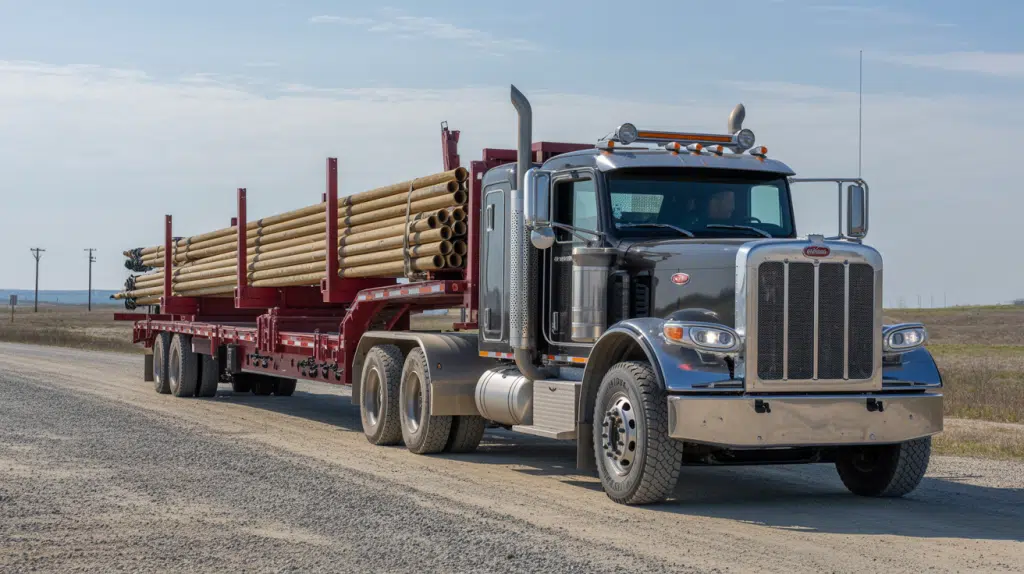
Securement should control:
- forward movement
- rearward movement
- side movement
- rolling movement
- vibration and settling
- contact between bundled materials
- contact with trailer edges or supports
The load should ride as one stable unit, not as separate long pieces shifting against each other.
Loading and unloading need enough working room
Long utility materials often require cranes, loaders, forklifts, pole-handling equipment, or other support. The site must have enough space to load or unload without forcing the material through awkward angles.
Before pickup or delivery, the team should confirm:
- where the trailer will park
- how the material will be lifted or placed
- whether the ground can support equipment
- whether overhead lines or trees create hazards
- where the material will be staged after unloading
- whether crews need immediate access to specific pieces
The unloading plan should make the materials useful, not simply place them wherever the trailer can stop.
Staging can decide whether crews can work efficiently
Utility poles and long materials often arrive before installation begins. They may need to be staged along a corridor, in a yard, near a substation, or close to a road project. Poor staging can block crews, create rehandling work, or place materials too far from where they are needed.
A good staging plan answers:
- which materials are needed first
- where they should be placed
- whether the site has enough laydown length
- whether the ground is firm enough
- whether the materials need separation or labeling
- whether the trailer can exit after unloading
Long materials can take up more space than expected, so staging should be planned before the delivery arrives.
Weather can affect long-material transport
Wind, rain, snow, and poor visibility can affect long utility-material moves. Wind may matter more when long materials are wide, stacked high, or lightly loaded compared with dense cargo. Rain can soften access roads and laydown areas. Snow and ice can affect loading, securement checks, and final-mile access.
Weather planning should consider both the route and the delivery site. A highway may be clear, but a rural utility access road or roadside staging area may still be muddy, icy, or difficult to use.
Utility corridors often have limited access
Utility work may take place near roads, fields, substations, transmission corridors, rural properties, or undeveloped access paths. These areas may not offer the same space as a commercial yard or industrial plant. A long load may need to enter from a specific direction, stage near a work zone, or wait for traffic control before unloading.
This is where long-material transport becomes practical and site-specific. The route to the general area matters, but the final approach and laydown plan often decide whether the delivery goes smoothly.
What utility teams should prepare before moving long materials
Utility teams can help carriers plan safer moves by sharing accurate load and site details early.
Helpful information includes:
- material type and quantity
- pole or beam length
- bundle dimensions and weight
- loading and unloading method
- pickup and delivery site photos
- laydown space available
- road or corridor access details
- overhead hazards
- ground condition
- required delivery order
- site contact information
These details help the carrier choose the right trailer, securement method, route, and staging plan.
Conclusion
Utility poles and long infrastructure materials are moved safely when the transport plan respects length, support, turning behavior, securement, loading access, and delivery staging. These loads may not always be the heaviest cargo in a utility project, but they can be difficult because they need space to move and space to land.
A successful long-material delivery gives crews usable materials in the right place, with less rehandling and less site confusion. When the trailer, route, securement, and staging plan match the length of the cargo, utility infrastructure work can continue with fewer delays.