Cranes are rarely transported the way they work on site. A crane may lift as one machine, but it often travels as a system of separate parts, each with its own transport logic. The carrier does not just move “a crane.” The carrier moves a main body, a boom or jib section, counterweights, outriggers, hook blocks, and sometimes support gear that must arrive in the right sequence. That is what makes crane transport different from hauling many other types of heavy equipment.
For the broader view of how machine type changes hauling strategy, this topic belongs within how different types of heavy equipment are transported safely. Crane transport simply pushes that idea further, because one machine often becomes several coordinated loads.
Why cranes are not usually moved as a single unit
A crane combines height, weight, and complexity in one piece of equipment. Once it is prepared for the road, those same qualities become transport problems. The boom creates length. The upper structure creates concentrated weight. Counterweights change balance. Outriggers widen the profile. Because of that, road transport usually depends on breaking the crane into manageable components rather than forcing one oversized configuration onto a trailer.
That is the first safe-transport principle for cranes: road configuration is different from working configuration.
The main crane transport methods and when they make sense
Not every crane moves the same way, and the method depends on crane type, job distance, and route limits.
Method 1: transport the crane body separately and remove major components
This is common for larger cranes. The carrier moves the crane body on one trailer, while boom sections, jib pieces, counterweights, and support parts travel on separate loads. This method lowers transport height, improves balance, and makes routing more realistic.
It also reduces the pressure on one trailer setup, which is important because concentrated crane weight can create significant axle-loading issues if the move is forced into one oversized configuration.
Method 2: move smaller cranes in a more complete form
Some smaller cranes or more compact units can travel in a more assembled state, especially when route conditions are easier and dimensions stay within manageable limits. Even then, the machine still needs close review because “smaller than a large crane” does not automatically mean “simple to haul.”
Method 3: staged multi-load transport for large project moves
For larger projects, crane transport often becomes a sequence rather than a single dispatch. The parts are scheduled so the unloading and assembly process makes sense at the destination. This is less glamorous than the lift itself, but it is usually what keeps the project calm and efficient.
Crane bodies create a weight problem before they create a route problem
With many machines, route height is the first concern. With crane bodies, weight concentration often appears even earlier. The body may be dense, irregular, and axle-sensitive. That means the trailer must do more than hold the machine. It must spread weight in a way the road system can tolerate.
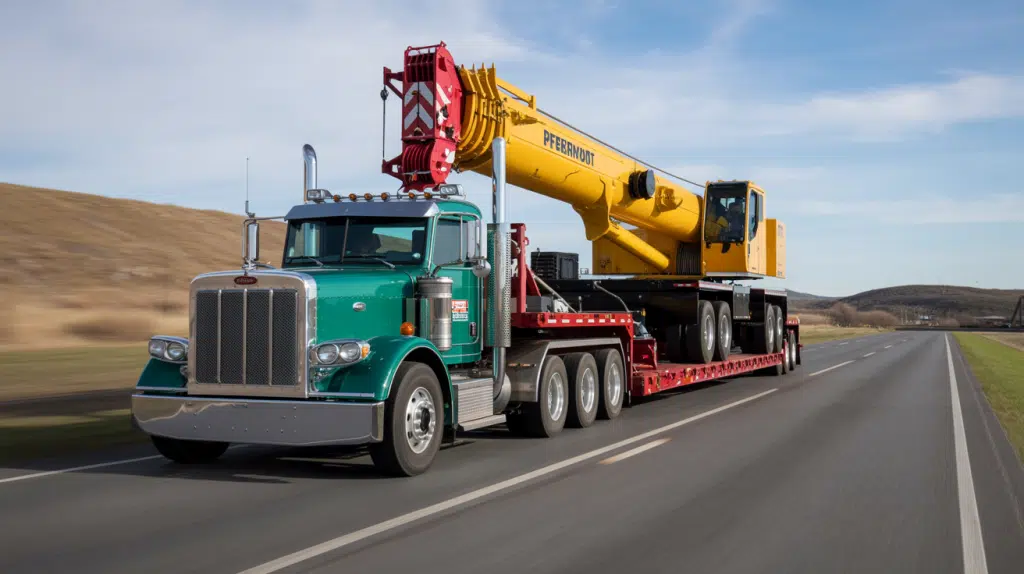
This is one reason crane transport planning often overlaps with axle weight distribution planning. If the body is positioned badly, the move can become unstable or run into permit trouble even before bridge or clearance restrictions are considered.
Boom sections and jibs create a different kind of challenge
Boom sections are not always the heaviest part of the project, but they can become the most awkward. Their length changes turning behavior, rear swing, and support point requirements. Jibs and lattice sections may also require careful blocking and spacing so they do not flex, rub, or shift during transit.
That is why long crane components are often more about support and geometry than about raw tonnage. A section that looks light compared with the crane body can still become difficult if the trailer length, deck support, or securement pattern is wrong.
Counterweights should be treated like precision cargo, not spare pieces
Counterweights are dense, compact, and easy to underestimate. Because they often move separately, they can look simple compared with the rest of the crane. In practice, they still need careful loading, deck support, and securement because their density can stress trailer setups quickly.
What makes them especially important is that they influence the sequence of the whole move. If the body arrives without the right support components, the job site can end up waiting even though “the crane is there.”
Route planning matters because crane transport mixes multiple load types
One crane move may include a heavy body, long components, and dense support pieces, all with different routing pressure points. The body may be more limited by bridge capacity and axle layout. The boom sections may be more limited by turning space and escort needs. That means one project can involve multiple route decisions inside the same transport plan.
This is where crane transport begins to feel like project coordination instead of simple equipment hauling. The safest moves usually treat each component according to its own transport behavior instead of assuming one route plan fits all.
Height and width still matter, even when the crane is broken down
Breaking a crane into components reduces risk, but it does not remove it. The body can still be tall. Outriggers may still create width concerns. Support frames and rigging structures may still affect transport profile.
If any part of the move involves a taller road profile, it helps to think through low-clearance planning for oversized loads before the trailers are fully committed to a route. This matters because crane transport often runs on tighter timing, and route surprises are especially expensive once multiple loads are involved.
Loading and unloading order can make or break the site handoff
Cranes are unusual because delivery sequence can matter almost as much as travel safety. If boom sections arrive before the body is staged correctly, or if counterweights are delayed behind less urgent parts, site assembly can slow down quickly.
That is why the best transport method is not always the shortest route or the fewest trailers. Sometimes the best method is the one that delivers the right parts in the right order so the crane can actually be built and used when it reaches the site.
What owners and project teams should confirm before transport begins
Crane transport becomes more reliable when a few things are clear early:
- the exact crane model and configuration
- which components will travel separately
- which parts create the biggest route or weight constraints
- whether assembly order at the destination affects delivery order
- what lifting or unloading support will be available on site
These details seem procedural, but in crane transport they often decide whether the move feels coordinated or chaotic.
Conclusion
Looking for reliable heavy equipment transport? Freedom Heavy Haul offers competitive rates and professional service for machinery shipping across the entire United States.
The best transport methods for cranes and crane components begin with one simple truth: cranes travel more safely when they are planned as systems, not just as machines. The crane body, boom sections, jibs, counterweights, and support parts each create different hauling demands, and those demands should shape trailer choice, axle planning, route selection, and delivery sequence. When those decisions are made deliberately, crane transport becomes smoother, safer, and much easier to coordinate from pickup to final assembly.