Heavy haul transport projects carry more risk than standard freight because oversized equipment does not move through the road system easily. A load may be too wide for certain lanes, too tall for low-clearance routes, too heavy for some bridges, or too complex for a simple pickup-and-delivery schedule. That is why risk in heavy haul is not one problem. It is a group of connected issues that can affect permits, routing, loading, weather, site access, communication, and delivery timing.
A safe project does not remove every possible risk, but it identifies the most likely problems before the truck moves. When the risks are clear, the carrier and customer can plan around them instead of discovering them under pressure.
Route restrictions are one of the biggest heavy haul risks
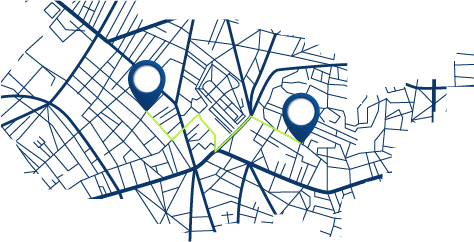
Oversized loads cannot use every road that standard trucks use. A route may have low bridges, weak structures, narrow lanes, sharp turns, steep grades, road construction, utility conflicts, or local travel restrictions. Even one unsuitable point can force a route change.
That is why route review is a major part of heavy haul risk management for oversized equipment projects. The route must fit the actual load, not just the pickup and delivery addresses.
Permit problems can delay the project before transport starts
Oversize and overweight moves usually need permits. Those permits may depend on load dimensions, weight, axle configuration, route, travel time, escort requirements, and state or local rules. If the information is incomplete or the route needs special review, the permit process can slow down.
This risk becomes more serious when the customer has a strict delivery date, crane booking, construction schedule, or shutdown window. A permit delay can push the entire project back, even if the truck and trailer are ready.
Incorrect equipment details create planning mistakes
Heavy haul plans depend on accurate information. If the machine weight is estimated, the height is measured without attachments, or the width changes because of tires, buckets, blades, or other parts, the plan may be wrong from the start.
Incorrect details can affect:
- trailer selection
- permit applications
- route clearance
- axle planning
- loading method
- securement approach
This is one of the simplest risks to prevent. Accurate dimensions, photos, model details, and attachment information help the carrier build a safer plan.
Loading and unloading sites can create hidden risk
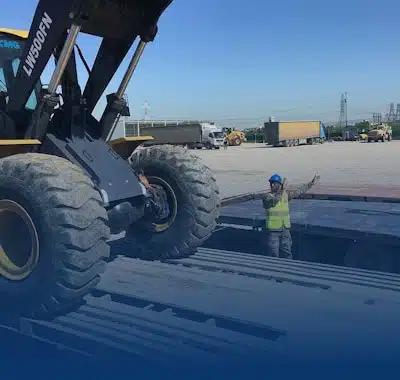
A machine may be ready for transport, but the site may not be ready for the machine to move. Soft ground, narrow entrances, uneven surfaces, overhead wires, parked vehicles, limited staging space, and unclear receiving locations can all create problems during loading or delivery.
These risks often appear at the worst time, when the trailer is already on site and the crew needs to make decisions quickly. A better plan checks site conditions early, especially when the pickup or delivery location is a construction site, farm, industrial yard, remote property, or public road project.
Weather can change safe movement conditions
Weather can affect heavy haul in several ways. Rain can soften the ground. Wind can make wide or tall loads harder to manage. Snow and ice can reduce traction. Heat can affect equipment, tires, and working conditions. Fog or poor visibility can make escort coordination harder.
Because weather can change quickly, heavy haul plans should include timing flexibility where possible. When movement windows are strict, weather becomes a bigger risk because there may be less room to adjust.
Escort and traffic-control issues can slow the move
Some oversized loads require escort vehicles, pilot cars, police coordination, traffic control, or special movement rules. If escort timing is not aligned, the move may wait even when permits and equipment are ready.
Traffic-control issues are especially important in urban areas, narrow corridors, construction zones, and public road projects. A wide load may need lane control, temporary stops, or careful timing through difficult sections.
Communication gaps create avoidable confusion
Heavy haul projects involve several people: customer contacts, dispatchers, drivers, permit teams, escort crews, site supervisors, crane operators, and receiving crews. If one party has old information, unclear instructions, or no direct contact, small issues can become larger delays.
For example, the driver may arrive at the wrong gate, the site contact may not know the delivery window, or the receiving team may not have cleared the unloading area. These are not technical failures. They are communication failures.
Last-minute changes can affect the whole plan
Heavy haul projects are sensitive to changes. A different attachment, a new delivery time, a blocked route, a delayed crane, or a wet job site can change the transport method. Because oversized loads have fewer easy options, even small changes may affect permits, escorts, staging, or trailer selection.
This is why last-minute heavy haul transport problems often come from details that were not confirmed early enough. The earlier a change is shared, the easier it is to adjust safely.
Equipment damage is always a risk if handling is rushed
Heavy equipment and industrial cargo can be damaged during loading, securement, travel, or unloading. Damage can come from poor ramp angles, weak tie-down points, rubbing chains, loose attachments, road vibration, or unsupported cargo areas.
Damage prevention depends on careful preparation, proper securement, controlled loading, and re-checks during the move. The goal is not only to deliver the equipment. The goal is to deliver it ready for work.
Schedule risk can be as costly as cargo risk
A heavy haul delay can affect more than the transport bill. If the equipment supports a construction crew, plant shutdown, utility upgrade, crane lift, or project milestone, late delivery can create cost across the entire job.
That is why risk planning should consider the project timeline, not only the road move. The transport plan should account for delivery windows, site readiness, staging space, unloading support, and possible delay points before the equipment leaves pickup.
A practical way to identify heavy haul risks early
Before the move is scheduled, the carrier and customer should review the risk areas together:
- Is the load weight confirmed?
- Are dimensions measured in transport condition?
- Are attachments included or removed?
- Does the route support height, width, length, and weight?
- Are permits and escorts required?
- Is the pickup site ready for loading?
- Is the delivery site ready for unloading?
- Is staging space available?
- Could weather affect movement?
- Is one site contact assigned at each end?
These questions do not make the project more complicated. They make the project more predictable.
Conclusion
Common risks in heavy haul transport projects include route restrictions, permit delays, inaccurate equipment details, poor site conditions, weather, escort coordination, communication gaps, last-minute changes, equipment damage, and schedule pressure. These risks are connected, so one weak detail can affect the entire move.
The safest heavy haul projects are planned with those risks in mind from the beginning. When the cargo, route, permits, sites, weather, communication, and timeline are reviewed early, the move becomes less reactive and more controlled. That is the purpose of risk management: not to make heavy haul simple, but to make it safer, clearer, and easier to execute.