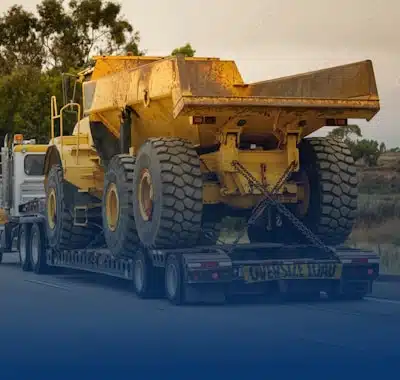
Double-drop trailers reduce transport height by placing the cargo in a lower center well between the front and rear deck sections. That lower well allows taller equipment, machinery, tanks, and industrial components to ride closer to the road than they would on a flatbed or standard step deck. When height is the main challenge, a double-drop trailer can make an oversized load easier to route, permit, and deliver.
In heavy haul transport, a few inches can matter. A load that is too tall may face bridge restrictions, utility conflicts, detours, escort changes, or permit complications. A double-drop trailer helps by lowering the loaded profile before those problems reach the route.
Double-drop trailers are used when height becomes the main transport problem
Some loads are difficult because they are heavy. Others are difficult because they are long. Double-drop trailers are mainly used when the cargo is too tall for higher deck options.
The lower center section gives tall cargo more vertical room. That can help with:
- overpasses
- bridges
- utility lines
- signs and signal structures
- industrial entrances
- tree canopies
- construction-zone overhead limits
When comparing heavy haul trailer types and when each one is used, the double-drop usually becomes important when the load needs maximum height reduction but does not necessarily need the same loading method as an RGN.
The lower center well creates extra clearance room
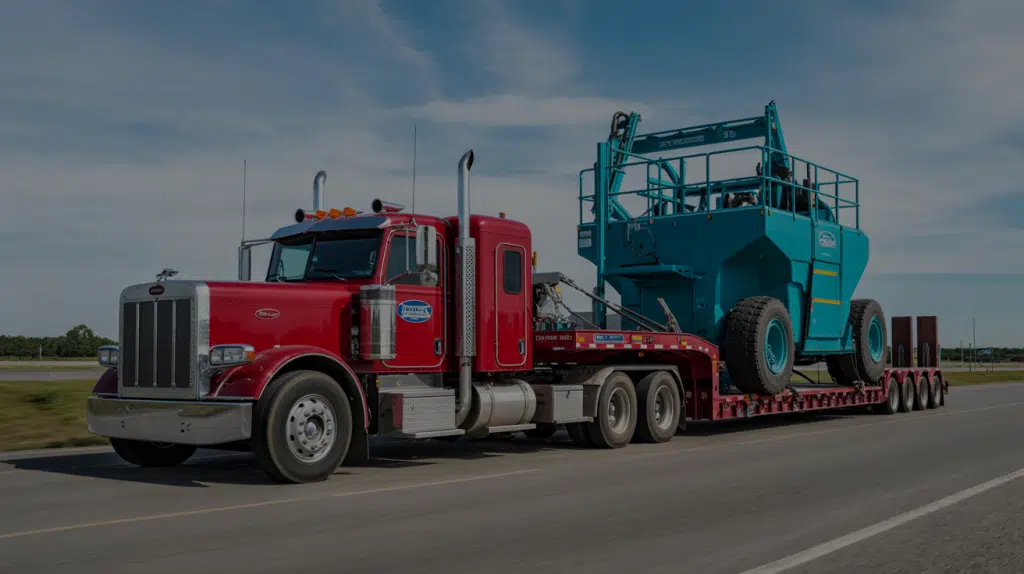
The main advantage of a double-drop trailer is the drop in the middle. Cargo placed in that well sits lower than it would on many other open-deck trailers. That lower position can reduce the total loaded height and give route planners more clearance margin.
This does not mean clearance issues disappear. The carrier still has to measure the loaded height, check the route, review bridges, and confirm overhead hazards. But the lower well gives the move a better starting point.
A tall load on the wrong trailer may create route problems immediately. The same load on a double-drop may become much more practical.
Double-drops are useful for tall industrial and construction cargo
Double-drop trailers are often used for cargo that has height but still needs stable open-deck support. This can include machinery, tanks, vessels, plant equipment, large components, and certain construction machines.
The trailer may be a good option when the load is:
- too tall for a flatbed
- too tall for a standard step deck
- better suited to a lower center well
- stable enough to sit in the center section
- not easily reduced in height
- route-sensitive because of overhead clearance
In these cases, the trailer helps solve the height problem before the load reaches the road.
Double-drop trailers are different from lowboys
Double-drop trailers and lowboys both reduce height, but they are not always used for the same kind of move. A lowboy is commonly used for heavy equipment and construction machinery that benefits from a low deck and strong equipment-hauling setup. A double-drop often provides a lower center well that works well for tall cargo, machinery, and industrial freight that can be placed in the well.
When lowboy trailers are used for heavy equipment transport, the decision often comes from a mix of height, stability, loading method, and machine type. With a double-drop, the decision is often more focused on reducing loaded height as much as practical.
Double-drops can reduce detours caused by overhead restrictions
Overheight loads often face routing problems. A bridge, overhead wire, or low structure can force a carrier to take a longer path, coordinate utility support, or revise the permit plan. Reducing loaded height may open better route options and help the move avoid unnecessary detours.
This can affect:
- route distance
- permit complexity
- escort requirements
- delivery timing
- cost
- customer schedule
A double-drop trailer may not make the route simple, but it can reduce the number of clearance problems the transport team has to solve.
Cargo placement inside the well matters
The lower center well is useful only when the cargo can be placed correctly. The load must fit the well length, sit on proper support points, and allow securement access. If the cargo is too long, too wide, oddly shaped, or poorly supported, the double-drop may not be the right choice.
Before using a double-drop, the carrier should confirm:
- cargo height
- cargo length
- cargo width
- weight and center of gravity
- support-point requirements
- securement access
- loading and unloading method
- route clearance limits
The trailer reduces height, but the cargo still has to sit safely and legally on the deck.
Loading method should be reviewed before choosing a double-drop
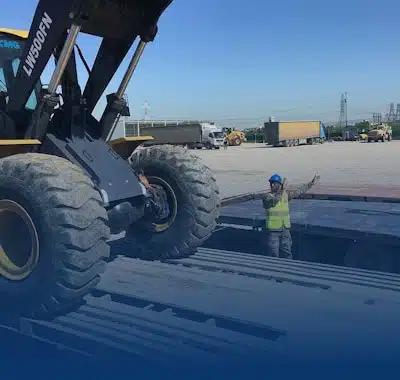
Some double-drop cargo can be loaded by crane, forklift, or other lifting support. Some equipment may need ramps, winching, or a different trailer style. If the load needs to drive onto the trailer from the front, an RGN may be more practical. If the cargo needs to be lifted into the well, the site must have the right support equipment and space.
The loading method matters because the lower center well does not automatically mean the cargo is easy to place. A double-drop can solve height while still requiring careful loading coordination.
Double-drop trailers can help with stability
Lowering the cargo can also improve stability. When a tall load rides lower, the center of gravity may sit closer to the road. That can make the load feel more controlled during turns, braking, and road transitions.
This is especially useful for tall cargo that is stable once placed but would ride too high on a flatbed or step deck. A lower travel profile helps the load behave more predictably.
Still, stability depends on more than deck height. Weight distribution, securement, route condition, and driver control all matter.
Double-drops are not always the best trailer
A double-drop is useful for height reduction, but it is not the answer for every oversized load. Another trailer may be better if the main challenge is weight, length, loading access, or axle distribution.
A double-drop may not be ideal when:
- the load is extremely heavy and needs more axles
- the cargo is too long for the well
- the machine needs RGN front loading
- the cargo is simple enough for a step deck or flatbed
- the pickup or delivery site cannot support the loading method
- the route has problems that height reduction alone cannot solve
The trailer should solve the dominant constraint without creating avoidable complications elsewhere.
Double-drop vs step deck: the height difference matters
A step deck can help with moderate height concerns, but a double-drop usually gives more height reduction. If a load is only slightly too tall for a flatbed, a step deck may be enough. If the load is seriously height-sensitive, a double-drop may be the better option.
The decision depends on the actual loaded height, not just the cargo type. A machine or industrial component should be measured in its real transport position before the trailer is selected.
What customers should share before requesting a double-drop move
Customers can help the carrier decide whether a double-drop trailer is needed by providing clear cargo and site details.
Helpful information includes:
- cargo height, width, length, and weight
- photos of the load
- whether the cargo can be reduced in height
- support-point or lifting-point details
- whether crane or forklift loading is available
- pickup and delivery access conditions
- overhead hazards near either site
- delivery deadline or timing restrictions
These details help confirm whether the double-drop solves the real problem or whether another trailer type would be better.
Conclusion
Double-drop trailers reduce transport height by carrying cargo in a lower center well between the front and rear deck sections. They are useful when tall equipment, machinery, tanks, vessels, or industrial components need more clearance than a flatbed or step deck can provide.
The main value of a double-drop trailer is height control. When the cargo fits the well, the route has overhead restrictions, and the loading method is practical, a double-drop can make an overheight move safer, cleaner, and easier to plan.