Modular trailers support oversized industrial cargo by giving carriers a trailer system that can be configured around the load instead of forcing the load to fit a standard deck. Some cargo is too heavy, too dense, too unusual in shape, or too sensitive for a normal trailer setup. A transformer, pressure vessel, plant component, mining module, large generator, or industrial assembly may need a trailer arrangement built around its weight, support points, route limits, and final delivery conditions.
That is where modular trailers become valuable. They are used when the cargo needs more than a basic hauling platform. The trailer becomes part of the engineering plan, helping distribute weight, support the cargo correctly, and make difficult industrial moves more controlled.
Modular trailers are used when standard trailers are not enough
A standard trailer works when the cargo has manageable size, weight, and support needs. Modular trailers are used when those limits are pushed further. The load may be extremely heavy, unusually shaped, or built with support requirements that do not match a simple trailer deck.
Modular trailers can be configured with different axle lines, deck sections, steering options, and support arrangements depending on the project. That flexibility makes them useful for oversized industrial cargo that would be difficult or impossible to move safely on a conventional trailer.
Within the larger group of heavy haul trailer types and when each one is used, modular trailers usually sit at the more specialized end because they are selected for cargo that needs custom planning.
Industrial cargo often needs engineered support
Industrial cargo may look strong from the outside, but it often needs careful support during transport. A vessel may need saddles. A transformer may need specific base support. A large machine may need reinforced contact points. A modular plant component may need support under certain structural members.
A modular trailer can help because the trailer setup can be adjusted to match the cargo’s support needs. This matters when the load should not be supported randomly across a flat surface.
A good support plan considers:
- where the cargo is designed to carry weight
- whether support beams or saddles are needed
- whether the load has weak or sensitive contact areas
- whether the cargo must stay level
- whether the support system can handle road movement
The goal is to move the cargo without twisting, stressing, or damaging it before it reaches the site.
Weight distribution is one of the biggest reasons to use modular trailers
Many oversized industrial loads are not only large. They are extremely dense. That means the weight may be concentrated in a smaller footprint, which can create problems for axles, bridges, pavement, and permits.
Modular trailers help spread that weight across more axle lines or a more suitable trailer configuration. This can make the load easier to review for route approval and safer to move through infrastructure.
The same weight-management logic appears when multi-axle trailers are used for extreme heavy haul loads, but modular trailers can offer even more configuration flexibility for complex industrial cargo.
Modular trailers can be configured around the route
The route often decides how the trailer must behave. A heavy industrial load may need more axles for bridge limits, steering control for tight turns, or special support for uneven final-mile access. Modular trailer systems can be arranged to better match those route demands.
This can help with:
- bridge loading concerns
- tight industrial access roads
- plant entrances
- remote project sites
- heavy turning movements
- staging and final placement
- road sections with strict weight limits
The trailer is not selected only for the cargo. It is selected for the cargo moving through a specific route.
Steering control can matter on tight industrial moves
Some modular trailer systems offer steering features that help move large cargo through tight spaces. This can be important for industrial plants, refineries, power facilities, construction sites, mining locations, and ports where standard turning space may not exist.
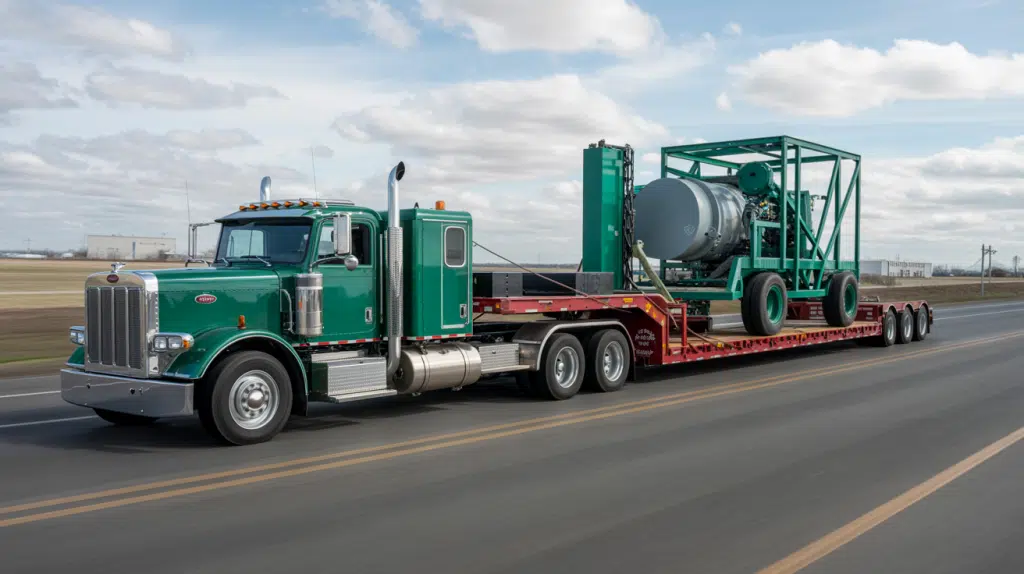
A long or heavy industrial load may need controlled steering to clear gates, turn around structures, avoid equipment, and enter a staging area correctly. Without that control, the cargo may fit the road in theory but fail during the final approach.
For difficult industrial cargo, maneuverability can be just as important as capacity.
Modular trailers help with project cargo and multi-load work
Large industrial projects often involve more than one shipment. A plant relocation, energy project, refinery upgrade, or infrastructure installation may include several oversized components that need to arrive in the right order.
Modular trailers can support these projects when one or more loads are too heavy or unusual for standard equipment. The trailer setup can be planned around each component’s role in the project, not just its physical size.
That matters because industrial cargo usually does not arrive just to sit in a yard. It often supports installation, assembly, replacement, or production work.
Cargo shape affects modular trailer planning
Not every industrial load has a simple rectangular base. Some cargo is round, tall, offset, uneven, or built with unusual connection points. That shape affects how the trailer should be configured and how the cargo should be restrained.
For example:
- a vessel may need curved support
- a transformer may need base-frame support
- a plant module may need multiple support points
- a mining component may have uneven weight concentration
- a large assembly may need protection from flex or twist
Modular trailers help because they allow more planning around the load’s real shape instead of relying on a generic deck layout.
Loading and unloading require more coordination
Modular trailer moves usually need careful loading and unloading plans. The cargo may require cranes, gantries, jacking systems, skidding systems, or other controlled handling methods. The trailer must be positioned correctly, and the support system must be ready before the load is placed.
At delivery, the same care is needed. The site must have enough space, stable ground, and the right unloading support. If the load needs to be placed directly onto a foundation, pad, or installation area, the trailer plan must support that final step.
A modular trailer move is rarely just “load and go.” It is usually a coordinated project movement.
Modular trailers can affect permits and cost
Because modular trailers are more specialized, they can affect permitting, route review, escort needs, staging, and overall cost. More axle lines, unusual configurations, or heavier loads may require deeper review by permitting agencies.
That added complexity is not a problem when the cargo requires it. It becomes valuable because the trailer setup helps make the move possible.
The customer should understand that modular trailer use is usually driven by real project constraints: extreme weight, special support needs, route restrictions, or industrial delivery requirements.
When modular trailers are usually the right choice
A modular trailer may be the right choice when:
- the cargo is extremely heavy
- the load has unusual support requirements
- weight must be spread across more axle lines
- the route has bridge or infrastructure concerns
- the cargo is industrial, project-critical, or high-value
- final-mile access needs more control
- the load shape does not fit standard trailer support
- the move requires a custom configuration
In these cases, the modular trailer is not extra equipment for appearance. It is the system that allows the move to be planned safely.
When another trailer may be enough
A modular trailer is not needed for every oversized load. If the cargo can move safely on a lowboy, RGN, step deck, double-drop, extendable trailer, multi-axle trailer, or flatbed, a simpler setup may be more practical.
Another trailer may be better when:
- the load is mainly tall, not extremely heavy
- the cargo is long but not unusually dense
- the machine needs drive-on loading
- the load has simple support needs
- the route does not require advanced axle configuration
- the project does not justify modular complexity
The best trailer is the one that fits the cargo without adding unnecessary cost or complication.
What customers should share before a modular trailer move
Customers can help the carrier evaluate whether modular trailers are needed by sharing accurate cargo and site details early.
Helpful information includes:
- confirmed weight
- full dimensions in shipping condition
- center-of-gravity details if available
- lifting and support-point drawings
- cargo photos
- site access details
- unloading method
- foundation or final placement requirements
- delivery deadline
- known route or bridge concerns
These details help the carrier decide whether a modular trailer system is necessary and how it should be configured.
Conclusion
Modular trailers support oversized industrial cargo by allowing the trailer system to be configured around extreme weight, unusual shape, special support needs, route restrictions, and final delivery requirements. They are used when standard trailers do not provide enough flexibility, axle support, or control for the load.
The core value of a modular trailer is adaptability. When the cargo is too heavy, too complex, or too project-critical for a standard setup, a modular trailer can turn a difficult industrial move into a controlled transport plan.