Telehandlers are prepared for heavy haul transport by controlling the boom, forks, tires, weight balance, trailer position, and delivery access before the machine is loaded. A telehandler may look easier to move than a crane or excavator, but its boom, reach, frame height, steering style, and attachments can create transport details that should be checked early.
On a construction site, a telehandler is often needed for material handling, pallet movement, roof work, framing support, masonry work, or site logistics. Because it serves so many roles, it may be moved between jobs often. That frequent movement can make the machine feel routine, but safe transport still depends on preparation.
Telehandler transport starts with boom position
The boom is the most important feature to prepare before transport. If it is raised, extended, or left in an awkward position, it can increase transport height, affect balance, or create unnecessary movement risk.
Before loading, the boom should usually be lowered, retracted, and placed in the proper travel position. This helps reduce the machine’s overall profile and keeps the center of gravity more controlled.
When construction site equipment and machinery is moved by heavy haul transport, every machine needs to be prepared according to how it actually works. For telehandlers, that starts with the boom because the boom changes both height and balance.
Forks and attachments should be checked before loading
Telehandlers may travel with forks, buckets, platforms, truss booms, jibs, or other attachments. These attachments can change the machine’s length, height, width, and securement needs. Forks can also create contact risks if they are left in a poor position.
Before the machine is loaded, the crew should confirm:
- which attachment is installed
- whether the attachment should stay mounted
- whether forks should be lowered, removed, or secured
- whether the attachment changes transport dimensions
- whether it blocks safe tie-down access
- whether it affects unloading at the destination
A telehandler body may fit the trailer, but the attachment can still create the real transport issue.
Tires and steering condition matter during loading
Telehandlers usually ride on large tires and often use different steering modes, depending on the model. That makes tire condition and steering response important before loading. A soft tire, damaged tire, weak braking response, or steering issue can make trailer approach harder than expected.
The loading crew should confirm that the telehandler starts, drives, steers, and brakes properly. If it does not, the loading method may need to change. A non-running telehandler may require a winch, forklift support, crane support, or another controlled loading method.
A machine that is easy to maneuver on site can still become difficult if it is not mechanically ready for loading.
Trailer choice depends on height and loading method
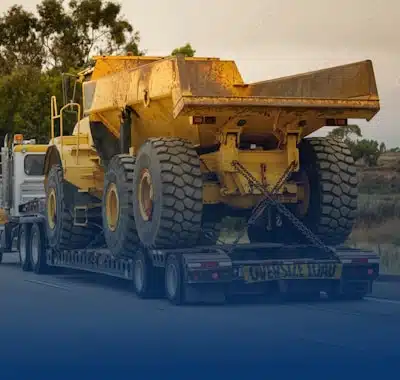
Telehandlers can be tall, especially when cab height, boom structure, tires, and attachment position are considered together. A lower trailer may be needed if the loaded height creates clearance concerns. The trailer also needs to support the machine’s weight and allow the telehandler to load without a steep or unstable approach.
The best trailer setup usually depends on:
- transport height
- machine weight
- tire position and wheelbase
- boom and attachment configuration
- loading surface
- route restrictions
- delivery-site unloading conditions
The trailer should fit the telehandler’s full travel profile, not just the machine body.
Loading should be slow and straight
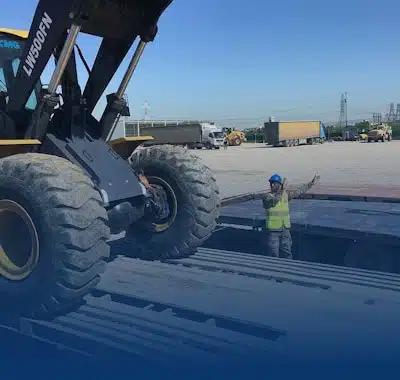
Telehandlers are usually driven onto trailers, but that process still needs control. The machine should approach the trailer in a straight line, with the boom and attachment in transport position. Spotters should guide the operator because the cab view may not show every ramp edge or trailer boundary clearly.
Loading becomes harder when the ground is soft, the ramp angle is steep, or the site is crowded. A telehandler can feel stable on site but still pitch or shift during the transition from ground to trailer deck.
The safest loading process is calm, slow, and guided. If the machine needs sharp corrections while climbing, the setup should be checked before continuing.
Deck placement affects balance and securement
Once the telehandler reaches the trailer deck, it must be placed correctly. The machine should sit where the trailer can carry the weight safely and where the crew can secure it through proper tie-down points.
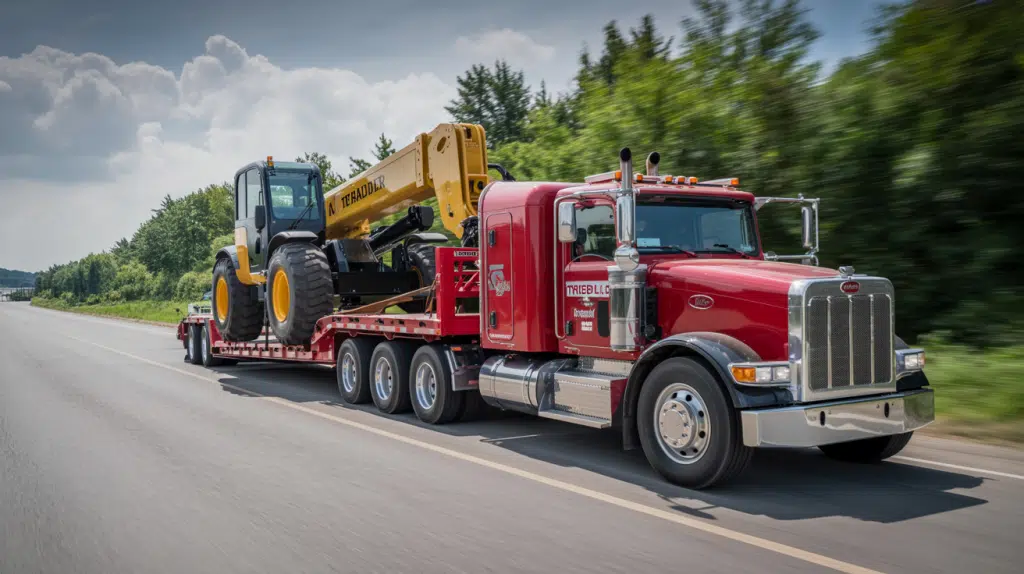
Poor placement can create:
- uneven axle loading
- weak securement angles
- poor trailer balance
- blocked tie-down access
- difficult unloading at delivery
- extra stress during braking or turns
A telehandler’s weight may not feel as extreme as some larger construction machines, but its height and boom structure make stable deck placement important.
Securement should control the machine and the attachment
Telehandler securement must hold the machine body and control the attachment. The boom should be settled in travel position, and any forks or mounted tools should be restrained so they cannot bounce, shift, or create contact damage during the move.
Securement should avoid weak points, hydraulic hoses, guards, panels, and parts not designed to receive tie-down force. The machine should be held through proper restraint points with angles that control forward, backward, side, and vertical movement.
A telehandler should arrive with the boom and attachment still in the same safe travel condition in which they were loaded.
Delivery access should be checked before transport
Telehandlers are often delivered to active construction sites where space is limited. The delivery site may have stored materials, unfinished ground, narrow entrances, overhead wires, or other machines working nearby. If the trailer cannot stage and unload safely, the delivery can delay the project.
Before delivery, the site should confirm:
- correct gate or entrance
- unloading area
- ground stability
- overhead clearance
- machine path after unloading
- final parking or work position
- site contact
- whether the trailer can exit after unloading
This is especially important because telehandlers are often needed in tight parts of a job site where material handling starts quickly after delivery.
Telehandler delivery should match site workflow
A telehandler may be needed for unloading materials, lifting pallets, supporting framing crews, moving masonry supplies, or assisting other trades. If it arrives too late, crews may wait. If it arrives too early, it may block the site before it is needed.
That timing is closely related to how heavy haul delivery timing affects construction projects, because a telehandler is often part of the site’s daily workflow rather than a machine that can simply sit anywhere.`
The best delivery window is the one that matches both site readiness and crew need.
What contractors should prepare before moving a telehandler
Contractors can make telehandler transport smoother by providing accurate details before scheduling the move.
Helpful information includes:
- telehandler make and model
- operating weight
- boom height in travel position
- attachment details
- tire condition or known machine issues
- whether the machine runs and drives
- pickup and delivery site photos
- access restrictions
- ground condition at both sites
- required delivery timing
- site contact information
These details help the carrier select the right trailer, loading method, route, and delivery plan.
Conclusion
Telehandlers are prepared for heavy haul transport by lowering and securing the boom, checking forks and attachments, confirming machine condition, choosing the right trailer, loading slowly, placing the machine correctly on the deck, and planning delivery around site access.
A telehandler is a practical construction machine, but its height, boom, tires, and attachments make transport preparation important. When those details are handled before loading, the machine can arrive safely, unload smoothly, and support the construction site without unnecessary delay.