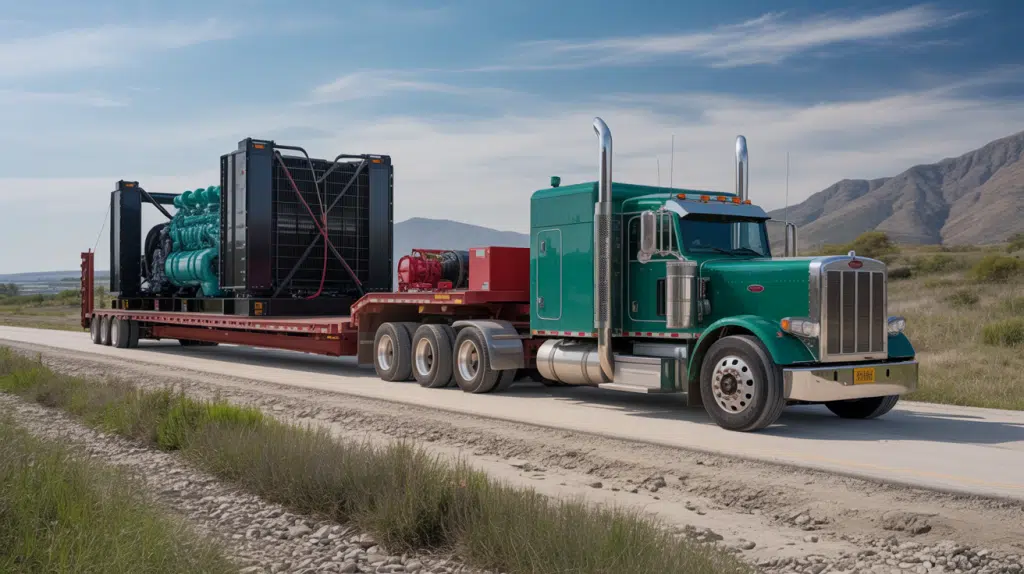
Industrial generators and power units do not usually look as dramatic as cranes, excavators, or mining machines. They sit still. They often have clean rectangular frames. From a distance, they can even look simple to haul. In real transport planning, though, they create a different kind of challenge. Their weight is often dense, their lifting points are critical, and their value can be high enough that vibration, poor blocking, or rough handling turns into expensive damage very quickly.
That is why moving a generator safely is less about “can it fit on the trailer?” and more about “can it stay protected, supported, and stable for the entire trip?” For the broader machine-by-machine view behind this, see how different types of heavy equipment are transported safely, where the transport method is shaped by the load itself.
A generator is static equipment, but transport still creates movement
Unlike a dozer or backhoe, a power unit does not roll onto a trailer and sit there naturally. It has to be lifted, placed, supported, and restrained correctly from the start. Once it is on the deck, the danger is not that it will “operate” during travel. The danger is that road shock, deck flex, braking, and vibration will work through the frame, mounts, housing, and connection points over time.
That makes generator hauling feel different from machine hauling. The cargo may be still, but the transport forces are not.
Support points matter more than many people expect
A generator frame is not meant to be treated like a random steel block. It has structural support zones, lifting provisions, and weight concentrations that should be respected during loading and transport. If support is placed badly, the frame can carry stress in ways it was never meant to handle.
That is why preparation usually starts with confirming:
- where the actual lifting or support points are
- whether the base frame needs cribbing or spread support
- how the weight is concentrated within the unit
- whether the trailer deck can support that footprint cleanly
The cleaner the support plan, the calmer the move tends to be.
Lifting is usually the first real test
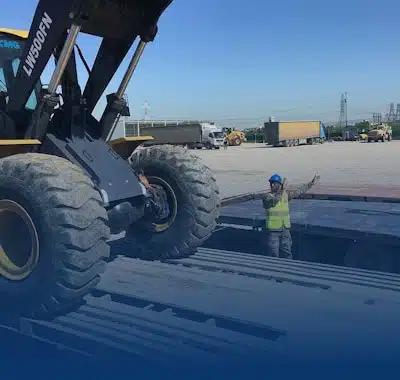
With many generators and power units, loading is not drive-on loading. It is a lift. That changes the whole process. The transport team must know whether the unit is picked by crane, forklift, or another lifting method, and the lifting method must respect the manufacturer’s frame and balance requirements.
This means the transport plan often needs to answer:
- how the unit will be lifted safely
- whether lifting lugs or base frame points are confirmed
- whether spreader bars or specific rigging methods are needed
- whether the loading site gives enough room for a clean lift and placement
Once a load begins in a poor lifting position, the rest of the haul often becomes harder to trust.
Dense weight can create axle trouble faster than expected
A generator may not be as large as a crane body, but it can still be deceptively heavy for its footprint. That density matters because it can create concentrated loading on the trailer and across axle groups. A load that seems modest in overall dimensions can still become a permit or handling issue if it is placed poorly.
That is why dense power units are often better planned with the same discipline used in axle weight distribution planning. The trailer has to carry the weight correctly, not just carry it somehow.
Protection matters as much as restraint
Some heavy equipment can tolerate rougher treatment than others. Generators and power units usually reward the opposite approach. They may contain cooling systems, enclosed housings, vibration-sensitive components, electrical sections, and connection points that should not be exposed to unnecessary shock or rubbing.
A better transport plan usually focuses on:
- keeping the unit square and fully supported
- avoiding metal-to-metal stress points
- protecting corners, housings, and exposed components
- using restraint that controls movement without crushing or distorting the frame
In that sense, generator transport is often closer to controlled industrial freight than to machine hauling.
Trailer choice should match the load profile, not just the weight rating
It is easy to think that any trailer with enough capacity will work. In practice, deck height, support area, and loading method still matter. Some generators are easier to haul on lower-profile setups because lower deck height improves stability and makes lifting or placement easier to manage. Others need more open deck access or different securement geometry depending on the frame.
The right trailer usually depends on:
- how the unit is loaded
- how much support the base frame needs
- how travel height affects the route
- whether the securement angles are actually workable
If route height is already tight, that planning may also need to align with low-clearance planning for oversized loads, especially when the generator enclosure or skid base adds more profile than expected.
Weather, vibration, and distance affect “quiet cargo” more than people realize
A generator may not have tracks, wheels, or booms, but it still reacts to a long trip. Bad pavement, repeated braking, rough bridge transitions, and temperature shifts can all affect how the unit rides and how its mounting points respond over time. On shorter trips, those forces may remain invisible. Over long distances, they become more meaningful.
That is why route quality and stop planning still matter. Dense, valuable cargo benefits from:
- smoother routes where possible
- early inspection stops
- securement checks after the first miles
- enough margin in the trip plan to avoid rushed handling
The quieter the load looks, the easier it is to forget how much the road is still working on it.
What should be confirmed before pickup
The cleanest generator moves usually begin with a few accurate details:
- exact model and operating weight
- base frame dimensions
- approved lifting points
- any sensitive external parts or connection panels
- whether the unit is enclosed, open-frame, or skid-mounted
- loading conditions at pickup and unloading conditions at delivery
These details help the team choose a method that protects the unit instead of improvising once it is already at the trailer.
Conclusion
Need professional heavy equipment transport? Freedom Heavy Haul provides reliable, cost-effective shipping for machinery and oversized loads nationwide.
Moving industrial generators and power units safely depends on controlled lifting, correct frame support, stable trailer placement, and securement that protects both movement and structure. These loads may look less dramatic than excavators or bulldozers, but they often demand more discipline in support, restraint, and handling because their weight is dense and their value is high. When the transport plan respects how the unit is built and how the road will affect it, the move becomes smoother, safer, and much easier to trust from pickup to delivery.