Mining equipment does not move on ordinary transport logic. A haul truck component, shovel section, crusher module, drill assembly, or processing unit may be too heavy for a routine trailer setup, too large for a simple permit route, or too critical to arrive out of sequence. In mining work, the transport plan must serve the equipment and the operation at the same time. If either one is ignored, the move becomes harder, slower, and far more expensive than it needed to be.
That is why mining logistics sits naturally inside heavy haul transport solutions across construction, energy, agriculture, and industry. The cargo is heavier, the access is rougher, and the operational pressure is often higher than in more conventional equipment moves.
Mining transport starts long before the truck is loaded
A mining move rarely begins with a trailer backing into place. It usually begins with questions.
Is the equipment moving as one piece or as a sequence of components?
Can the mine road, plant road, or public route actually handle the setup?
Will the receiving site be ready when the cargo arrives?
Does the cargo need cranes, jacking, skidding, or modular axle support?
Those questions matter because mining equipment often sits at the extreme end of heavy haul planning. A mistake with a compact machine may cause delay. A mistake with mining cargo can affect route engineering, escort coordination, lift planning, site readiness, and project cost all at once.
The cargo is often larger than the highway assumptions around it
Mining equipment tends to break normal assumptions. The parts are not only heavy. They are often tall, wide, dense, and awkward in ways that standard freight systems were never designed to carry. A haul truck body may create width and height issues. A crusher module may create concentrated support demands. A shovel component may change both axle strategy and bridge feasibility before the trip is even permitted.
That is why mining freight must be planned from the cargo outward, not from the trailer inward.
One machine can become several separate heavy haul problems
A mining machine may work as one system in the field, but it often travels as multiple engineered loads. That changes everything. The body, frame, attachments, modules, supports, and auxiliary components may each need different loading methods, different trailers, and sometimes different route conditions.
This is where mining logistics becomes less like “hauling equipment” and more like staged project movement. The question is no longer just how to move the machine. The question becomes how to move the right parts in the right order so the receiving site can actually use them.
Weight density often becomes the first technical constraint
With some industries, width or height causes the first transport problem. In mining, dense weight often appears first. A component may be compact enough to look manageable, yet still overload axle groups quickly if it is placed carelessly or matched to the wrong equipment.
That is why mining moves often depend on:
- strong trailer support
- accurate weight confirmation
- careful axle-group planning
- correct placement before permits are finalized
- route checks that account for bridges and road structure, not just clearance
In practical terms, this is the same discipline behind transporting plant and industrial machinery safely, but mining cargo usually pushes those support and weight questions much further.
Mine access roads and final-mile conditions deserve their own planning
A transport route may look acceptable until the final miles begin. That is often where mining projects become demanding. Access roads may be steep, narrow, temporary, dusty, unpaved, or structurally limited. Turning space may be restricted. Staging areas may be active with other site traffic. Delivery conditions may change with weather.
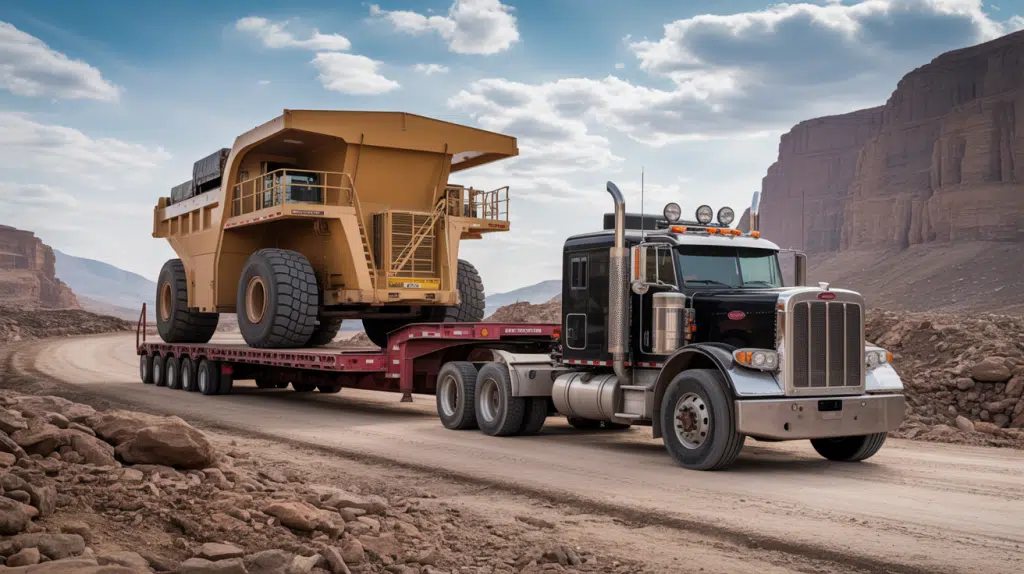
Because of that, mining logistics should not treat the “site approach” as a minor detail. It is often the place where the clean public-road plan meets the real operating environment.
A strong final-mile review usually asks:
- can the trailer actually turn where it needs to turn
- can the road surface support the loaded setup
- is there enough room to stage cranes or support vehicles
- can the site receive the load in the sequence required
- will unloading conditions change during the chosen delivery window
Modular and specialized setups are often necessary, not optional
Large mining components frequently exceed what common heavy haul setups can manage efficiently. That is where modular axle systems, specialized trailers, engineered support frames, and staged unload plans become essential.
The reason is simple. Mining loads do not forgive lazy equipment matching. When the setup is wrong, the route gets harder, the site gets tighter, and the transport becomes reactive. When the setup is right, the move feels calmer, even if the cargo is enormous.
Sequence matters because delivery is part of the operation
Mining transport is closely tied to uptime, shutdown windows, maintenance planning, and production schedules. That means a component arriving safely but out of sequence can still hurt the project. A site may need structural sections before attachments. A maintenance team may need a replacement module at a very specific time. A shutdown may allow only a narrow unloading window.
This is why the best mining logistics plans care deeply about order:
- what must arrive first
- what can stage separately
- what unloading resources will be ready
- how the move fits the operating calendar at the site
A good heavy haul move does not just deliver equipment. It delivers usefulness.
Securement and support should reflect the equipment’s real load path
Mining equipment often includes reinforced areas that carry transport weight correctly, and other areas that should not be asked to carry that force at all. This becomes especially important with large structural pieces, modules, and dense assemblies that appear rugged from the outside but still have very specific support requirements.
That is why a proper mining move should answer:
- where should the equipment be supported
- where should restraint forces be applied
- which areas can tolerate vibration and which cannot
- whether the load path during travel matches the way the component is actually built
If those answers are vague, the transport plan is not ready.
Customers usually need more than “a quote and a trailer”
Mining clients often need confidence that the carrier understands remote access, heavy components, staging order, site coordination, and infrastructure limitations. They are not only buying trailer space. They are buying control.
That confidence grows when the hauling team can clearly explain:
- how the load will be broken down
- which trailer setup fits which component
- why the route has been chosen
- how the final-mile delivery will be handled
- what the site should prepare before the convoy arrives
In mining logistics, clarity is part of the service.
Conclusion
Heavy haul solutions for mining equipment logistics work best when the move is treated as an engineered project, not a routine shipment. Mining cargo often brings extreme weight, awkward dimensions, rough access conditions, staged delivery requirements, and very little tolerance for transport mistakes. When trailer choice, axle planning, support geometry, route review, and delivery sequence are aligned to the real equipment and the real site, the haul becomes predictable instead of reactive. That is the standard mining logistics requires: not just enough transport to move the load, but enough planning to make the entire move usable from the moment it arrives.