Manufacturing and plant machinery is often more sensitive than it looks. A press, mixer, conveyor section, CNC unit, packaging line component, or processing machine may not appear as rugged as construction equipment, yet it can be more demanding to move correctly. The weight may be concentrated into a tight footprint. The frame may need support at precise points. Internal components may tolerate very little twisting, shock, or vibration. Because of that, plant machinery transport is not just a hauling job. It is a stability and protection job.
That is why industrial machinery moves best when the transport plan respects how the machine was built to stand, lift, and operate. Once those conditions are understood, the haul becomes less risky and much more controlled.
This kind of planning belongs naturally within heavy haul transport across construction, energy, agriculture, and industry, because manufacturing cargo follows a different transport logic than field equipment, farm machines, or public-works loads.
Industrial machinery usually creates a support problem before it creates a route problem
With a dozer or loader, people often worry first about trailer loading or route height. With plant machinery, the first concern is often support. The machine may be dense, rigid in some places, and vulnerable in others. It may sit on a base frame that must be supported evenly. It may also include precision components, housings, piping, or mounted assemblies that should not absorb transport stress carelessly.
That is what makes manufacturing transport feel different. The machine may not be especially dramatic from the outside, yet the wrong support decision can create hidden damage long before the delivery is complete.
The shipping position should be confirmed before the lift is planned
A plant machine should never be treated like a simple steel box. Before any crane, forklift, or trailer work begins, the machine’s transport condition should be clear.
That usually means confirming:
- the true shipping weight
- the approved lifting points
- the base-frame dimensions
- the real center of gravity
- whether accessories, guards, or mounted assemblies should be removed
- whether the machine must remain upright or travel in one fixed orientation
These details decide whether the move will feel measured or improvised.
Base frames and support points matter more than appearance
Industrial machinery often hides its real load path. A clean enclosure may suggest the machine can be supported anywhere along the underside, but that is often not true. The actual support points may sit at a few reinforced locations, and uneven deck contact can introduce unwanted stress into the frame.
That is why a safe move usually depends on:
- matching the trailer deck to the machine’s support geometry
- blocking or cribbing where the load path is intended to be carried
- avoiding casual support under weak or non-structural sections
- making sure the unit settles squarely before final securement
A machine that looks level is not always a machine that is supported correctly.
Loading method should protect the machine before it protects the schedule
Some industrial units can be loaded by crane. Others may be lifted by forklift, rollback, gantry, skate system, or another controlled method. The safest choice usually comes from asking how the machine can be placed without frame distortion, sudden shock, or unstable transition onto the trailer.
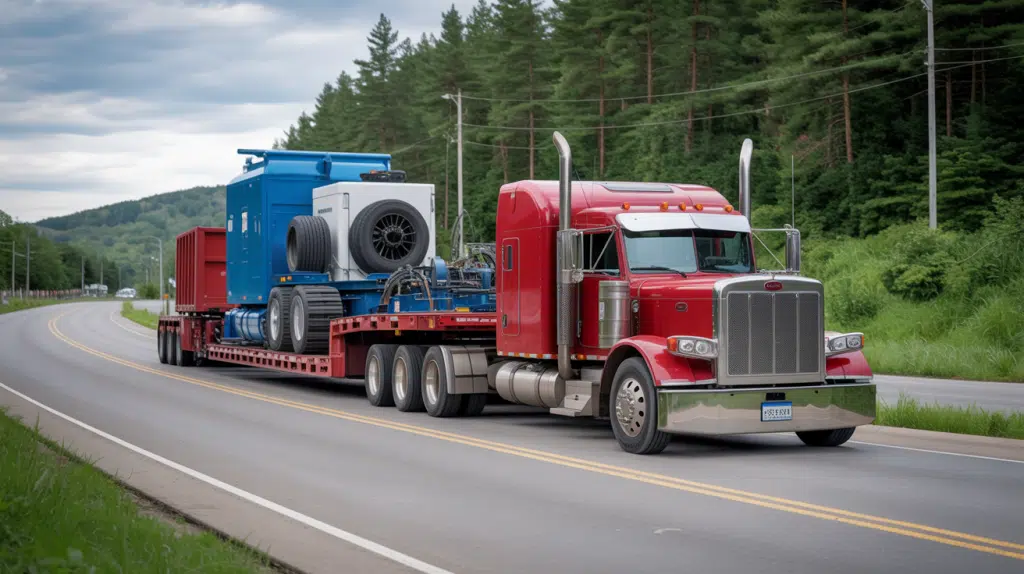
That is one reason manufacturing cargo sometimes shares transport logic with moving industrial generators and power units by controlled loading methods, because both categories often depend on support, lifting discipline, and dense weight carried through a limited footprint.
Trailer choice should follow support geometry, deck stability, and route reality
Plant machinery often does not need the same trailer style as tracked construction equipment, but trailer selection still matters deeply. A trailer that is too high can complicate route clearance. A deck that is too flexible can work against a rigid machine base. A layout that leaves poor securement angles can make a stable-looking load less secure than it appears.
A safer trailer decision usually accounts for:
- deck capacity and stiffness
- how the machine base contacts the deck
- whether height is route-sensitive
- whether axle distribution can stay compliant
- whether the trailer allows proper securement without forcing bad restraint angles
When height and route geometry become more important, these decisions also connect to how cargo type changes heavy haul planning requirements, because industrial machinery proves clearly that dense cargo and sensitive cargo are not always planned the same way.
Vibration control is part of machinery protection
Manufacturing equipment may include aligned components, precision internals, mounted controls, or assemblies that are harder to replace than the machine’s exterior suggests. Because of that, safe transport is not only about preventing visible movement. It is also about reducing unnecessary vibration, rubbing, or frame stress over the full trip.
That means securement should do more than hold the machine down. It should help the machine ride quietly.
A good setup usually aims to:
- keep the unit seated firmly on the deck
- prevent walking or micro-shifting during travel
- avoid point-loading weak components
- control contact between the machine and any blocking or restraints
- encourage a steady ride instead of a harsh one
Calm transport is especially valuable with industrial machinery, because the cost of hidden stress may not show up until installation or commissioning.
Site coordination matters because plant deliveries are often sequence-sensitive
Manufacturing and plant machinery is frequently delivered into controlled environments rather than open sites. A facility may have limited dock space, shutdown windows, forklift schedules, crane bookings, or installation sequencing that affects when the machine can actually be received. In those situations, “delivered today” is not always the same as “delivered usefully.”
That is why delivery planning should confirm:
- unloading method at the destination
- whether the facility floor or staging area is ready
- if the machine must arrive in a specific sequence
- whether access restrictions change by shift, traffic, or plant operations
The smoother the delivery sequence, the safer the overall move usually feels.
What plant teams should confirm before transport begins
The cleanest machinery moves usually begin with accurate information from the facility or project side. Before dispatch, it helps to confirm:
- exact machine identity and shipping weight
- approved lifting and support points
- whether any components should travel separately
- final transport dimensions
- pickup and delivery access conditions
- whether the machine is sensitive to tilt, vibration, or shock
- whether the installation team needs the unit in a specific unloading order
These details reduce guesswork, and less guesswork usually means less risk.
Conclusion
Transporting manufacturing and plant machinery safely depends on understanding that industrial equipment is often more sensitive than it appears. The machine’s base frame, support points, lift method, transport orientation, and vibration tolerance all matter before the road movement even begins. When the trailer is chosen for support and stability, the machine is loaded through its real load path, and the delivery is coordinated around plant conditions, the haul becomes far more controlled. That is what safe industrial machinery transport should deliver in practice: not just arrival, but arrival without unnecessary stress on the equipment or the operation waiting for it.