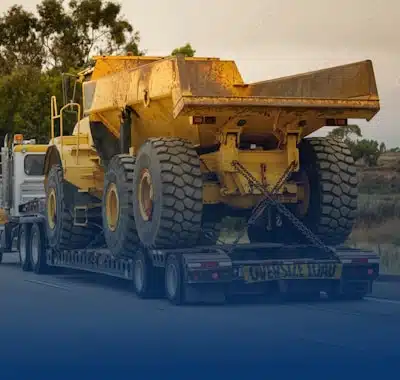
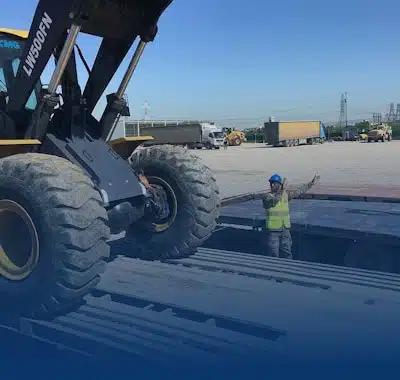
Attachment position can change a securement plan before a chain is ever tightened. A bucket left high, a boom stretched too far, a blade angled poorly, or forks left in the wrong position can change the machine’s height, balance, movement risk, and tie-down geometry. The equipment may be the same machine, but once the attachment changes position, the transport load changes too.
That is why attachment control is a core part of heavy haul load securement and damage prevention. The machine body may be properly placed on the trailer, but an attachment that can move, bounce, swing, rub, or increase clearance risk can still make the haul unsafe or damaging.
Attachments change the machine’s transport shape
Heavy equipment is designed to work with moving parts. Those parts are useful on a job site, but during transport they must be controlled. A loader bucket, excavator arm, dozer blade, forklift mast, grapple, ripper, or auger can extend beyond the machine’s main body and change the way the load fits on the trailer.
That affects:
- overall height
- transport width
- front-to-rear balance
- securement access
- clearance under bridges or utility lines
- contact points between the machine and trailer
A machine that fits legally with the attachment lowered may become overheight with the same attachment raised. That small position change can affect permits, routes, and safety.
Raised attachments create unnecessary movement risk
A raised attachment carries energy. It can bounce, vibrate, settle, or shift during transport. Even if the machine itself is restrained, a raised or unsupported attachment may still move enough to create damage or clearance problems.
For example, a raised bucket can place extra weight forward. A raised boom can increase travel height. A loose fork carriage can create vibration. A poorly controlled ripper can add rear overhang and stress. These are not separate from securement; they are part of the securement problem.
The safest transport position is usually the most compact and stable position the machine can safely travel in.
Lowering an attachment often improves both safety and balance
Lowered attachments usually reduce movement potential and help keep the machine’s profile more compact. A lowered bucket, blade, or fork set can reduce height and bring the machine closer to a stable travel condition. This also helps securement gear work more predictably because the attachment is not acting like a loose extension of the machine.
However, “lowered” does not always mean “safe.” The attachment still needs to be positioned so it does not:
- scrape the trailer deck
- overload a weak contact point
- block tie-down access
- create sharp rubbing points
- shift against chains or straps
The goal is not simply to lower the attachment. The goal is to place it where it supports safe travel.
Attachment position affects tie-down angles
Tie-down angles decide how restraint force works. If an attachment blocks access to proper tie-down points, the crew may be forced into weaker angles or less effective restraint paths. That can make the securement system look tight while reducing its ability to control real movement.
For example, a bucket or blade may block a clean forward pull. A boom position may limit access to frame points. Forks may create contact areas where chains or straps rub during vibration. When that happens, the attachment position should be adjusted before the securement plan is finalized.
Good securement begins with good access.
Attachments can hide damage risks
Some attachment-related damage does not come from the attachment moving dramatically. It comes from quiet contact. A chain may rub against a bucket edge. A strap may cross a sharp corner. A lowered blade may sit too close to the deck. A boom or arm may rest where vibration creates repeated pressure.
These risks often appear after miles of travel, not at the loading site. That is why attachment position should be checked during the same careful process used when pre-transport inspections identify equipment damage risks before the move begins.
Some attachments should travel separately
Not every attachment belongs on the machine during transport. Some tools create too much height, width, imbalance, or securement complexity. In those cases, removing the attachment and hauling it separately can make the entire move safer and simpler.
Separate transport may make sense when:
- the attachment increases overall width or height too much
- the tool creates poor balance
- the attachment has sharp or fragile parts
- securement points are blocked
- the route becomes easier with the machine in a smaller profile
This decision can feel slower at pickup, but it may save time by reducing route restrictions and damage risk later.
Buckets, blades, forks, booms, and rippers each need different handling
Attachments should not all be treated the same way.
A bucket usually needs to be lowered and positioned to avoid bounce or deck damage. A blade should be set so it does not scrape, shift, or create front-heavy stress. Forks should be lowered, secured, or removed so they cannot slide or create a hazard. A boom or arm should be tucked into a compact travel position. A ripper should be controlled so it does not create rear clearance or contact problems.
The right position depends on the machine, the trailer, and the route.
Attachment locks and transport pins should be confirmed
Some machines have locks, pins, latches, or transport supports that help hold attachments in place. These should be checked before the machine is treated as road-ready. If a lock is missing, damaged, or not fully engaged, the attachment may move even when it appears properly positioned.
A useful check asks:
- is the attachment fully lowered or locked
- are pins or latches engaged
- can the attachment bounce during vibration
- does it need separate restraint
- will it stay in the same position after the first miles
This simple check can prevent a surprisingly large number of transport problems.
Attachment position affects route clearance
A machine’s legal height or width is not always fixed. It may depend on how the attachment is positioned. A boom tucked properly may clear a route. The same boom left slightly higher may create a low-clearance problem. A bucket angled one way may stay inside the deck profile, while another position may increase overhang.
That is why attachment position should be confirmed before permits and route decisions are treated as final. A few inches can change the route, escort needs, or clearance margin.
Re-checking attachments matters after the load settles
Attachments can settle after transport begins. A bucket may rest differently. A boom may move slightly into its restraint. Forks may shift. A blade may press into blocking. That is why the first re-check should include attachment position, not just chain tension.
During re-checks, the crew should look for:
- changed attachment angle
- new rubbing marks
- loosened restraint
- shifted blocks or supports
- contact with chains, straps, or trailer edges
- any increase in movement potential
If the attachment has changed position, the securement plan should be corrected before continuing.
What customers should confirm before pickup
Equipment owners can help prevent attachment-related problems by sharing clear details before the transport team arrives. It helps to confirm:
- which attachment is installed
- whether extra attachments must travel with the machine
- whether any attachment should be removed
- whether pins, locks, or transport supports are available
- whether the machine has known movement or hydraulic issues
- whether the attachment changes height or width in travel position
These details help the carrier plan the trailer, securement gear, and route more accurately.
Conclusion
Attachment position affects load securement because attachments change the machine’s shape, balance, clearance profile, and movement risk. A machine can be placed correctly and still be unsafe if its bucket, blade, boom, forks, ripper, or other attachment is left in a poor travel position. Safe transport depends on lowering, locking, removing, or separately securing attachments before the road begins testing the load. When attachments are controlled correctly, the equipment rides quieter, the securement system works better, and the machine arrives with less risk of avoidable damage.