

Permits and escorts affect transport costs because they change a heavy haul move from a standard road trip into a controlled operation. Once a load exceeds ordinary legal limits, the carrier is no longer pricing only the truck, trailer, and mileage. The carrier is also pricing the legal approval, movement conditions, coordination, and road-control requirements needed to get the shipment across the route without violations or disruption.
That wider cost picture fits into what affects heavy haul transport costs and project pricing, where permits and escorts sit alongside route difficulty, trailer choice, timing, and load dimensions.
Permits add cost before the load ever moves
A heavy haul permit is not just a paper requirement. It is part of the work needed to make the move legal. Once a shipment crosses weight, height, width, or length thresholds, the transport plan often has to be reviewed against state or local rules before the truck can begin the trip.
That permit process may involve:
- dimension and weight review
- route approval
- travel-time restrictions
- bridge or infrastructure conditions
- coordination across more than one jurisdiction
Even before direct permit fees are considered, the move already carries more administrative and planning cost than standard freight.
One state can be simple while another can be restrictive
Permit-related cost increases because heavy haul rules are not always uniform from one jurisdiction to another. A shipment that is manageable in one state may face tighter rules in the next. Travel windows may change. Escort requirements may shift. Route approvals may become more selective. Timing may narrow.
That means the quote often reflects not just “how big is the load,” but also “how difficult is the legal path across the route.”
Escorts are not just extra vehicles
Escort vehicles are often misunderstood as simple add-ons. In reality, they are part of the safety and control system around the load. They help manage traffic interaction, warn of upcoming hazards, support lane control, and protect the move when the shipment is too wide, too tall, or too unusual for normal road behavior.
When escorts are required, costs can rise through:
- direct escort service charges
- scheduling coordination
- slower travel pacing
- restricted movement windows
- added staging and communication effort
The shipment does not simply gain another vehicle. It gains another layer of controlled execution.
Permit conditions often shape the route, not just the legality
A permit does more than say yes or no. It often shapes how the move must happen. The approved route may be different from the shortest one. Travel may be allowed only at certain times. Some crossings may require specific operating rules. In that sense, the permit changes both the legal status and the practical structure of the trip.
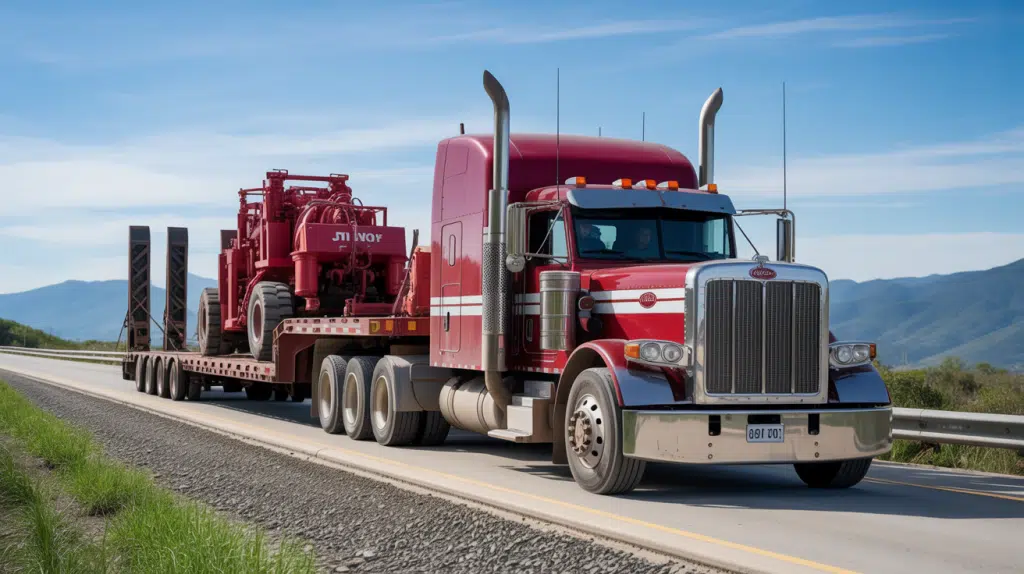
That is why legal approval and route difficulty often work together. A move with heavier route pressure usually overlaps with how route complexity changes heavy haul pricing, because the permit is often built around those same road challenges.
Escorts can increase cost indirectly through time
Escort requirements do not only add direct service fees. They also affect how quickly and how freely the load can move. Convoys may travel more slowly. Traffic-sensitive areas may require narrower time windows. Starts and stops may need more coordination. If multiple escorts or staged crossings are involved, the whole trip can become more time-dependent.
In heavy haul pricing, time matters because the truck, trailer, crew, and support resources remain committed longer. So escort-related cost is often partly a time cost, not just a line-item cost.
Bigger dimensions usually mean more control
As a load becomes wider, taller, longer, or more complex to route, permit and escort requirements tend to increase because the public-road risk also increases. A wider load may interfere more with lane use. A taller load may need closer route monitoring. A longer load may create more turning and traffic-control challenges.
This is one reason oversized loads cost more than standard freight. The shipment is not only larger. It usually needs more legal oversight and more active control.
Multi-jurisdiction moves can become pricing projects of their own
A local move within one jurisdiction may be straightforward by heavy haul standards. A multi-state move can become much more involved. Different agencies, different rules, different escort thresholds, and different permit timelines can all affect both cost and schedule. In those cases, the pricing is influenced not only by the road distance but by how many legal systems the shipment must pass through cleanly.
The move becomes more project-based, and the quote reflects that broader coordination burden.
Customers often see permit and escort costs only after the load is fully understood
Many customers ask for a quote before exact dimensions, weight, or route details are fully confirmed. That is normal, but it also means permit and escort cost may remain broad until the real scope of the move is clear. Once the actual load profile is known, the legal requirements become easier to define, and the pricing usually becomes more precise.
In that sense, permit and escort cost is one of the clearest examples of why early project detail improves pricing accuracy.
Conclusion
Permits and escorts affect transport costs because they add legal structure, operational control, and timing constraints to a heavy haul move. Permits shape the approved route and define how the shipment may travel. Escorts add safety support, traffic control, and coordination that standard freight does not need. Together, they increase both direct cost and execution complexity. Once a load crosses into oversized or overweight territory, those requirements become part of the transport job itself, and the quote reflects the work required to move the shipment lawfully and safely.