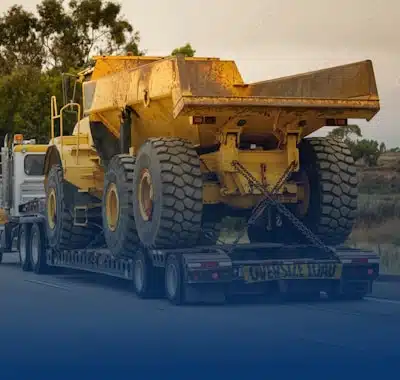
Heavy equipment is secured for transport by controlling movement before the road creates it. A machine may sit firmly on a trailer in the yard, but once the truck begins moving, braking force, turns, vibration, road shock, and grade changes all act on the load. That is why securement is not just about attaching chains or straps. It is about building a restraint system that keeps the equipment stable from pickup to delivery.
A strong securement plan protects the machine, the trailer, the driver, and everyone sharing the road. It also protects the customer’s schedule because equipment that arrives safely can go back to work without avoidable repairs or delays.
Heavy equipment securement is one part of a wider load securement and damage prevention process, where restraint, inspection, attachment control, vibration checks, and post-delivery review all work together.
Securement starts with understanding the machine
Different machines move differently in transport. A bulldozer sits on tracks. A wheel loader rides on tires. An excavator carries a boom and attachment. A generator may sit on a base frame. Because each machine carries weight in its own way, each one needs a securement method that matches its structure.
The first question is not “how many chains are needed?” The first question is “where can this machine move if force is applied?”
That includes:
- forward movement during braking
- rearward movement during acceleration
- side movement during turns
- vertical movement from bumps and vibration
- attachment movement from loose or raised components
Once these movement points are understood, the securement plan becomes much more accurate.
The machine must be placed correctly before it is tied down
A machine that is poorly positioned is harder to secure safely. If it sits too far forward, too far back, or slightly off center, the trailer may carry weight unevenly and the tie-down angles may become weak.
Good placement usually means:
- the machine is centered side to side
- axle groups carry weight correctly
- the machine sits fully supported on the deck
- securement points are accessible
- attachments do not create unnecessary height or overhang
This step matters because securement cannot fully fix poor placement. Chains and straps are meant to hold a properly placed machine, not compensate for a bad loading decision.
Tie-down points must carry securement force safely
The best securement gear can still fail to protect the load if it is attached to the wrong point. Heavy equipment often has designed tie-down locations because those points are built to carry restraint force during transport. Using weak brackets, steps, guards, or thin structural areas can damage the machine and weaken the securement system.
This is why proper equipment restraint depends heavily on using tie-down points that can safely carry transport forces. The chain or strap must not only be strong; it must also pull from a place that can handle the load.
Securement must control movement in multiple directions
A heavy machine needs restraint in more than one direction. During transport, the load may try to move forward, backward, sideways, and upward. A securement plan should account for all of these forces, not just the most obvious one.
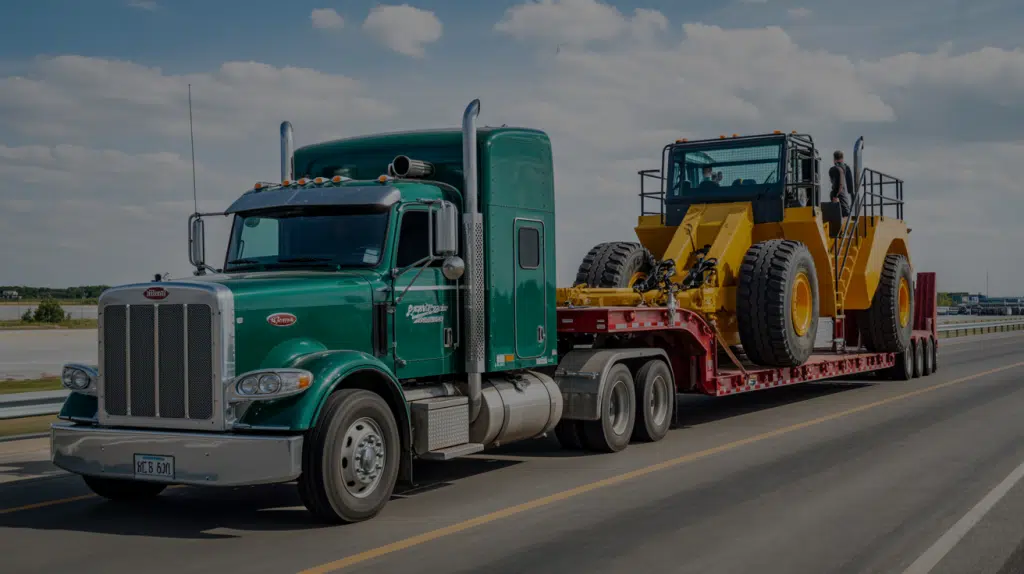
A strong setup usually includes:
- forward restraint for braking force
- rearward restraint for acceleration and grade changes
- lateral restraint for turns and lane changes
- downward force to keep the machine seated on the deck
- attachment restraint where needed
The goal is not only to stop the equipment from falling off the trailer. The goal is to stop small movement before it becomes shifting, rubbing, loosening, or damage.
Attachments should be lowered, locked, or secured
Attachments often create the biggest avoidable securement risks. Buckets, blades, booms, forks, rippers, and grapples can change height, weight balance, and movement potential. If they are left raised, loose, or unsupported, they can vibrate, swing, shift, or create clearance problems.
A safer approach is to place attachments in a stable travel position before the machine is fully secured. In many cases, that means lowering them, locking them, removing them, or restraining them separately.
The machine body may be secure, but the attachment still needs its own attention.
Rated securement gear should match the load
Securement gear must be chosen for the load, not for convenience. Chains, binders, straps, hooks, anchor points, and trailer fittings all need enough working capacity for the machine being hauled.
The system is only as strong as its weakest part. If the chain is strong but the hook is not, the system is limited by the hook. If the binder is strong but the anchor point is weak, the system is limited by the anchor point.
That is why professional securement uses rated gear, proper angles, and a setup that keeps force moving through the correct parts of the trailer and machine.
Edge protection prevents avoidable damage
Securement can protect the load and damage it at the same time if contact points are ignored. Chains can rub paint. Straps can cut on sharp edges. Hooks can press into sensitive areas. Repeated vibration can turn a small contact point into a visible mark by delivery.
Edge protection helps prevent:
- paint damage
- strap cutting
- chain abrasion
- frame contact marks
- rubbing against attachments or guards
This matters because successful transport is not only about keeping the machine attached. It is also about delivering it in the condition the customer expects.
Re-checks are part of the securement process
A load can settle after the first few miles. Tires compress, tracks seat into the deck, chains find tension, and attachments may shift slightly into their travel position. Because of that, securement should be checked after the load has had time to settle.
Re-checks are especially important:
- after the first short travel segment
- after rough road sections
- after hard braking or unusual movement
- before continuing through long-distance routes
- before final delivery if the load has traveled for many hours
A securement plan is not finished when the truck leaves the pickup point. It continues through the trip.
What customers should understand about securement
Customers often see the trailer, the machine, and the final delivery. They may not see the securement logic behind the move. Even so, that logic matters.
Good securement means:
- the machine was placed correctly
- tie-down points were chosen carefully
- attachments were controlled
- rated gear was used
- movement was checked after travel began
- damage risks were reduced before delivery
These details protect the customer’s equipment and help keep the project on schedule.
Conclusion
Heavy equipment is secured for transport by matching the machine, the trailer, the tie-down points, and the restraint gear into one controlled system. The machine must be placed correctly, restrained in multiple directions, protected from rubbing or edge damage, and checked again after it settles into travel. When securement is handled this way, heavy equipment does not simply arrive at the destination. It arrives stable, protected, and ready for the work waiting for it.