A tie-down point is not just a convenient place to hook a chain. It is the place where transport force enters the machine. If that point is strong, correctly located, and intended for securement, the load can be restrained cleanly. If that point is weak, decorative, or poorly chosen, the securement system may look acceptable while quietly putting stress into the wrong part of the equipment.
That is why tie-down points matter so much in heavy haul transport. The chain, binder, strap, and trailer anchor all depend on one simple truth: the restraint force must travel through parts of the machine and trailer that are built to handle it.
Tie-down selection is one of the most important details in a complete heavy haul load securement and damage prevention process, because good restraint protects both road safety and equipment condition.
A strong chain cannot fix a weak attachment point
Securement gear often gets most of the attention. People look at chain size, binder strength, strap condition, and hook type. Those things matter, but they only work properly when the hook connects to a point that can carry the force.
A chain may be rated correctly, but if it is attached to a thin bracket, a step, a guard, or a non-structural edge, the securement plan becomes weak at that point. The equipment may move. The attachment point may bend. Paint, frame surfaces, or mounted components may be damaged.
The problem is not always obvious in the yard. It often appears later, after braking, vibration, or rough pavement sends repeated force through the wrong connection.
Tie-down points control the direction of force
Securement is not only about strength. Direction matters too.
A good tie-down point allows the restraint to pull in a useful direction. It helps control forward movement, rearward movement, side movement, and vertical bounce. A poor tie-down point may create a bad angle where the chain looks tight but does little to control the movement that actually matters.
For example, a chain pulling mostly sideways may not add enough downward force to keep a machine seated. A chain pulling from too high or too low may create stress in the wrong direction. A hook placed at an awkward angle may side-load hardware instead of applying clean restraint.
That is why tie-down points should be evaluated for both strength and geometry.
Designated tie-down points protect the machine
Many heavy machines include specific tie-down or transport points because manufacturers expect those machines to be hauled. These locations are usually placed where the machine structure can accept restraint force without damaging weaker areas.
Using those points helps protect:
- frames and structural members
- tracks, tires, and suspension areas
- steps, guards, panels, and covers
- hydraulic lines and mounted accessories
- painted surfaces and finished components
This matters because equipment transport should not create damage while trying to prevent movement. A machine can arrive legally restrained but still arrive with avoidable marks, bent parts, or stressed components if the tie-down points were poorly chosen.
Wrong tie-down points can create hidden damage
Some damage appears immediately. A bent bracket or scraped paint is easy to see. Other damage may be less obvious. A poor restraint point can place stress into a frame area, pull against a guard, or create rubbing that becomes visible only after miles of vibration.
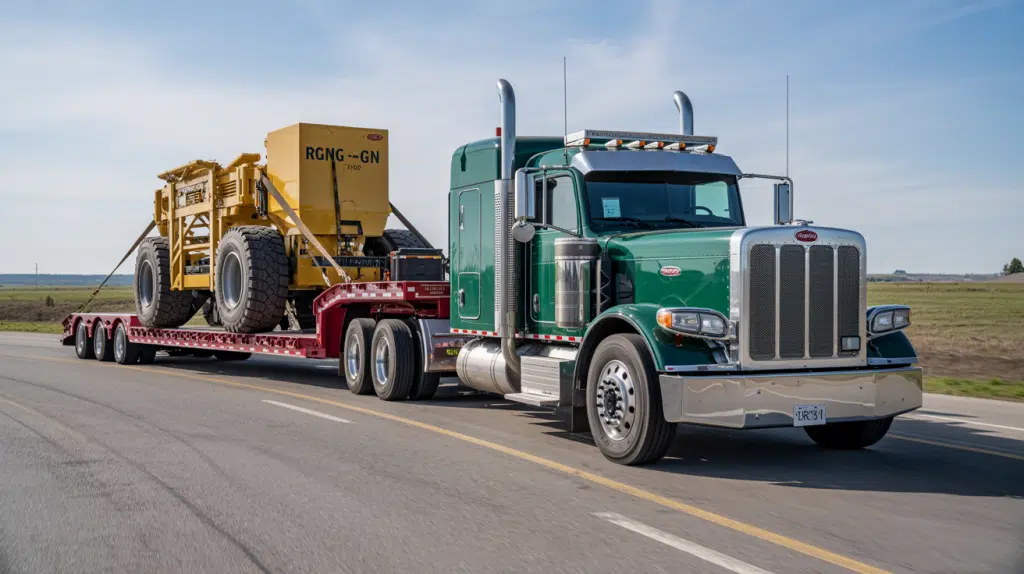
This is especially important with machines that have attachments, body panels, undercarriage parts, or base frames that are not meant to receive chain force. The machine may look strong from the outside, but not every visible part is a securement point.
That is why tie-down planning is also damage-prevention planning.
Trailer anchor points matter just as much
A securement system has two sides: the machine side and the trailer side. The tie-down point on the equipment must be strong, but the trailer anchor must also be rated and positioned correctly. If the trailer anchor is weak, damaged, poorly located, or pulling from the wrong angle, the entire restraint system loses reliability.
A clean securement setup usually matches:
- equipment tie-down point strength
- trailer anchor strength
- chain or strap rating
- binder or tensioning hardware rating
- the direction of pull needed to control movement
Each part supports the others. If one part is wrong, the system becomes less dependable.
Tie-down points affect load-shift prevention
Load shifting often begins when the securement system cannot control movement evenly. If one chain pulls from a strong point and another pulls from a poor angle, the machine may settle unevenly. If the tie-down points are not balanced, the load can slowly work against one side of the restraint system.
That is why tie-down point selection should support the bigger goal of preventing load shifting during oversized transport. The best securement system controls movement before it becomes visible.
Different equipment types need different tie-down thinking
A bulldozer, excavator, generator, wheel loader, and industrial machine may all require securement, but they do not offer the same connection logic.
A bulldozer may need restraint through heavy structural areas near the track frame. An excavator may require attention to both the machine body and the attachment position. A wheel loader may need securement that respects its tires, articulation, and bucket placement. A generator may rely on base-frame tie-downs rather than exterior panels.
The correct point depends on the machine’s design. That is why guessing is risky, even when the equipment looks familiar.
Tie-down points should be inspected before use
A tie-down point can be correctly located and still be unfit for use if it is damaged, cracked, bent, rusted, blocked, or poorly accessible. Before securement, each point should be checked visually and practically.
A useful inspection looks for:
- cracks or deformation
- corrosion or heavy wear
- sharp edges that could damage straps
- blocked access that forces poor hook placement
- signs that the point was used incorrectly before
- nearby hoses, wires, or panels that could be damaged
This inspection does not need to be complicated. It needs to be consistent.
Good tie-down points make re-checks easier
Securement does not end after loading. Chains and straps should be checked again after the machine settles into travel. Good tie-down points make those re-checks easier because the hardware remains visible, accessible, and stable.
Poor tie-down locations make re-checks harder. They may hide movement, create awkward tensioning, or place hooks where inspection is difficult. Over a long trip, that matters. A securement system that is hard to inspect is harder to trust.
What customers should understand about tie-down points
Customers may not know every technical detail of securement, but they should understand the principle: the machine should be restrained from points built to handle transport force. That protects the equipment as well as the road move.
When the correct tie-down points are used, the load is more likely to:
- remain stable during braking and turns
- avoid rubbing and contact damage
- stay balanced on the trailer
- arrive without bent accessories or stressed components
- unload normally at delivery
That is the kind of quiet detail that separates careful heavy haul work from rushed transport.
Conclusion
Tie-down points matter in heavy haul transport because they decide where securement force enters the machine and trailer. A strong chain, strap, or binder only works properly when it connects to a point that can carry the load safely and pull in the right direction. When tie-down points are chosen carefully, inspected before use, and matched with the correct trailer anchors, the equipment rides more securely and arrives better protected. In heavy haul transport, securement strength is not only in the gear. It is in the connection points that make the whole system work.