An industrial tank or vessel rarely behaves like ordinary freight, even when it looks simple from a distance. Its shape changes how it sits on a trailer. Its shell changes how support points must be handled. Its length, diameter, and center of gravity change how the route, trailer, and securement plan should be built. Because of that, tank and vessel transport is not mainly about “how heavy is it?” It is about how the load carries itself once it leaves the shop and enters the road system.
That is exactly why these moves belong inside heavy haul transport solutions for construction, energy, agriculture & industry. Tanks and vessels serve industrial projects, but they travel according to their own transport logic.
Shape creates the first transport problem
A vessel can be lighter than a mining component and still be harder to move cleanly. A tank can be structurally strong in service and still need careful support in transit. Cylindrical freight creates this kind of contradiction often. It looks uniform, yet that same round shape reduces natural stability on a flat deck and makes contact points more important than many customers expect.
This is what changes the planning conversation. With some industrial cargo, the biggest concern is weight density. With tanks and vessels, shape and support usually rise to the top much earlier.
Support should match the vessel, not the nearest trailer
A vessel cannot simply be “laid down and strapped.” It has to be supported in a way that respects the shell, the saddles, the frame, or whatever structure is actually intended to carry transport force. If the contact is wrong, the trailer may still move legally while the cargo absorbs stress it was never meant to carry.
That is why support planning usually focuses on:
- where the load path is meant to travel
- whether saddles or support cradles are required
- how much deck contact should exist
- whether the shell can tolerate the support arrangement chosen
- how the vessel will settle under road vibration
A well-supported vessel rides quietly. A poorly supported one often gives trouble slowly and expensively.
Diameter can become more difficult than weight
Industrial tanks and vessels often turn clearance into the real route issue. A large diameter raises transport height quickly, especially when the trailer deck, saddle height, and road crown are added into the total profile. That means a tank move may be governed less by its tonnage and more by what happens under bridges, wires, and overpasses.
If the shipment pushes height limits, route planning becomes tightly connected to transport planning for long or oversized energy components, because both categories force the team to respect shape-driven route reality rather than relying on ordinary oversize assumptions.
Orientation changes what the road sees
A vessel may travel horizontally, and that may feel obvious. Even so, orientation is never a casual choice. The way the load sits affects height, width, support geometry, securement angles, and wind exposure. In some cases, one orientation may fit the shop better while another fits the road better. The right answer is the one that protects the cargo and keeps the route workable at the same time.
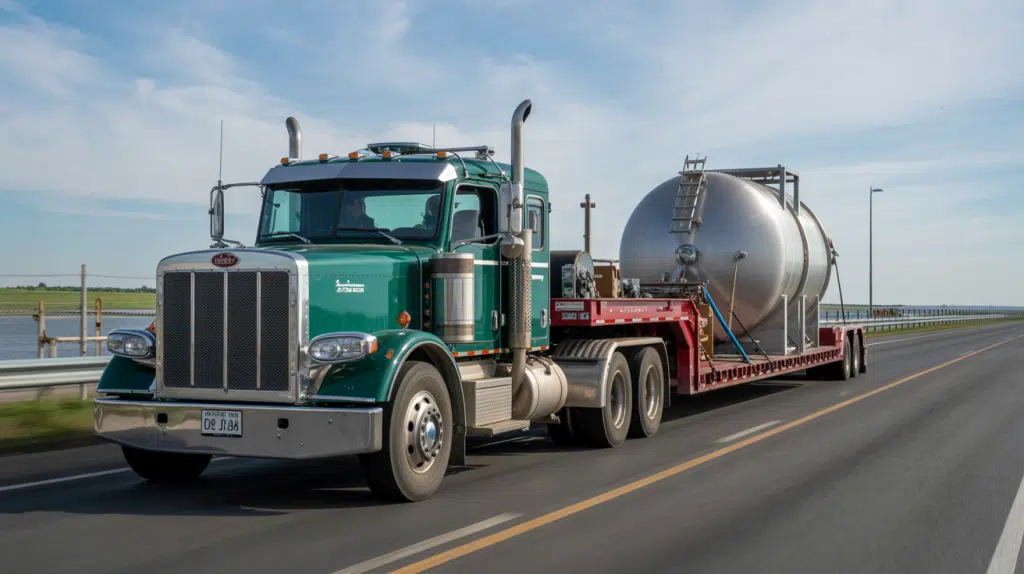
This matters most when the transport profile is close to route limits. A small orientation change can affect whether the move remains practical or becomes escort-heavy and infrastructure-sensitive.
Securement should restrain the load without distorting it
Round cargo needs restraint, but it also needs restraint that does not create damage. Chains, straps, blocking, and restraint systems should control the vessel’s movement while avoiding unnecessary stress on the shell or weak connection points. That usually means the securement plan has to work together with the support plan instead of fighting against it.
In practice, a safer setup usually does three things at once:
- it keeps the vessel seated in its supports
- it prevents rolling, walking, or shifting
- it applies force where the load is built to tolerate it
That balance matters because tanks and vessels often travel long enough for weak securement decisions to become visible.
Delivery conditions matter because these loads are often installation-sensitive
A tank or vessel is often moved because it is part of something larger: a plant expansion, a process upgrade, a shutdown project, or a new installation phase. That means delivery is rarely just “drop it at the gate.” The site may need the vessel in a certain order, at a certain time, with a certain crane, or near a certain staging point.
This is where industrial cargo begins to feel more like project cargo than simple freight. The road move has to line up with what the receiving site can actually do when the load arrives.
Access roads, plant gates, and final approach often decide the hardest part
A wide plant entrance, a narrow internal road, a soft laydown area, a crane pad, a sloped approach, or overhead obstructions near the final site can all become more important than the highway miles behind them. This is especially true with large vessels because turning space and staging room can disappear quickly once the convoy leaves the main corridor.
A clean transport plan usually checks:
- gate clearance and plant-road width
- internal turn geometry
- staging room for cranes or skidding systems
- whether the unloading area is level enough to receive the load
- whether delivery timing affects plant operations or other contractors
If these details are left too late, the final hundred feet can become harder than the entire route before them.
Customers should think beyond “can it be moved?”
Industrial clients often focus first on whether the vessel can be hauled. That is an understandable first question, but it is not the only one that matters. A better set of questions usually looks like this:
- how will the vessel be supported during transport
- what route shape can it actually tolerate
- what transport profile will the road system see
- what unloading setup will be needed at arrival
- how should the move fit the project sequence
Those questions lead to better decisions because they treat the vessel as project-critical equipment, not just a large shipment.
Conclusion
Industrial tank and vessel transport works best when the load is treated as shaped cargo with specific support, clearance, and installation demands. The shell, diameter, orientation, support method, and route profile all influence whether the move remains stable and practical from pickup to final placement. When those factors are planned together, the transport becomes calmer, safer, and much more useful to the project waiting for it. That is the core consideration in tank and vessel hauling: the load must not only arrive, it must arrive in a condition and sequence the site can work with immediately.