Wind energy transport starts looking difficult long before the convoy reaches the road. A blade is not just long. A nacelle is not just heavy. A tower section is not just oversized steel. Each component creates its own transport behavior, and each one asks for a different mix of trailer choice, route geometry, escort coordination, and delivery sequencing. That is why wind energy hauling is usually planned as a series of engineered moves rather than one simple oversized shipment.
This industry-specific approach sits naturally inside heavy haul transport solutions for construction, energy, agriculture & industry, because wind projects follow a transport logic that is very different from construction equipment, plant machinery, or farm equipment.
Why wind energy components change the normal heavy haul playbook
Most heavy haul loads become difficult because of weight, width, or height. Wind components can do that too, but they also add something else: shape. A blade may be light compared with a dense industrial machine, yet still become the harder move because turning radius, swept path, and road geometry begin to control the trip. A nacelle may be shorter, but its density, support needs, and lifting demands create a completely different problem. Tower sections then add another layer, because cylindrical freight changes support, securement, and loading behavior again.
So in wind transport, one project often creates three separate hauling strategies inside one schedule.
Start by separating the project into component types
A better wind-energy plan usually begins by dividing the cargo into what it actually is:
- blades
- nacelles
- tower sections
- hubs and support components
That separation matters because these pieces do not behave the same on trailers, and they do not create the same route pressure. Once each component is treated according to its own transport character, the project becomes easier to plan and much harder to derail.
Blades are really route-geometry cargo
Wind blades create a strange kind of transport challenge. They may not overload the pavement the way dense mining or industrial equipment can, but they ask the road to do things the road was never designed to do easily. Curves, intersections, roundabouts, guardrails, median islands, and overhead constraints all begin to matter in a much more visible way.
That is why blade transport usually depends on:
- route geometry review
- turning-path control
- escort and traffic coordination
- trailer setups designed for long swept movement
- final-mile planning that respects actual road shape, not just width on a map
A blade move that looks fine by mileage can fail quickly once the turns begin.
Nacelles create the opposite problem: compact, dense, and infrastructure-sensitive
If blades stretch the route, nacelles often stress the trailer and the infrastructure. They are usually more compact than blades, but much denser. That makes support points, axle placement, trailer strength, and bridge behavior much more important.
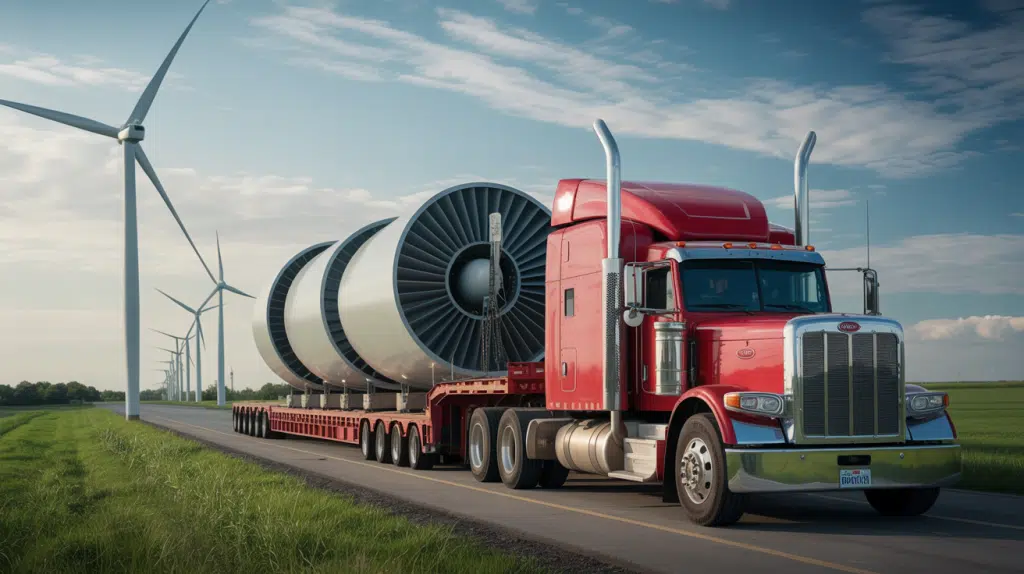
In that sense, nacelle hauling has something in common with mining equipment logistics, where dense cargo and support geometry often become the first real transport issue. The load may not look extreme in length, but the wrong trailer setup can still turn it into a permit or route problem very quickly.
Tower sections need stable support more than dramatic handling
Tower sections are unusual because their shape can make them look simpler than they are. Their cylindrical form changes how they sit, how they are blocked, and how they are restrained. A support system that works badly can create movement, rubbing, or unnecessary stress even if the route itself is relatively manageable.
That is why tower-section hauling usually depends on:
- correct support spacing
- deck stability
- securement that respects the round shape
- route planning that accounts for length and height together
- careful loading and unloading control
A tower section should feel settled on the trailer, not merely held down.
Route surveys matter more in wind work because one obstacle can cancel the move
In many heavy haul jobs, route trouble appears as a restriction. In wind work, one bad turn or one impossible pinch point can invalidate the entire path. That is why route surveys become far more than a box to check. They are often the difference between a realistic move and a paper route that cannot be executed in the field.
These reviews usually focus on:
- curve geometry
- intersection swing space
- road edge conditions
- overhead conflicts
- bridge and culvert limits where relevant
- whether the escort pattern can actually work on the chosen road
This is where wind-energy planning naturally overlaps with how cargo type changes heavy haul planning requirements, because few cargo types prove more clearly that shape can control transport as much as weight does.
Delivery sequence matters because wind projects are assembly projects
Wind components do not simply “arrive.” They are assembled. That makes delivery order part of the transport plan. A site may need tower sections staged in one pattern, nacelles delivered under a different lifting schedule, and blades brought in only when the route, crane, and weather window all line up.
This is one reason wind transport is rarely just dispatch management. It becomes project choreography. The trailer may finish its road job at the site gate, but the delivery is only successful if the component arrives when the project can actually use it.
Weather can matter earlier and more visibly than on other heavy haul work
All heavy haul work notices weather, but wind energy hauling feels it more directly. Wind itself can affect blade movement, escort coordination, and final-mile control. Rain can change rural access roads and staging conditions. Visibility can influence whether a long escorted move remains practical. Because of that, the route is only part of the plan. The weather window becomes part of the transport method too.
That does not make wind hauling fragile. It makes it deliberate.
What project teams should confirm before transport starts
Wind-energy transport becomes far more reliable when a few decisions are settled early:
- which components move in which order
- which trailer setup matches each component type
- whether the route has already been reviewed for actual geometry
- what crane and staging support will exist at delivery
- whether weather or local access restrictions affect the chosen schedule
- what site conditions matter once the convoy leaves the public road
These answers reduce uncertainty, and uncertainty is usually the most expensive part of a wind move.
Conclusion
Wind energy component transport works when the project is planned according to the real nature of the cargo. Blades demand route geometry and turning control. Nacelles demand stronger support and better axle planning. Tower sections demand stable support and careful restraint. Once those differences are respected, the transport plan becomes far more usable and far less reactive. That is the core reality of wind energy hauling: the components may belong to one turbine, but on the road each one needs its own transport strategy to arrive safely, in sequence, and ready for assembly.