Agricultural equipment moves under different pressure than most other heavy haul cargo. A combine does not just need a trailer. It often needs width control, seasonal timing, attachment planning, and a route that respects rural bridges, narrow turns, and local road limits. In other words, farm equipment creates a transport problem that is shaped as much by where it travels as by what it weighs.
That is why agricultural hauling works best when the machine, the season, and the route are planned together. A machine that looks manageable in the yard can become difficult once headers, duals, tanks, folding parts, or escort needs enter the picture. When those details are handled early, though, the move becomes smoother and far less stressful.
Agricultural hauling fits inside the broader reality of heavy haul transport across construction, energy, agriculture, and industry, because farm equipment follows its own transport logic rather than borrowing the same method used for industrial or construction machinery.
Farm equipment creates width and timing problems more often than pure weight problems
Many agricultural machines are not the heaviest loads on the road, but they often become difficult because of width, shape, and seasonal urgency. A combine may travel with a wide body and a separate header. A sprayer may create unusual width and height. A tractor with duals may change both loading and route planning. These machines often move at exactly the time when fields, harvest schedules, and weather windows matter most.
That is the first thing to understand: agricultural transport is often controlled by operating season and road access before it is controlled by raw tonnage.
The machine should be reduced into its safest travel profile before the haul begins
A good farm-equipment move usually starts by making the machine smaller, steadier, and simpler to carry. Sometimes that means removing headers. Sometimes it means folding mirrors, booms, or extensions. Sometimes it means separating parts that would otherwise create escort requirements, route trouble, or unnecessary risk.
This step matters because transport height and width are not just machine specifications. They are road realities. Once the equipment is in travel condition, the hauling team can make better decisions about trailer choice, securement, permits, and route timing.
Headers, implements, and removable parts often decide the whole move
With agricultural equipment, the removable parts are often what turns a normal haul into a more demanding one. A combine body may be one load, but the header may need a different trailer, a different timing sequence, or separate escort planning. Implements can be long, awkward, and sensitive to support points even when they are not especially heavy.
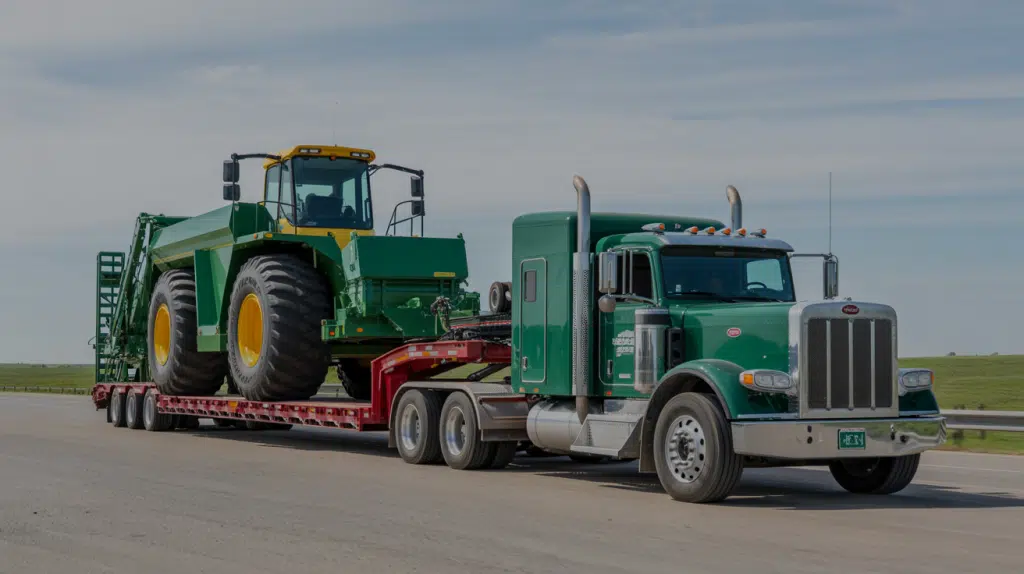
That is why attachment and component planning matters so much. The main machine may not be the only freight being moved. The transport method has to account for the equipment system as a whole.
Trailer choice should follow shape first and convenience second
Farm equipment can tempt people into using the nearest available trailer rather than the best-matched one. That usually works until deck height, ramp angle, axle balance, or machine width creates a problem. A lower-profile setup may be better for a taller machine. A longer deck may help with support and placement. A detachable setup may make loading calmer and safer if the machine geometry is awkward.
The trailer should help solve the biggest transport constraint, not simply provide a place for the machine to sit.
Rural routes are not simple routes
Agricultural equipment often travels through secondary roads, county bridges, narrow intersections, small-town corridors, and access roads that were not designed with heavy haul convenience in mind. That is what makes route planning so important. The road may look open on a map, but that does not mean it works cleanly for a wide machine, a long trailer, or a separate header convoy.
This is one reason agricultural hauling connects naturally with how cargo type changes heavy haul planning requirements, because farm equipment proves very clearly that the same trailer and route logic cannot be used for every load category.
Loading conditions in agricultural moves can change by site, weather, and season
Unlike factory pickups, agricultural loading areas are often temporary, uneven, dusty, muddy, or seasonally crowded. A machine may be loaded from a farm lane, a shed approach, a field edge, or a local equipment yard. Those conditions affect ramp alignment, trailer stability, machine approach, and unloading risk at the destination.
That means the loading surface matters almost as much as the machine. A safe transport plan should account for whether the trailer can line up properly, whether the ground is stable, and whether there is enough room to reposition if needed.
Securement should match both tires and field-built geometry
Agricultural equipment often includes high-clearance frames, large tires, folding parts, and machine shapes that are very different from construction equipment. Because of that, securement should be treated carefully. Tie-down points, transport position, and attachment restraint all matter. A machine can look settled while still carrying avoidable movement risk if a folding part, loose attachment, or poorly supported component has been ignored.
What makes this more important is distance. A short move may hide weak planning. A longer farm-equipment haul usually exposes it.
Seasonal urgency should never replace transport discipline
Planting and harvest seasons create pressure, and that pressure can lead to rushed hauling decisions. A customer may want the machine moved immediately. A crew may need the equipment the same day. Even so, the transport still needs the same discipline around width, route, securement, loading, and timing.
A hurried move can end up being the slower move if it causes a permit issue, a route problem, or a roadside adjustment.
What owners and farm operators should confirm before dispatch
Agricultural moves become much easier when clear information is available before pickup. It helps to confirm:
- the exact machine model and travel dimensions
- whether headers or implements travel separately
- whether tires, duals, or folding parts change width
- loading and unloading surface conditions
- route-sensitive concerns such as small bridges or town access
- whether timing is tied to planting, harvest, or immediate field use
These details do not complicate the haul. They make the haul more dependable.
Conclusion
Moving agricultural equipment with heavy haul trailers requires more than matching a machine to a deck. Farm equipment creates width, season, route, and attachment challenges that are easy to underestimate when the move is planned too casually. When the machine is reduced into a safe travel profile, the trailer is matched to the real transport constraint, and rural route conditions are respected from the beginning, the haul becomes far more controlled. That is how agricultural transport should work in practice: not rushed, not improvised, but planned carefully enough that the equipment arrives ready for the season that depends on it.