Backhoes and compact machines are easy to underestimate. They are smaller than many heavy haul loads, they move between jobs more often, and they often look straightforward to load. Yet that combination is exactly why transport mistakes happen. A machine that seems manageable can still be poorly balanced, badly secured, or awkward to load if the trailer, the attachment position, and the job-site conditions are not checked carefully first.
This article supports the broader guide on how different types of heavy equipment are transported safely, where transport decisions begin with the machine’s real shape, weight, and working design rather than assumptions based on size.
Why backhoes need their own transport logic
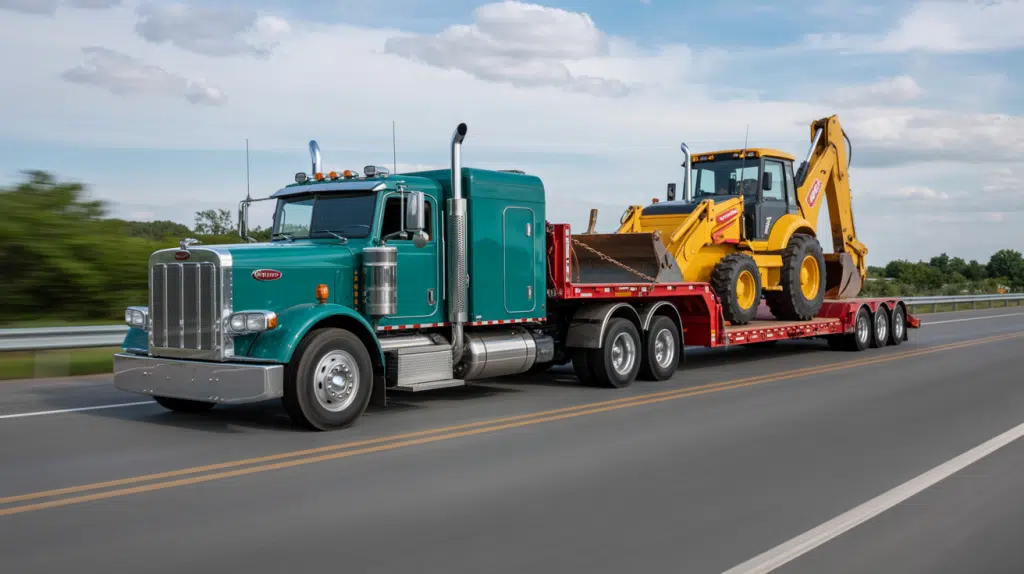
A backhoe is not just a small loader and it is not just a small excavator. It combines a front loader assembly with a rear digging arm, and that mixed design changes how the machine carries weight in transport. The front bucket can affect forward balance. The rear boom can change rear profile and swing risk. The machine may ride on tires, but its working geometry still makes transport more complicated than many people expect.
That is why safe backhoe transport depends on thinking about the machine as a combination unit, not a generic compact machine.
The machine should be prepared for travel before the trailer is treated as “ready”
One of the most common transport mistakes is focusing on the trailer first and the machine second. In reality, the machine should be prepared into its safest travel condition before anyone decides the setup is ready.
That usually means checking:
- front bucket position
- rear boom and stick position
- whether stabilizers are fully secured
- whether any attachment increases width or height
- whether the machine sits in a compact travel profile
If those parts are left in a rushed or half-working position, the transport setup may look acceptable while still carrying unnecessary risk.
Compact equipment often creates more attachment-related risk than size-related risk
The smaller the machine, the more likely people are to think the details do not matter. They still do. On compact equipment, attachments often create the most avoidable problems. Forks, trenchers, augers, grapples, and buckets can all change overall dimensions, front-end weight, and securement needs.
That is why compact machine transport usually improves when the team decides early:
- which attachment stays mounted
- which attachment should travel separately
- whether height or front weight changes enough to matter
- whether securement must control both machine and tool separately
This is especially true on smaller job-site equipment, which is why many of the same lessons also apply in transporting skid steers safely and correctly, where compact size does not remove real transport risk.
Backhoes load differently because they carry “working shape” at both ends
A backhoe does not present one simple loading profile. It presents a front assembly and a rear assembly, and both affect how the machine behaves on ramps and how it settles onto the trailer.
That means the loading approach should consider:
- whether the machine should be driven on forward or backed on
- how the rear boom affects departure angle and deck space
- whether the front bucket position changes ramp contact or machine pitch
- whether the trailer deck allows the machine to sit compactly once loaded
A poor loading approach can create unnecessary stress before the road trip even begins.
Compact machines still need balanced deck placement
Backhoes, mini equipment, and other compact machines may not create the same scale of axle issues as large mining or crane components, but placement still matters. A machine that is too far forward or too far back can affect trailer behavior, securement angles, and overall handling. On repeated job-site moves, those small errors become recurring problems.
A steadier placement usually does three things at once:
- keeps the machine centered left to right
- avoids loading one part of the trailer more than necessary
- leaves room for securement that actually pulls in the right directions
In other words, compact machines still need transport discipline even when the load is not dramatic.
Site conditions often decide whether the move feels easy or stressful
With backhoes and compact equipment, pickup and delivery conditions are often more important than highway conditions. These machines move between construction sites, utility work zones, yards, and temporary staging areas. Those places are not always level, spacious, or clean.
Safe planning should account for:
- narrow approach space for aligning with ramps
- soft or muddy ground near the trailer
- uneven loading areas that change machine pitch
- enough room to reposition if the first attempt is poor
- unloading conditions that may be tighter than the pickup point
Many “simple” compact-equipment moves become difficult because the site was treated like an afterthought.
Securement should match the machine’s working layout
Backhoes and compact equipment often have more than one part that can move, settle, or bounce during transit. The machine body must be restrained, but so must the features that make the machine useful in the first place.
A safer securement plan usually accounts for:
- the main frame tie-down points
- front bucket restraint or lowered travel position
- rear boom or attachment control
- any side movement that could develop during vibration
- early re-checks once the machine has settled on the road
Compact machines may be smaller, but they still need the same seriousness in securement that larger machines receive.
What transport planning should confirm before dispatch
Backhoe and compact-equipment transport tends to go smoothly when the planning is simple but complete. Before dispatch, the team should know:
- exact machine type and operating weight
- overall dimensions in travel position
- what attachments are staying on the machine
- whether the pickup site supports clean loading
- what trailer setup best suits the machine’s shape
- whether unloading conditions create extra risk
That information does not complicate the move. It reduces the chances that the move becomes reactive.
Conclusion
Looking for reliable heavy equipment transport? Freedom Heavy Haul offers competitive rates and professional service for machinery shipping across the entire United States.
Safe transport planning for backhoes and compact equipment begins with a clear understanding of what these machines really are: compact in size, but still complex in shape, balance, and movement. A backhoe carries working equipment at both ends, and many compact machines carry attachments that change transport behavior more than people expect. When travel position, loading method, site conditions, deck placement, and securement are all handled deliberately, the move stays calm and controlled. That is what safe compact-equipment transport should feel like from the first ramp contact to the final unload.