Skid steers are compact, but compact does not mean simple. Their short wheelbase, front attachment, and fast-loading reputation can make people treat them like “easy freight,” yet safe transport still depends on preparation, trailer fit, securement, and site conditions. A skid steer that is loaded casually can become unstable, overheight, poorly balanced, or improperly restrained just as quickly as larger equipment.
For the broader machine-by-machine view, this topic belongs within how different types of heavy equipment are transported safely. Skid steers are smaller than many other machines, but they still need a transport plan that respects how they actually behave.
The biggest mistake is assuming small equipment means small risk
A skid steer often looks easy to move because it is compact, maneuverable, and common on many jobsites. That convenience creates a false comfort. The machine still has a front-heavy attachment zone, a concentrated footprint, and a loading process that can go wrong quickly if the trailer, ramps, or securement points are not matched correctly.
That is the first thing worth knowing: transport risk is shaped by machine behavior, not just machine size.
Attachment choice changes the entire transport profile
Many skid steers travel with a bucket, but not all of them do. Forks, augers, trenchers, grapples, and other attachments change height, balance, and securement needs. In some cases, the attachment becomes the main transport problem, not the machine body itself.
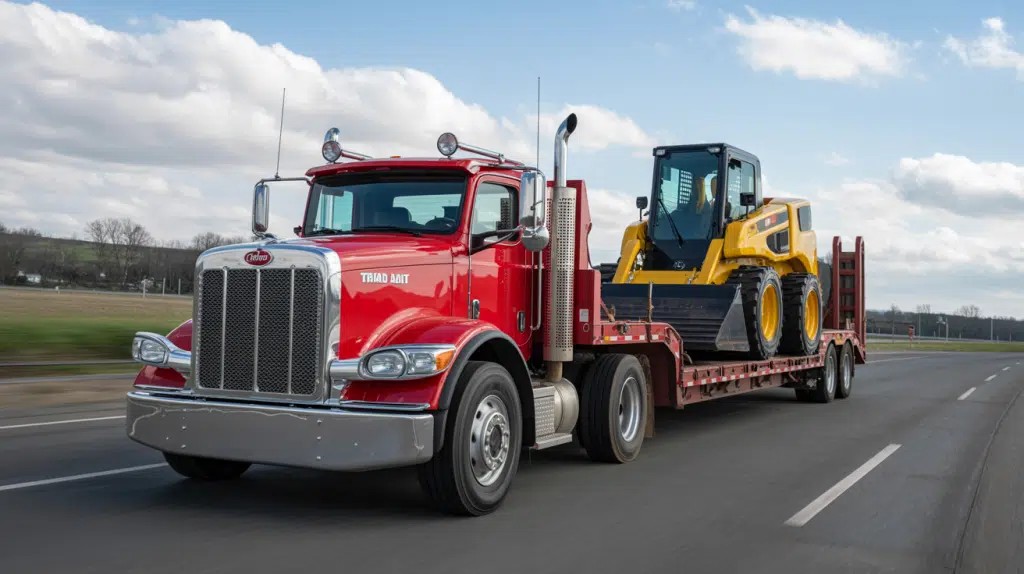
Before transport, it helps to confirm:
- which attachment is installed
- whether that attachment should travel mounted or removed
- how it affects total height and front-end balance
- whether it creates extra securement or clearance concerns
That same logic appears with other compact and mixed-function machines, which is why transport planning for backhoes and compact equipment is closely related to skid steer hauling.
Trailer fit should be checked before the machine reaches the ramps
A skid steer can usually load quickly, but speed should not replace fit. The machine width, tire condition, attachment position, and trailer deck dimensions all matter before the first tire touches the ramps. A trailer that is technically available is not always the trailer that is safely matched.
A better approach is to confirm:
- deck width relative to machine stance
- ramp width and loading angle
- trailer capacity including the attachment
- enough deck space for placement and securement geometry
The trailer should make the machine feel controlled during loading, not cramped or rushed.
Ramps and loading angle matter more than people expect
Because skid steers are compact, operators sometimes underestimate ramp angle. If the angle is too aggressive, the machine can pitch, scrape, or load with less control than expected. That risk increases when the trailer is high, the site surface is soft, or the attachment shifts front-end weight.
A calmer loading setup usually comes from:
- a stable trailer position
- ramps that match the machine width
- a loading angle that does not force a sharp breakover
- enough straight alignment space in front of the trailer
This is one place where the “easy to load” reputation of skid steers can create unnecessary mistakes.
Weight distribution still matters, even on smaller machines
Skid steers are not exempt from balance problems. A heavy attachment, a poor deck position, or uneven trailer loading can still put more stress into one axle group than expected. That may not look dramatic in the yard, but on the road it can affect handling, braking feel, and legal compliance.
That is why placement should still be deliberate:
- centered left to right
- set where the trailer carries the machine evenly
- placed so securement angles remain useful
- checked against the attachment’s effect on front-end weight
If the setup needs closer review, it helps to think in the same practical terms used in preparing wheel loaders for heavy haul transport, where front-end mass and transport profile both shape the final placement.
Securement should restrain the machine and control the attachment
A skid steer may be smaller than many other heavy machines, but it still needs proper restraint. The machine body must be secured against forward, rearward, and lateral movement, and the attachment should be treated as something that can create its own transport risk if it is not controlled.
A stronger plan usually includes:
- using the manufacturer’s proper tie-down points
- keeping the machine seated squarely on the deck
- restraining the attachment or lowering it into a stable travel position
- re-checking securement early in the trip
The machine should look settled, not simply “tied enough.”
Pickup and delivery site conditions can make or break the move
With skid steers, the site itself often creates the real problem. Mud, loose stone, narrow access, poor trailer alignment space, and uneven approach conditions can all make loading harder than the machine size suggests.
That is why transport planning should also confirm:
- whether the site allows straight ramp access
- whether the surface is stable enough for loading
- whether there is enough room to reposition if needed
- whether unloading will be more difficult than pickup
Smaller machines move more often, which makes site reality especially important over time.
What owners should confirm before the trailer arrives
Good skid steer transport usually begins with clear information, not improvisation. Before pickup, it helps to confirm:
- exact model and operating weight
- tire or track configuration
- attachment type
- overall transport dimensions
- loading and unloading conditions at both ends
These details reduce guesswork and help the haul feel controlled from the start.
Conclusion
Looking for reliable heavy equipment transport? Freedom Heavy Haul offers competitive rates and professional service for machinery shipping across the entire United States.
What to know before transporting skid steers comes down to one simple truth: compact equipment still deserves full transport discipline. Attachment choice, trailer fit, ramp angle, machine placement, securement, and site conditions all influence whether the move stays smooth or becomes unnecessarily risky. When those details are handled early, a skid steer remains what it should be in transport—compact, manageable, and fully under control.