A load securement mistake does not always look dangerous at first. A chain may look tight. A bucket may look low enough. A machine may look centered. Yet once the trailer starts moving, small mistakes begin to show themselves through vibration, braking, turning, and road shock. In heavy equipment hauling, the dangerous part is often not what looks obviously wrong. It is what looks “good enough” until the road proves otherwise.
This is why securement mistakes should be understood before they happen. The goal is not to blame the driver, the loader, or the customer. The goal is to identify the common weak points that turn a routine haul into preventable movement, damage, delay, or roadside correction.
A strong heavy haul load securement and damage prevention process prevents these mistakes by treating securement as a system, not a last step before departure.
Mistake 1: Treating equipment weight as if it secures the load
Heavy equipment feels immovable when it is parked. That feeling can be misleading. A dozer, excavator, loader, or generator can still move under braking force, side force, vibration, or repeated road impact. Weight increases seriousness. It does not replace securement.
A machine that weighs thousands of pounds still needs restraint in every movement direction. It must be held against forward movement, rearward movement, side movement, and vertical bounce. Without that thinking, the securement plan depends too much on gravity and not enough on control.
Mistake 2: Using tie-down points that were never designed for transport force
One of the most common mistakes is hooking to whatever looks strong. A step, guard, thin bracket, panel edge, or convenient opening may seem usable, but it may not be designed to carry securement force. That mistake can damage equipment and weaken the entire restraint system.
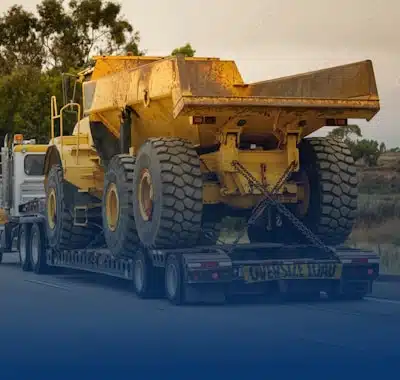
Good securement uses points that can handle the load and pull from the right direction. This is why selecting proper tie-down points changes the safety of the entire haul. The chain is only useful if the connection point can safely receive the force.
Mistake 3: Ignoring the direction of pull
A tie-down can be tight and still pull poorly. If the angle is wrong, the chain or strap may not control the movement that matters most. A tie-down that mostly pulls sideways may not keep the machine seated. A tie-down that pulls too vertically may not stop forward shift. A tie-down attached from an awkward angle can also side-load hooks or hardware.
The question is not only, “Is it tight?”
The better question is, “What movement does this tie-down actually prevent?”
That one question catches many securement problems before they become road problems.
Mistake 4: Forgetting that attachments are part of the load
Many equipment hauling mistakes happen because the machine body is secured, but the attachment is treated casually. Buckets, blades, booms, rippers, forks, grapples, augers, and masts can shift, bounce, or create extra height if they are not placed correctly for transport.
Sometimes the attachment should be lowered. Sometimes it should be locked. Sometimes it should be removed or restrained separately. The wrong choice can create clearance problems, load movement, contact damage, or extra stress on the machine.
A secured machine with an unsecured attachment is not fully secured.
Mistake 5: Skipping the first re-check after the load settles
The first part of a trip often reveals how the equipment really sits on the trailer. Tires compress. Tracks settle. chains find their working tension. Blocking beds in. Attachments rest into position. This settling may be normal, but it should never be ignored.
Skipping the first re-check can allow small slack to become real movement. A short stop early in the trip can catch loose binders, shifted blocks, rubbing points, or changed attachment position before the haul continues for hours.
Securement is not a one-time action. It is a condition that should be confirmed after the load begins to travel.
Mistake 6: Allowing chain or strap contact to damage the equipment
Securement can prevent movement and still damage the load if contact points are ignored. A chain rubbing paint, a strap running over a sharp edge, a hook pressing into a panel, or a binder sitting against a finished surface can create preventable marks by delivery.
Damage prevention requires looking at the contact path, not just the restraint path.
A good securement check asks:
- where does the chain touch the machine
- where could vibration create rubbing
- where does a strap need edge protection
- could the hook or binder mark a visible or sensitive area
- will this contact point look worse after 300 miles
That kind of inspection protects both the cargo and the customer relationship.
Mistake 7: Placing the machine poorly and trying to fix it with chains
Securement works best when the machine is already positioned correctly. If the load is too far forward, too far back, off center, or sitting unevenly, the securement system has to fight problems that should have been solved during loading.
Poor placement can create:
- weak tie-down angles
- uneven axle loading
- unstable trailer behavior
- attachment overhang problems
- difficult re-check access
A better approach is to reposition the machine before final securement, even if it takes longer in the yard. It is easier to fix placement before departure than to fight a bad setup on the shoulder.
Mistake 8: Using damaged or mismatched securement gear
Chains, straps, binders, hooks, and trailer anchors all work as one system. If one part is damaged, underrated, worn, bent, cracked, or mismatched, the whole system becomes less reliable. The securement system is limited by its weakest component, not by its strongest one.
That means gear inspection matters before every haul. A strong-looking chain with damaged links is not a safe chain. A strap with cuts should not be trusted. A binder that does not hold tension properly should not be treated as “good enough.”
Good gear does not make a careless setup safe, but bad gear can make a good setup unsafe.
Mistake 9: Not adjusting securement for the route
Some routes are harder on securement than others. Rough pavement, bridge joints, steep grades, sharp turns, high winds, and construction zones all change what the load experiences. A setup that seems reasonable for a short local move may need more attention for a long route or a difficult corridor.
This is where securement planning connects with preventing load shifting during oversized transport, because route conditions often decide how aggressively the load will test the securement system.
Mistake 10: Treating “legal” and “protected” as the same thing
A load can meet minimum securement expectations and still be poorly protected from avoidable cosmetic or mechanical damage. Legal compliance matters, but customers also care about paint, tires, tracks, frames, attachments, hydraulic lines, and whether the machine arrives ready to work.
The best heavy haul work does both. It restrains the load for safety and protects the equipment for the customer.
What careful crews do differently
Careful securement habits are usually simple:
- they verify the machine’s real movement points
- they choose tie-down locations deliberately
- they control attachments before final tensioning
- they protect contact points from rubbing
- they inspect gear before use
- they re-check after the load settles
- they adjust the plan to the route and cargo type
None of these habits are dramatic. That is the point. Good securement often feels calm because the risky details were handled before they became visible.
Conclusion
Common load securement mistakes in heavy equipment hauling usually come from assumption, speed, or convenience. The machine looks heavy enough. The chain looks tight enough. The attachment looks low enough. The route looks normal enough. But heavy haul transport does not reward “enough” when the load begins facing real road forces. Securement becomes safer when every movement path is controlled, every connection point is chosen carefully, every attachment is addressed, and every re-check is treated as part of the process. That is how heavy equipment arrives not only secured, but protected.