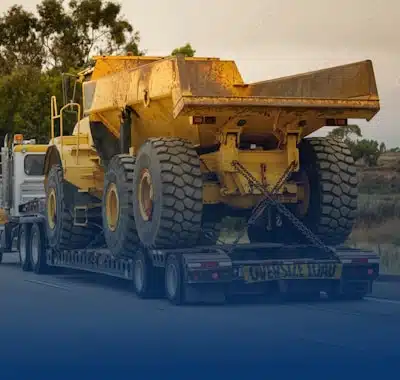
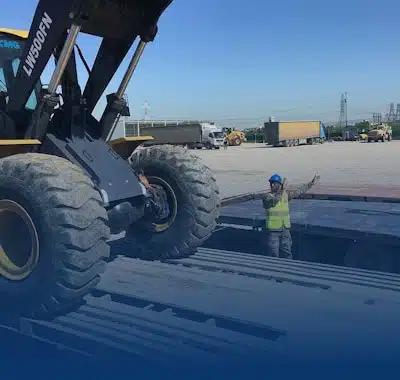
Forklifts and warehouse machines live in controlled spaces. Their normal world is smooth concrete, marked aisles, loading docks, and predictable turning room. The moment they leave that environment and move by trailer, the rules change. Road transport introduces vibration, braking force, ramp angles, weather exposure, and securement demands that indoor equipment never faces during ordinary use.
That is why moving forklifts and warehouse equipment safely is less about size and more about control. These machines may be smaller than many construction loads, but they still need a transport plan that matches their weight, mast height, tire type, and attachment setup. For the wider machine-by-machine framework behind this, see how different types of heavy equipment are transported safely, where transport method is shaped by the equipment itself.
Indoor equipment becomes road cargo the moment it leaves the floor
A forklift behaves very differently on a trailer than it does in a warehouse. In a warehouse, its tires grip flat surfaces, the mast works in short travel ranges, and the machine stops and starts under controlled conditions. On a trailer, the same machine must handle ramp transitions, deck placement, highway movement, and securement pressure.
That change matters because forklifts are compact but not neutral. The mast adds front-end structure. The forks add projection and weight. The battery or rear counterweight changes balance. A machine that feels agile indoors can become awkward on a trailer if those factors are ignored.
Mast height and fork position should be settled before loading begins
With forklifts, the mast is often the first transport concern. A raised or poorly positioned mast increases travel height quickly, and fork position can create both safety and clearance problems. That means the machine should be placed into a true transport profile before it ever approaches the ramps or lifting point.
That usually involves:
- lowering the mast into a stable travel position
- securing or aligning the forks so they do not shift
- checking whether the attachment should remain installed
- confirming overall transport height once the mast is lowered
This is where forklift transport starts to overlap with low-clearance planning for oversized loads, because even smaller equipment can become taller than expected once it is sitting on a trailer deck.
Tire type changes how the machine loads
Not all forklifts touch the deck the same way. Cushion-tire forklifts, pneumatic forklifts, and specialty warehouse machines each behave differently during loading. Some are more stable on firm deck surfaces. Others are less forgiving on uneven ramps or rough outdoor staging areas.
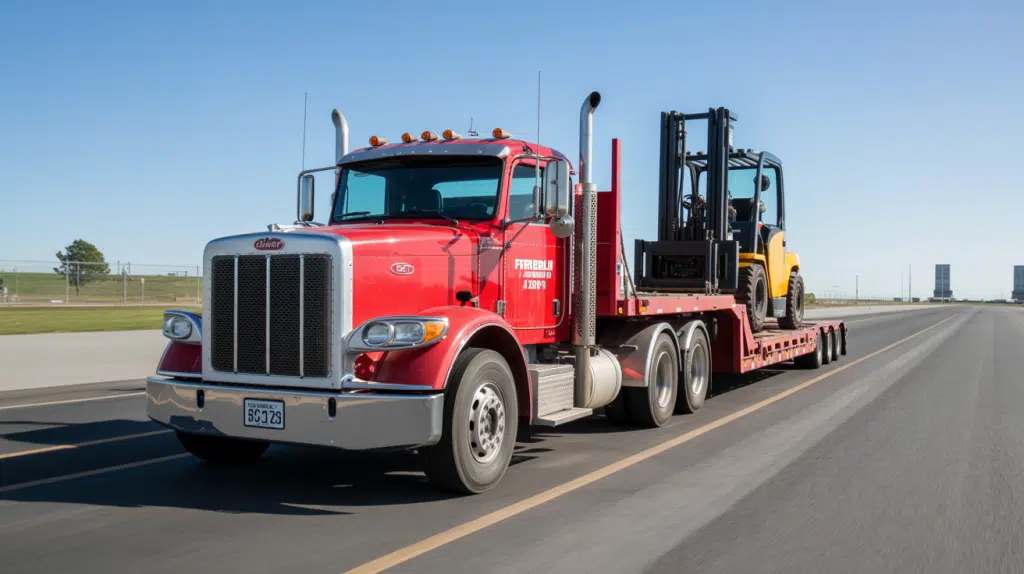
That is why loading should account for:
- whether the tire type suits the loading surface
- whether the machine can climb the ramps safely
- whether weather or mud around the loading area changes traction
- whether the forklift should be driven on or lifted onto the trailer
A forklift may be built to move pallets all day, but that does not mean it is naturally suited to every loading condition outside the warehouse.
Counterweight balance matters more than the compact size suggests
Forklifts are built around a weight relationship: the front carries the work, and the rear counterweight keeps the machine stable. That same design affects transport. Once the forklift is on a trailer, the balance between mast, forks, chassis, and rear weight changes how the load should be placed and restrained.
That is why trailer placement should not be guessed. The machine should sit where:
- left-to-right balance stays centered
- axle loads remain reasonable
- securement angles are workable
- the forklift does not ride “heavy” into one part of the trailer setup
In this sense, warehouse equipment is not exempt from the same planning discipline used in preparing wheel loaders for heavy haul transport, where front-end geometry and machine balance shape the transport method.
Attachments can quietly become the main transport issue
A standard fork carriage is one thing. Specialty attachments are another. Clamps, rotators, paper handlers, booms, and side-shift systems can alter width, weight distribution, and securement needs in ways that are easy to overlook.
Before transport, it helps to confirm:
- what attachment is mounted
- whether it should stay mounted or travel separately
- how it changes overall dimensions
- whether it creates extra front-heavy behavior
- whether it needs its own restraint or protection
Sometimes the attachment is the reason the transport plan becomes more complicated than the forklift itself.
Trailer selection should support loading and restraint, not just capacity
Because forklifts are relatively compact, it is tempting to focus only on gross trailer capacity. That is not enough. A better trailer is the one that makes loading smoother, deck placement cleaner, and securement more reliable.
That usually means thinking about:
- ramp angle and deck height
- trailer width relative to the machine stance
- enough room for mast and fork profile
- anchor points that allow proper restraint
A trailer with enough capacity but poor loading geometry can still create avoidable stress and risk.
Securement should restrain the machine without fighting its structure
Forklifts are not shaped like solid industrial blocks. They have masts, carriages, hydraulic elements, and balance points that need to be respected. The securement plan should hold the machine firmly, but it should also avoid creating force in the wrong places.
A safer approach usually includes:
- using approved tie-down points on the machine
- controlling forward, rearward, and side movement
- ensuring the mast and forks are in stable transport position
- checking the machine after the first segment of the trip
This matters because forklifts can appear “small enough to hold easily” while still moving in undesirable ways if the restraint plan is weak.
Site conditions often create the real transport challenge
Unlike some heavy equipment that loads in large open yards, forklifts are often picked up from tight commercial spaces, warehouse lots, loading docks, or mixed indoor-outdoor environments. That means the trailer approach and loading area may be tighter than the machine’s size suggests.
It helps to check:
- approach room for ramps or lifting
- dock or pavement condition
- whether the forklift must travel from indoor floor to outdoor staging
- whether unloading conditions are more restricted than pickup
That is one reason this topic also relates naturally to safe transport planning for compact equipment, where site conditions can matter as much as the machine itself.
What owners and facility teams should confirm before pickup
Forklift transport usually goes better when a few details are clear ahead of time:
- exact machine model and operating weight
- mast height in travel position
- attachment type
- tire configuration
- whether the machine will be driven or lifted onto the trailer
- pickup and delivery access conditions
Those details make the move feel coordinated instead of improvised.
Conclusion
Looking for reliable heavy equipment transport? Freedom Heavy Haul offers competitive rates and professional service for machinery shipping across the entire United States.
Transporting forklifts and warehouse equipment by trailer requires more planning than their compact size suggests. Mast height, fork position, attachment choice, tire type, counterweight balance, trailer geometry, and securement all shape whether the move stays smooth and controlled. These machines are designed for indoor precision, not road travel, so the safest transport method is the one that adapts them carefully to highway conditions. When that happens, the equipment arrives ready to work instead of arriving with avoidable stress, delay, or damage.